Narrative Bias
So, Snape is better than most – if not all – Hogwarts teachers, some of his infamous interactions with students were not the cataclysmic tragedies that haters said they were, his actions are in line with the cultural context, oftentimes stem not from malice but from misunderstandings and poor educational heritage that he nonetheless managed to surpass… But, still, he’s a huge bully of a teacher, right? He’s incredibly nasty and horrible to have in general?
Well, about that…
Snape is a very effective teacher and the students don’t all hate him
1. Most people succeed under Potions and his classes are advanced
In Y2, Snape teaches students about Polyjuice Potion, which exceeds the curriculum requirements. Umbridge’s objective is to discredit Dumbledore’s hires, but even she recognizes that his class is advanced. Snape constantly explains to the students what they did wrong, even if Harry calls this bullying. His exam pass rate is high: The Trio earns two Es and one O even though Harry and Ron don’t care about the subject. Snape is an effective, albeit very imperfect, teacher: Harry, Ron, and Hermione all earn the same grade in Potions as they do in Charms and Transfiguration; Neville can be deduced to have passed his Potions and his Transfiguration OWLs with an A. Draco is surprised that Harry needs remedial Potion classes, indicating that students rarely need them to pass their final exams. Snape’s the teacher that if you manage to get an A or an E with him, you will breeze over your exams; as a reminder, only the final exams count, not the marks given during the year.
Snape only admits O students into his NEWT potions class, whereas Minerva is “very pleased” with Harry’s E. This is not as restrictive as it sounds:
This is the composition of Harry’s 6th year Potions class:
The four Slytherins took a table together, as did the four Ravenclaws. This left Harry, Ron, and Hermione to share a table with Ernie.
Everyone but Harry and Ron had earned Os, because they all had the textbook already. That’s at least 10 out of 28* students in Harry’s year who got the highest grade.
*There is some debate about the size of Harry’s year. I’m only counting students who have names.
25 out of 25 eligible students take DADA with Snape in their 6th year:
”Before we start, I want your dementor essays,” said Snape, waving his wand carelessly, so that twenty-five scrolls of parchment soared into the air and landed in a neat pile on his desk.
The missing ones are Crabbe and Goyle, who failed their OWLs, and Abbott, who left.
Neville definitely took DADA with Snape:
Typically, ten minutes into the lesson Hermione managed to repel Neville’s muttered JellyLegs Jinx, a feat that would surely have earned her twenty points for Gryffindor from any reasonable teacher.
Harry whines, but note that Snape doesn’t take points from Neville for muttering, either.
That’s how less biased students like Ernie talk about Snape:
“[I] didn’t get a chance to speak in Defense Against The Dark Arts this morning. Good lesson, I thought.”
Snape when Harry is not in the picture:
‘I’m sorry, Harry!’ [Hermione] wailed. ‘Snape came out and asked me what I was doing, so I said I was waiting for Flitwick, and Snape went to get him, and I’ve only just got away. I don’t know where Snape went.’
Wouldn’t you know? That’s Snape behaving like a normal teacher.
2. The Advanced Potion-Making book misconception
Many fans still argue that Snape is a shit teacher for making his students buy Advanced Potions-Making, a very old Potions book filled to the brim with outdated potion recipes, which Snape knew because he was the very student who corrected it entirely under his Half-Blood Prince signature. There’s a problem: while Slughorn made his students buy this book when he was in office (from Snape’s generation to Harry’s, at the very least), Snape didn’t make his students buy this book. At least, not that we know of.
The book that Snape does ask students to buy is cited in PS:
Magical Drafts and Potions by Arsenius Jigger
Later in PS, Harry suggests that Snape basically expected him to learn the book One Thousand Magical Herbs and Fungi by Phyllida Spore:
He had looked through his books at the Dursleys’, but did Snape expect him to remember everything in One Thousand Magical Herbs and Fungi?
But that’s the Herbology book.
Furthermore, as we mentioned earlier when discussing the Trevor drama, Snape writes the instructions on the blackboard and orally specifies them:
- “The ingredients and method” — Snape flicked his wand — “are on the blackboard” — (they appeared there) — “you will find everything you need” — he flicked his wand again — “in the store cupboard” — (the door of the said cupboard sprang open) — “you have an hour and a half… Start.” [OotP]
- Determined not to give Snape an excuse to fail him this lesson, Harry read and reread every line of the instructions on the blackboard at least three times before acting on them. [OotP]
- “Didn’t you hear me say, quite clearly, that only one rat spleen was needed? Didn’t I state plainly that a dash of leech juice would suffice?”
The recipes had to be better or even personally improved because Hermione and Draco always managed to succeed in Potions under Snape, being respectively the first and second best of the class, whereas they utterly failed under Slughorn and his textbook – as does the rest of the class, of course, during their entire NEWT year.
We never actually see Snape having the students use the Potions textbook he asks them to buy, though we could suspect that they use it at least when it comes to completing Potions homework during the summer. Snape does use the Defense textbooks:
- They sat and made notes on werewolves from the textbook, while Snape prowled up and down the rows of desks, examining the work they had been doing with Professor Lupin.
- “Now open your books to page two hundred and thirteen,” said Snape, smirking a little, “and read the first two paragraphs on the Cruciatus Curse.”
But unlike Slughorn, he doesn’t leave his students to work out their lesson on their own by letting a shitty textbook do the teacher’s job:
“I have not asked you to take out your books,” said Snape, closing the door and moving to face the class from behind his desk; Hermione hastily dropped her copy of Confronting the Faceless back into her bag and stowed it under her chair. “I wish to speak to you, and I want your fullest attention.” [After which he has them practise nonverbal spell]
3. He’s an excellent Defence teacher
Snape’s Defense classes are very interesting and instructive. Resembling Harry’s pseudo-Defense lessons; he makes the students practice, in contrast with Umbridge’s classes of the previous year, just like he held a Dueling Club in Harry’s 2nd year; from which Harry learned his signature spell Expelliarmus. His introductions of the subjects he will teach are passionate and induce the desire to prove you’re capable (Hermione definitely answers to it). If a curse hadn’t been placed on the Defense post and Snape had been allowed to be the Defense Against the Dark Arts teacher during the entire HP series, Harry’s generation would have wrecked Voldy’s ass. Now, let’s summarise what he tackles or touches on the few times he’s allowed to teach Defense:
- In CoS, during the Defense Club: Expelliarmus and Serpentsortia, probably tried to teach Protego as well
- In PoA, while replacing Lupin: Werewolves, lightly touching on Kappas
- In OotP: Occlumency, lightly touching on the Imperius
- In HBP:
- Nonverbal spells
- The Cruciatus Curse
- Dementors and alternative ways to protect oneself against them
- Inferi
- Ghosts
- Resisting the Imperius
Notice how Snape took care to enable the students to defend themselves against the Dementors regardless of their ability to perform a high-level spell like the Patronus that only an elite are able to master – a smart compromise that empowers everybody for the upcoming year(s).
By contrast, Lupin never taught the students some basics on Dementors despite them running down the corridors and making people faint left and right. He gave private lessons to his favorite student Harry only, and you’d think that the Defense Against the Dark Arts wunderkid with an wand-determined affinity to master spiritually-fueled spells, a Virgin Mary-like mother-inherited anti-Dark Arts “blood with pearls of goodness”, an anti-Voldy sacrificial protection spell and a literal, prophecy-backed up edge against the Dark Lord, would make The Chosen One add the Patronus to his arsenal relatively easily under Lupin, except that Lupin actually failed. The lessons failed because the spell was too complicated and his schedule too brutal (immediately making Harry confront a pseudo-Dementor rather than take the time to strengthen his Patronus). Harry mastered the spell… through timeloop shenanigans that broke not only the laws of time and Time Turner use but also the laws of plot consistency and logic: he learned to perform a Patronus because he literally saw his future self successfully perform it to protect his relatively past self, and his future self was able to do it because he was saved by his own future self… Yeah…… So if not for author preference and plot obligations, Harry would never have mastered the Patronus and would have been Kissed to death at 13.
Now you could argue that Snape failed to teach him Occlumency and that could have ended really badly as well, except that while Lupin was teaching a student who liked him, who was begging for the lessons and whose magic style and mindset predispose him to perform the Patronus, Snape was attempting to teach a 15 yo teen boy who hated him, didn’t follow, his instructions, didn’t do his homework, refused to learn out of fear that it was making his mind vulnerable to Voldemort, refused to close mind to Voldemort so he may save lives, and whose loud, overt, prideful, true-to-themselves, heart-on-sleeve mindset is the direct opposite of the one required to Occlude, one that needs a quiet, secretive, defense-oriented subject that can manipulate their own mind to fool others.
About Snape’s comment on Kappas in PoA:
‘Very poorly explained… that is incorrect, the Kappa is more commonly found in Mongolia… Professor Lupin gave this eight out of ten? I wouldn’t have given it three…’
The side-book Fantastic Beasts and Where to Find Them suggests that Snape was wrong:
KAPPA
M.O.M. Classification: XXXX Snape hasn’t read this either
The Kappa is a Japanese water demon that inhabits shallow ponds and rivers.
Some say that Snape was indeed wrong. On my hand, I’m not sure. Just because the Kappa is a Japanese water demon doesn’t mean it mostly inhabits Japan. If they were said to be Japanese water demons just because they were first discovered there, or if they were so hunted in Japan that its population there shrinked, then it would be logical to believe that the Kappa is most commonly found in other places such as Mongolia.
4. Anecdotical nice teaching methods
If Snape’s classes are so successful and advanced, then Snape’s methods seem to work well, for all their flaws. I already provided you with the core points on his management of the Occlumency Lessons; there’s more.
When Harry fails a potion, Snape asks him to review the instructions to see what he did wrong, then assigns homework to remediate it.
“No marks again, then, Potter,” said Snape maliciously, emptying Harry’s cauldron with a wave of his wand. “You will write me an essay on the correct
composition of this potion, indicating how and why you went wrong, to be handed in next lesson, do you understand?”
That’s is a superb method to improve from one’s mistakes.
Next, Harry fails his moonstone essay and the two that follow because he is often distracted and delays his homework. It takes dozens of pages before we read that he finally completed an essay.
In OotP, Snape hints that he will give detentions to those who got D’s again at their Potions essays:
I expect to see a great deal more effort for this week’s essay on the various varieties of venom antidotes, or I shall have to start handing out detentions to those dunces who get D’s.
Harry expects that Snape will give those detentions:
He knew he had done a poor job, but there was no help for it; unless he had something to give in he would be in detention with Snape next.
And when he receives his result for the essays:
The week did not improve as it progressed: Harry received two more D’s in Potions, was still on tenterhooks that Hagrid might get the sack, and could not stop himself from dwelling on the dream in which he had seen Voldemort, though he did not bring it up with Ron and Hermione again because he did not want another telling-off from Hermione.
…no mention at all that Snape gave him detention–or rather, that he did not give him detention, or anyone else for that matter. It takes a careful reading to see that often, Snape is all bark and no bite.
5. No yelling
I’ve seen antis portray Snape as a hysterical teacher who constantly screams and shouts at students, which is exactly what Professor Snape doesn’t. McGonagall is the kind to yell at students when they fail or misbehave:
- Professor McGonagall, in a tartan dressing-gown and a hairnet, had Malfoy by the ear.
‘Detention!’ she shouted. ‘And twenty points from Slytherin!
- ‘I’m disgusted,’ said Professor McGonagall. ‘Four students out of bed in one night! I’ve never heard of such a thing before!
- Professor McGonagall was shouting at someone who, by the sound of it, had turned his friend into a badger.
- “Provoked you?” shouted Professor McGonagall, slamming a fist onto her desk so that her tartan biscuit tin slid sideways off it and burst open, littering the floor with Ginger Newts. […] “But instead of leaving it to Madam Hooch to sort out, you two decided to give an exhibition of Muggle dueling, did you?” bellowed Professor McGonagall. […] “Not another one!” exclaimed Professor McGonagall violently.
Snape has the ability to keep a class quiet by his mere presence, he doesn’t need to raise his voice to make himself clear, and when confronted with a loud opponent, his voice becomes even quieter:
“I’m his godfather,” said Sirius, louder than ever.
“I am here on Dumbledore’s orders,” said Snape, whose voice, by contrast, was becoming more and more quietly waspish, “but by all means stay, Black, I know you like to feel… involved.”
It happens that Snape shouts, but never during class, never because a student failed or broke rules. Unless you count that time in CoS where Harry threw a firework in Potions class, resulting in everyone panicking and Snape having to raise his voice to maintain order, or that other time in CoS when Snape shouted a powerful Finite Incantatem because Lockhart couldn’t stop the students harming each other during the Dueling Club; but Snape is not shouting at students for their failure or anything there, he’s doing damage-control.
The few times Snape was actually driven over the edge are:
- when he realised that Sirius Black had escaped (because he believed Sirius Black was Lily’s murderer),
- when Snape witnessed Cedric’s death through Harry’s memories,
- when Harry forced through Snape’s childhood memories (with a mention of a girl laughing who was probably Lily),
- when Harry was caught witnessing Snape’s Worst Memory,
- when Harry attempted Levicorpus of all spells on Snape after he finished Dumbledore off,
- when Harry told him « Kill me just like you killed him [Dumbledore… or James?] you coward »,
- and when Snape is having a total mental breakdown in Dumbledore’s office after Lily’s death.
Notice that all instances involve personal trauma. Neville melting cauldron after cauldron did not involve personal trauma… not much anyway. [Why are we still here… just to suffer…]
Sanctioning students
1. Snape lets the students get away with a lot: he’s surprisingly patient and lenient for a teacher you musn’t cross
The books are keen to gloss over the fact that Snape lets students get away with a lot, including Gryffindors. Here’s a quick list:
- Hermione sets him on fire; if Quirrell knew about it, then Snape probably knew as well and did nothing
- As we saw, George aims a bludger at him when he refs a match, which should warrant a disciplinary hearing and/or expulsion in a normal school, or even a report to the police; Snape’s punishment is a penalty
- Ron loudly threatens to attack Draco for calling Granger a Mudblood and being sad she didn’t die in CoS, but Snape doesn’t punish Ron, hinting at his true allegiance. (In contrast, when Ron threatened to harm Draco the preceding year, Snape immediately intervened and removed 5 points.)
- Hermione steals Polyjuice ingredients while Snape is dealing with a seemingly random, unprovoked attack that harms multiple Slytherins in the middle of a Potions lesson. Harry knows Snape knows it was him, and Hermione turns up furry. In GoF, Snape can get in Harry’s mind the confirmation that Hermione stole boomslang skin from his private stores to brew Polyjuice Potion for the three of them. In OotP, Snape’s secret ability to know the truth by reading people’s minds was not secret to Harry and his friends anymore. But they will never get punished for what they did. One of Snape’s core flaws is supposed to be holding grudges, did you know?
- Snape defends the Trio when they are accused of Petrifying Mrs Norris; when asking why they were wandering the corridors instead of rejoining the Halloween Feast, the Trio evidently lies to his face; for wandering out in the corridors alone and lying to their teacher, Snape wants to punish them by removing Harry from the Quidditch team, but doesn’t protest when McGonagall refuses that kind of punishment (since she cannot afford to lose the Cup). In the end, they get away with it
- Harry shouted at Snape to “SHUT UP ABOUT MY DAD” twice, and he didn’t even lose points.
- Harry shouted at Snape “YOU’RE PATHETIC”, followed by the Trio knocking their teacher out; Snape covered them for it in front of Fudge and never tried to punish them later on.
- Snape likely got the confirmation directly from Harry’s head that he had indeed stolen his potion ingredients twice (once with Hermione, once with Dobby, who Snape may or may not know personally), and that Harry was indeed out of bed the other night and was lying to his teacher’s face about it, but other than threatening that he might use Veritaserum if Harry fucks around with him again, Snape does nothing.
- In OotP, Snape says that he might have to start handing out detentions to whoever got a D at his subject; Harry gets two more D’s but no detention (neither does Neville, who probably still sucks horribly at Potions).
- Harry was not punished for not doing his Occlumency homework or viewing Snape’s Worst Memory
- Of course, the peak of Snape’s surprising patience is displayed in HBP:
You don’t have to call me sir, professor
Whitehound, in her essay:
Snape is remarkably lenient over that « You don’t have to call me ‘sir’ » stunt. If someone tried that on McGonagall they’d probably get a lot worse than one detention. Either Snape is really quite soft, or he’s being lenient because of Harry’s recent bereavement [on Sirius], or he’s privately thinking « Nice line – wish I’d thought of it » [or “Alright I should have seen this coming”].
- Snape is surprisingly patient to a student who basically tells him he can die for all he cares and walks out before Snape finishes to speak:
“Listen to me,” said Snape, his voice so low now that Harry had to push his ear very hard against the keyhole to hear. “I am trying to help you. I swore to your mother I would protect you. I made the Unbreakable Vow, Draco — ”
“Looks like you’ll have to break it, then, because I don’t need your protection!
[…] There was another pause, then Snape said coldly, “You are speaking like a child. I quite understand that your fathers capture and imprisonment has upset you, but — ”
Harry had barely a second’s warning; he heard Malfoy’s footsteps on the other side of the door and flung himself out of the way just as it burst open. Malfoy was striding away down the corridor, past the open door of Slughorns office, around the distant corner, and out of sight.
Hardly daring to breathe, Harry remained crouched down as Snape emerged slowly from the classroom. His expression unfathomable, he returned to the party.
- In HBP, Snape deducts 50 points from Harry for arriving late and 20 for not wearing proper school attire, taunting him with: “You know, I don’t believe any House has ever been in negative figures this early in the term: We haven’t even started pudding. You might have set a record, Potter.” Except that we learned last year that it was impossible for House points to get into the negative, so Snape is giving an empty punishment. This is further confirmed by the fact that no one in the school ever gets mad that Gryffindor starts with -70 points, when we know from PS that Harry’s peers can bully him if he loses too many points at once. No one ever makes a remark about it simply because it did not happen. It was all a bluff. A brilliant Slytherin spy at work.
About that last point, let me develop what we learned in fifth year. It’ll be explicit enough.
“Put that wand away at once,” he said curtly. “Ten points from Gryff —”
Snape looked toward the giant hourglasses on the walls and gave a sneering smile.
“Ah. I see there are no longer any points left in the Gryffindor hourglass to take away. In that case, Potter, we will simply have to —”
“Add some more?”
You cannot take away points from a House if there are no points to take away. You must add some first, which defeats the purpose of the punishment. Which is why Snape was considering another kind of punishment. It is no wonder that Snape doesn’t believe “any House has ever been in negative figures”, early in the term or not: that’s not how the hourglasses work. If Harry had been smarter, he would have to conclude either that Snape is an idiot or that his teacher is fake-reprimanding him.
That Snape’s punishment was all a bluff is in-character too. The most he ever removed from Gryffindor at once was 50 points, when Ron and Harry just had a fight with Draco and Goyle, then proceeded to insult him profusely (so that’s 25 points each for two offenders who each committed two crimes). Otherwise, Snape sticks to removing 5 or 10 points at a time. Even in the first Potions class, where he was undoubtedly being unfair against Harry, the total sum of points he removed is… 2 points. He sure is no McGonagall.
Snape loved taking points from Harry, and had certainly never missed an opportunity to give him punishments, or even to suggest that he should be suspended from the school.
I call bullshit.
2. His detentions are safe, fair and useful
I went and listed all the detentions that Snape serves in the saga. Surprisingly, I found that even though the Trio fears Snape will give them detention since the beginning, the very first appears in book three, because Ron exploded against Snape:
‘You asked us a question and she knows the answer! Why ask if you don’t want to be told?’ The class knew instantly he’d gone too far. Snape advanced on Ron slowly, and the room held its breath. ‘Detention, Weasley,’ Snape said silkily, his face very close to Ron’s. ‘And if I ever hear you criticise the way I teach a class again, you will be very sorry indeed.’
The punishment? Scrubbing out the bedpans in the hospital wing without magic. Poor dear! And for that, not only Ron calls Snape something that had to be censored in the book, but he says:
‘Why couldn’t Black have hidden in Snape’s office, eh? He could have finished him off for us!
What the fuck Ron. He makes you clean some beds in the infirmary without magic and that’s enough to wish him gored by Sirius Black?
His next detention is served to Neville for melting his sixth cauldron in class in fourth year. He’s tasked with disemboweling horned toads.
The next two days passed without great incident, unless you counted Neville melting his sixth cauldron in Potions. Professor Snape, who seemed to have attained new levels of vindictiveness over the summer, gave Neville detention, and Neville returned from it in a state of nervous collapse, having been made to disembowel a barrel full of horned toads.
Harry and Ron recognize this is unusual for Snape. We know why: because of Moody and the Dark Mark.
Third detention is given to both Harry and Ron later that year, for yelling insults at Snape so loudly their words couldn’t be made out. They’re tasked with pickling rat brains.
- It was lucky, perhaps, that both Harry and Ron started shouting at Snape at the same time; lucky their voices echoed so much in the stone corridor, for in the confused din, it was impossible for him to hear exactly what they were calling him. He got the gist, however.
“Let’s see,” he said, in his silkiest voice. “Fifty points from Gryffindor and a detention each for Potter and Weasley. Now get inside, or it’ll be a week’s worth of detentions.”
- Harry had half hoped they would make things up during the two hours they were forced to pickle rats’ brains in Snape’s dungeon
Snape threatens to hand out detentions for those who score a D (or lower) for their homework. It never happens.
Snape reached the front of the class and turned to face them. “The general standard of this homework was abysmal. Most of you would have failed had this been your examination. I expect to see a great deal more effort for this week’s essay on the various varieties of venom antidotes, or I shall have to start handing out detentions to those dunces who get D’s.”
He threatens Harry with detention if he doesn’t stop choking Neville.
Fighting, Potter, Weasley, Longbottom?” Snape said in his cold, sneering voice. “Ten points from Gryffindor. Release Longbottom, Potter, or it will be detention. Inside, all of you.”
Next detention happens in sixth year, because Harry played cheeky with his teacher. He’s tasked with sorting out rotten flobberworms from good ones to use in Potions, which is safe enough not to need protective gloves.
- “There’s no need to call me ‘sir,’ Professor.” The words had escaped him before he knew what he was saying. Several people gasped, including Hermione. Behind Snape, however, Ron, Dean, and Seamus grinned appreciatively. “Detention, Saturday night, my office,” said Snape. “I do not take cheek from anyone, Potter… not even ‘the Chosen One.’“
- “He says you’re to come to his office at half past eight tonight to do your detention— er— no matter how many party invitations you’ve received. And he wanted you to know you’ll be sorting out rotten flobberworms from good ones, to use in Potions and — and he says there’s no need to bring protective gloves.”
The only time Snape serves a dozen of detentions at once happens that year, every Saturday for the remaining of the term, after Harry nearly murdered Draco with Sectumsempra and lied to keep the book of the Half-Blood Prince, thanks to which he was cheating and gaining unfair praise from Slughorn that surpassed Hermione’s efforts.
“Do you know what I think, Potter?” said Snape, very quietly. “I think that you are a liar and a cheat and that you deserve detention with me every Saturday until the end of term. What do you think, Potter?”
McGonagall remarks how kind Snape has been for this one:
Harry had already been called out of the common room to endure fifteen highly unpleasant minutes in the company of Professor McGonagall, who had told him he was lucky not to have been expelled and that she supported wholeheartedly Snape’s punishment of detention every Saturday until the end of term.
What is he tasked with?
“Mr. Filch has been looking for someone to clear out these old files,” said Snape softly. “They are the records of other Hogwarts wrongdoers and their punishments. Where the ink has grown faint, or the cards have suffered damage from mice, we would like you to copy out the crimes and punishments afresh and, making sure that they are in alphabetical order, replace them in the boxes. You will not use magic.”
While Harry rewrites the detention cards, his mind is elsewhere, thinking of Ginny.
The last punishment that we’re shown Snape giving out, if you count that as a detention, is sending Ginny, Luna and Neville out in the Forest, in their seventh year, to help Hagrid out, after they attempted to steal the Sword of Gryffindor (which Snape later gave to Harry):
“They weren’t thieving,” said Harry. “That sword isn’t Snape’s.”
“It belongs to Professor Snape’s school,” said Phineas Nigellus. “Exactly what claim did the Weasley girl have upon it? She deserved his punishment, as did the idiot Longbottom and the Lovegood oddity!”
[…] How did Snape punish Ginny, Neville, and Luna?” asked Harry urgently.
“Professor Snape sent them into the Forbidden Forest, to do some work for the oaf, Hagrid.”
Again, we’re reminded that Snape is particularly lenient:
“And Snape might’ve thought that was a punishment,” said Harry, “but Ginny, Neville, and Luna probably had a good laugh with Hagrid. The Forbidden Forest… they’ve faced plenty worse than the Forbidden Forest, big deal!”
He felt relieved: he had been imagining horrors, the Cruciatus Curse at the very least.
This, during a year where, as Neville explains:
We’re supposed to practice the Cruciatus Curse on people who’ve earned detentions—”
To summarize:
- Snape served no detention in Harry’s first, second, fifth and seventh year
- He has served 5 detentions over the course of seven years (6 if you count sending the Silver Trio to work with Hagrid rather than making them Crucio students)
- Three of them involved Harry: in his fourth then sixth year
- All his detentions involve safe and harmless community work, half the time in favor of another member of the staff, as in the case of Hagrid, Pomfrey and Filch, the other half to prepare potion ingredients, which… actually sounds fun? MaoMao would be in heaven.
Snape rarely hands out detentions to his students, even Harry, and when he does sanction them, he makes unsubstantial deductions and sets very safe, normal and constructive detentions. You would expect worse from an ex-Death Eater. Never has he asked a student to scrub cauldrons clean by the way.
But you know who serve the most detentions, in particular to Harry? whose names came up the most often as I searched for that word? McGonagall, Umbridge and Filch. McGonagall’s first detention involves the Forbidden Forest, then forcing 11-yo Harry to play Quidditch or else, and later forcing Neville out of the Gryffindor Tower at the risk of his life; Umbridge’s involve the Blood Quill, and Filch’s to clean stuff up, although he drools at the idea of torturing students and gets excited real quick when Umbridge proposes reintroducing the whipping of students as punishment.
But Snape is biased, right?
Not as biased as people think. He has issues with Harry, Neville, and sometimes Hermione, but not other Gryffs in particular, or with students in other Houses. He assigns zero house points, including to Slytherins (though it involves another issue, one that seems to have something to do with Snape’s negative upbringing). His deductions are rarely substantial. He does not bend the rules to get a 1st year student on the Quidditch team, he does not buy the seeker a top-model broom to set him apart from his opponents, and he does not give 170 last minute points to his House (PS), let alone 400 (CoS).
1. Points
So you know that Pottermore chart?
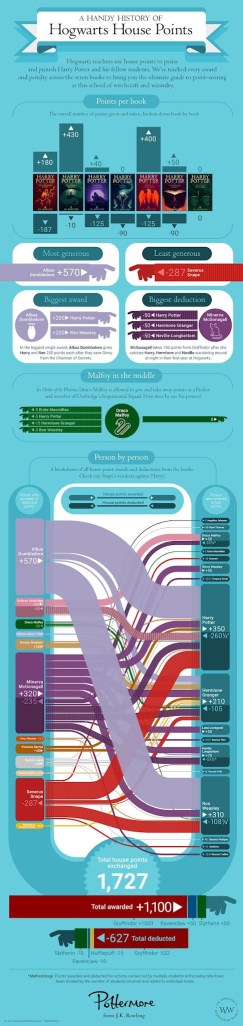
(PS: only 5 points were retrieved in CoS (by Percy), not ten: Harry merely thinks that losing 5 points was worth being one-up on Malfoy.)
The figures are wrong.
Here’s a spreadsheet detailing all the sanctions that Snape serves, with their motives.
Professor Snape:
| WHEN | WHO | WHY | WHAT |
1st year | Harry | Cheek | 1 point |
| Harry | Non-assistance to peer | 1 point | |
| Harry/Ron/Hermione | Taking a library book outside the castle | 5 points | |
| Ron | Assaulting a peer | 5 points | |
3rd year | Hermione | Disobeying | 5 points |
| Harry | Late at class | 10 points | |
| Harry | Not sitting down when told to several times | 5 points | |
| Hermione | Talking out of turn twice (in fact three times) | 5 points | |
| Ron | Flinging a large crocodile heart at a peer | 50 points | |
4th year | Harry + Ron | Loudly cursing a teacher | 50 points (25 each) |
| Fawcett (Ravenclaw) | Doing ( ͡° ͜ʖ ͡°) stuff in the bushes | 10 points | |
| Stebbins (Hufflepuff) | Doing ( ͡° ͜ʖ ͡°) stuff in the bushes | 10 points | |
| Hermione | Talking at class | 10 points | |
| Harry | Reading magazines under the table at class | 10 points | |
| 5th year | Harry + Ron (+ Neville) | Fighting (two on one) | 10 points |
6th year | Negative House points are impossible (cf OotP) + no one makes a remark on Gryffindor starting with -70 points: it never happened | ||
| Harry | Late at class again | 10 points | |
| Ron | Mocking Snape at class | 10 points | |
| TOTAL | 207 points |
Though we don’t know how many points were taken in their case, we do know that…
‘Cheer up,’ said Ron. ‘Snape’s always taking points off Fred and George.
We also know they’re reputed for breaking rules, purposefully flirting with expulsion, and engaging in general mischief – legitimately earning those retrievals of points.
The Pottermore chart says that Snape removed a total of 287 points, but if we take away the fake 70 points retrieval from 6th year, we’re left with 217 rather than 207 and honestly I don’t know where that extra 10 comes from. Either I missed them or the Pottermore crew added 10 points for the pleasure of it. Not that it would change our conclusion much. I checked and confirmed that McGonagall retrieved 235 points in total. That makes her the most punishing of teachers, not Snape, and notably in terms of the amount of points removed at once. Snape is still the least generous teacher – but not because he removed the most points, simply because he never gives any, not even to his Slytherins.
Professor McGonagall:
| WHEN | WHO | WHY | WHAT |
| 1st year | Hermione | Trying to fight against a troll on her own | 5 points |
| 1st year | Draco | Out of bed at night | 20 points |
| 1st year | Harry + Hermione + Neville | Out of bed at night and protesting | 150 points (50 each) |
| 3rd year | Malfoy + Crabbe + Goyle + Flint | Impersonating Dementors to destabilize the Gryffindor Seeker during a match | 50 points |
| 5th year | Angelina | Making a racket in the Great Hall | 5 points |
| 5th year | Harry | Getting a detention from Umbridge | 5 points |
Now you might think that, contrary to Snape, McGonagall balances out her punishments as she gives 320 points (mostly to her Gryffindors, never to Slytherins), but I haven’t told you yet:
The House Cup is largely won on the Quidditch field, not so much on doing well in class.
By making Harry the Seeker and giving him a top-model broom that surpasses all the others, McGonagall has ensured the way to win the House Cup, indirectly buying it. It ensures gaining 450 points a year consistently (150 points per Snitch for 3 matches). She did not wait for Harry to be in second year, she did not even allow him to refuse, she always tried to prevent Harry from losing his opportunity to play Quidditch, she absolutely needed that House Cup!
I’ll also have you note that in CoS, she does not remove points from Ron and Harry for nearly breaking the Statute of Secrecy, missing the Hogwarts Express, missing the Sorting Feast and damaging the Whomping Willow, on the excuse that term hadn’t yet started when they broke those rules. But then, in OotP, McGonagall awards 250 points to Gryffindor for exposing Voldemort and the Death Eaters to the grand public back there at the Ministry, which was definitely not school-related. McGonagall doesn’t just bend rules, she creates new ones depending on what is advantageous to her House.
2. Grades
Taken from pet_genius’ essay:
Unlike points, grades actually matter, and Snape grades fairly.
According to Lucius in COS, Hermione beat Draco in every test, including potions:
“I would have thought you’d be ashamed that a girl of no wizard family beat you in every exam,” snapped Mr. Malfoy.
Harry expects Snape to grade him fairly, when he tries:
Determined not to give Snape an excuse to fail him this lesson, Harry read and reread every line of instructions on the blackboard at least three times before acting on them.
Harry does fail. This is the Strengthening Solution they work on over two lessons. In the second lesson, Harry isn’t paying attention because he is too busy listening in on Umbridge’s interrogation.
Except the bit where Harry’s vial breaks (where Harry felt like he’d earned an E and wanted to force Snape to mark a new vial of the same potion, which he couldn’t do because Hermione vanished the contents of his cauldron), there is evidence that he grades fairly.
Snape appears unfair in the sense that when Harry does poorly, he receives poorer grades than he deserves (in Harry’s opinion), but when Harry does well, he expects to be graded fairly (OOTP29). Specifically, Harry complains that Snape grades only him unfairly, and not Ron or Neville, meaning that the issue is with Harry and not with all Gryffindors (OOTP12+15).
Additionally: The grading system in the UK is not the same as in, say, the US, where every mark during the year counts. In Hogwarts, only the final exams (OWLs and NEWTs) count:
“Of course, a lot can happen between now and the exam, we’ve got plenty of time to improve, but the grades we’re getting now are a sort of baseline, aren’t they? Something we can build on…”
So those reported 4 times Snape gave Harry zeros? They did not prevent Harry from attending Potions the next year, and they didn’t count in the final gradings.
3. Slytherin House
So… The situation with Slytherin House is complicated. Let’s start with pet_genius’ analysis (which I edited a little):
Snape’s bias shows only in that he does not punish his own students for their wrongdoings on-page. However, Slytherins wait until Snape’s back is turned to misbehave, and that includes Draco, Snape’s favourite:
- In the ISND incident, Pansy and her friends giggle behind Snape’s back
- Draco flashes his Potter Stinks badges when Snape’s attention is directed elsewhere
- Draco taunts Harry with his “remedial potions?!” jeer when Snape isn’t looking
- Right before the toad incident, Draco was pretending to be badly hurt, and pointed out to Snape that Ron (who was sitting next to him and whom Snape had asked to help Draco) wasn’t helping him properly. Draco lowers his voice to admit he pretends to be hurt partly because it means Snape will have someone help him.
They routinely bother to hide their nastiness, because they expect some sort of sanction.
McGonagall sends Slytherin transgressors to Snape for punishment, meaning she expects him to handle them, like in the case of Draco in PS then GoF via Mad-Eye Moody:
‘What utter rubbish! How dare you tell such lies! Come on – I shall see Professor Snape about you, Malfoy!’
Either she’s supremely stupid, or years working alongside the young teacher taught her that he could be trusted to regulate his House.
Snape assigns Crabbe and Goyle detentions to make sure they “pass their DADA OWLs”. Although this is also secretly done to thwart Draco’s attempts to kill Dumbledore, nobody is surprised at this.
Another thing to discuss is the misconception that Snape is biased against Gryffindor House as a whole. It turns out that in the books he never makes a disparaging comment against Gryffindors. In the movies, I think the total of his despise against the lions consists off a single thrown-off comment.
He does loathe Harry, but Harry is not 90% of the school nor the sole representative of Gryffindor House. He seems to despise Ron and Hermione as well, but he does not hesitate to call them Harry’s « more talented friends » in HBP, and as we see, he can be pretty lenient towards Hermione, not punishing her for standing up in class to answer, waiting three interruptions before actually sanctioning her.
He has fought his way out of a number of tight corners by a simple combination of sheer luck and more talented friends.
We’re led to believe that Snape favors any other House but Gryffindor when he referees a Quidditch match in PS. As Wood says:
Snape’s refereeing this time, and he’ll be looking for any excuse to knock points off Gryffindor!’
George says that Snape won’t be fair if Gryffindor might overtake Slytherin:
George Weasley really did fall off his broom at these words.
‘Snape’s refereeing?’ he spluttered through a mouthful of mud. ‘When’s he ever refereed a Quidditch match? He’s not going to be fair if we might overtake Slytherin.’
only to try and hit his teacher during the match against Hufflepuff:
Snape had just awarded Hufflepuff a penalty because George Weasley had hit a Bludger at him.
I mean, fair enough George. That shouldn’t have warranted a penalty but a ban from Quidditch and probably expulsion from the school.
And then, you have to take into account that, for all evil Slytherins can be, they are the outcasts of the school, the systematic scapegoats, which puts them in a position of vulnerability. They’re hated by their peers and constantly assumed to be the culprits of whatever wrong happens in Hogwarts, like that time Gryffindors accused them of cursing the Bludger to chase Harry in CoS; they’re the subject of a damaging rivalry in which the teachers are involved; several times, they are clearly made the enemy.
Dumbledore cheats the system by awarding an insane amount of points to Gryffindors for breaking the rules, and everyone rejoices, including the other Houses!
McGonagall bends the rules to allow Harry to play Quidditch with the best broom of the time, leading the Slytherins to rely on the Malfoys to compensate this injustice by buying better brooms the next year to rebalance the odds.
For the Battle of Hogwarts, she will have them all sent away, because a single student. They’re all made the enemy:
Then a figure rose from the Slytherin table and he recognized Pansy Parkinson as she raised a shaking arm and screamed, “But he’s there! Potter’s there! Someone grab him!”
Before Harry could speak, there was a massive movement. The Gryffindors in front of him had risen and stood facing, not Harry, but the Slytherins. Then the Hufflepuffs stood, and almost at the same moment, the Ravenclaws, all of them, with their backs to Harry, all of them looking toward Pansy instead, and Harry, awe struck and overwhelmed, saw wands emerging everywhere, pulled from beneath cloaks and under sleeves.
“Thank you, Miss Parkinson,” said Professor McGonagall in a clipped voice. “You will leave the Hall first with Mr. Filch. If the rest of your House could follow.”
That’s not accounting the abuse that Hagrid makes Draco a victim of: sending him away twice with a cowardly dog for protection in the Forbidden Forest for no reason (except having him meet the thing that kills unicorns), or humiliating him in class about that traumatic beat-up that Moody gave him:
“Yeh’ll do wha’ yer told,” he growled, “or I’ll be takin’ a leaf outta Professor Moody’s book… I hear yeh made a good ferret, Malfoy.”
The Gryffindors roared with laughter. Malfoy flushed with anger, but apparently the memory of Moody’s punishment was still sufficiently painful to stop him from retorting.
If the story was told by Draco, Snape would be the equivalent of Harry’s McGonagall (though a safer, more devoted one) and Hagrid would be the equivalent of Harry’s Snape.
Snape is their Head of House, tasked with protecting them, standing up for them – against Hogwarts, but also against Voldemort who would gladly use their vulnerability to gain more followers. Snape has personal experience with anti-Slytherin prejudice after all:
“Who wants to be in Slytherin? I think I’d leave, wouldn’t you?” James asked the boy lounging on the seats opposite him, and with a jolt, Harry realized that it was Sirius. Sirius did not smile. “My whole family have been in Slytherin,” he said. “Blimey,” said James, “and I thought you seemed all right!” Sirius grinned.
And:
“You are determined to hate him, Harry,” said Lupin with a faint smile. “And I understand; with James as your father, with Sirius as your godfather, you have inherited an old prejudice.
Was Lupin talking about anti-Slytherin prejudice? Something that Lily herself seems to have tolerated?
To know what happens when Snape starts to lose control over his House because another teacher interferes, have a look at Umbridge’s influence of Slytherin House, particularly with the creation of the Inquisitorial Squad. Snape is evidently not pleased with Umbridge’s hold on his own students:
“You are on probation!” shrieked Professor Umbridge, and Snape looked back at her, his eyebrows slightly raised. “You are being deliberately unhelpful! I expected better, Lucius Malfoy always speaks most highly of you! Now get out of my office!”
Snape gave her an ironic bow and turned to leave. […]
“Potter, when I want nonsense shouted at me I shall give you a Babbling Beverage. And Crabbe, loosen your hold a little, if Longbottom suffocates it will mean a lot of tedious paperwork, and I am afraid I shall have to mention it on your reference if ever you apply for a job.”
The results of Snape’s management of the Slytherins pay off: only three students as we know became Death Eaters under Snape’s tenure, and that is Draco – directly involved in Voldemort’s inner circle through his parents and visibly unwilling to be a Death Eater after all – as well as Crabbe and Goyle, his cronies, who were mostly harmless. Compare that with Slughorn’s tenure, under which whole generations of students became Death Eaters, and from whom emerged the Dark Lord himself. There’s no doubt Snape has been an excellent teacher for them.
Speaking of Draco, Snape seems to favor him in particular, though not Slytherin as a whole. In PS, during the first lesson, Snape congratulates no one but him. Now, you got to wonder: why would Snape seemingly give special treatment to the Slytherin version of James Potter? He’s everything Snape would hate in a student!
You cannot forget that the Malfoys seem to have a special relationship with him. Lucius is the one who patted Snape’s back after his Sorting; Sirius accuses Snape of being Lucius’ lapdog; and according to Umbridge, Lucius speaks highly of Severus in the Ministry – so Snape could be expected to return the favour. There’s tactical advantages in keeping friendly relationships with the Malfoys. It secures his position amongst the Death Eaters and can help him convince Voldemort that he, indeed, never stopped being loyal to him. That’s how he was able to protect Draco and take on the burden of a Death Eater’s dirty role. All this plan nearly failed in HBP because Bellatrix brainwashed her nephew, but Narcissa was right to trust Snape with the life of her son.
Finally, in the books, there is a strong dichotomy between the Slytherins and Gryffindors. All the Slytherins laugh when Snape reads aloud Rita’s article, and apparently, no Gryffindor laughs. On the other hand, Gryffindors draw their breaths then cheer for Neville’s potion, while the Slytherins want him to fail. It is such a childish, caricatural description of the class’ ambiance that I seriously think Harry’s internal point of view is just messing with us. It does not help Harry’s hatred of Draco Malfoy overlaps with his hatred of Snape.
Snape’s definitely an asshole; but he’s rude to everyone, not just his inferiors: Tonks and Sirius, fellow Order members, Bellatrix, a “fellow” Death Eater, and even Dumbledore, his superior in every way. Yes, he should have been gentler with students. He is harsh, unkind, strict, sometimes impatient, overbearing, and in many cases, bullying. Snape’s two biggest victims are Harry, who names a child after him, and Neville, who clearly got over it.
5. Snape has more than enough reasons to hate Harry
- Harry never, ever, thanks Snape for saving him.
- Harry gets hold of the Map and the Cloak to sneak off like his father, which must have been flashback inducing
- Just as Slytherin was cheering for winning the Cup, the Headmaster award Harry and his friends insane amounts of points for breaking rules, allowing them to steal the Cup from Slytherin House (the Trio never accomplished anything significant and risked Voldemort getting hold of the Stone by their intervention: if they hadn’t come in, Quirellmort wouldn’t have been able to get the Stone anyway; imagine Quirellmort wasn’t ahead of them but was following them as they opened the way to the Mirror? given the chess, the flying keys and the potions hadn’t been tampered with, you could have expected that).
What Harry perceives as a wondrous end of year, Snape and his Slytherins perceive it as a humiliating, painful and unfair experience, a nightmare and a direct antagonism from the Headmaster and the other three Houses who cheer at their defeat; how do you think Snape must have felt when he had to face his Slytherins because Dumbledore couldn’t allow Harry to lose the House Cup? Shortly after McGonagall bent the rules so that Harry, a first year, was allowed to compete in Quidditch as a Seeker (admittedly the most important role) AND bought him the best broom of the time to ensure he would win? It’s no wonder Lucius decided to buy all the team Nimbuses 2001 the next year. It’s no wonder that Snape would try to balance out Harry’s favouritism and the ostracization that Slytherins endure.
- The Deputy Head and Headmaster bend rules so that Harry can play Quidditch, and he’s given the best broom of the time to surpass and easily win over his opponents who must navigate with faulty brooms (a Hufflepuff worthy of his House would have refused to use the Nimbus 2000 for fair-play, but Gryffindor’s champion is not noble-hearted, and later has the gall to despise Slytherins for acquiring new top-model brooms of their own as well).
- Harry repeatedly suspects/accuses Snape of trying to kill him time and again, never learning from his mistakes.
- He almost makes Snape fall off his broom by rushing towards him to catch the Snitch
- Throughout the sage, Harry keeps breaking important rules, gets away with it and worse, is rewarded by the Headmaster himself, because he’s special.
- In COS, Harry arrives at school by flying car and damages the Whomping Willow, gets away with it
- In the same year, Harry launches a seemingly random attack on Slytherins to allow Hermione to steal Snape’s potion ingredients
- He wanders through the corridors and lies to Snape’s face about it.
- In PoA, Harry displays recklessness truly worthy of his father, sneaking off to Hogsmeade, throwing snowballs at Malfoy, lying about it, insults and humiliates Snape, puts himself in absurd danger to give an alleged serial killer a chance, calls Snape pathetic for hating Sirius for having tried to murder him as a teen, knocks him unconscious, allows Sirius to escape in impunity; Snape now knows Harry’s got the Invisibility Cloak and a Map to break curfew as he pleases
- He gets Sirius Black freed, repeatedly gaslights Snape and calls him pathetic because what he endured in school still pains him to this day
- In GOF, Harry becomes the center of attention. Snape resents this, as do Ron and Sprout, and the three schools really.
- Twice, the Legilimens is looking into Harry’s eyes, who’s fantasizing about hurting him
- Harry talks with his friends instead of paying attention in class, then reads Rita Skeeter’s article where Harry is treated like a celebrity
- Snape knows that Harry stole his gillyweed thanks to a certain « Dobby »
- In fifth year, Harry beats up Draco with the Twins (even McGonagall was furious)
- He refuses to study Occlumency seriously
- Then he violates Snape’s privacy and endangers him, Snape does not know that Harry regrets the whole thing
- He catches Harry at this:
“What are you doing, Potter?” said Snape coldly as ever, as he strode over to the four of them.
“I’m trying to decide what curse to use on Malfoy, sir,” said Harry fiercely.
Snape stared at him.
This must have been flashback-inducing. What we see as fiercely, Snape sees as vicious.
- In HBP, Harry is late again at the feast; Snape suspects Harry just wanted to get attention). He might have sensed in Harry’s mind that the boy unfairly blamed him for Sirius’ death.
- Harry refuses to answer Snape’s assignment on how to defeat Dementors without a Patronus even though that could help him in the future
- He steals Snape’s invented spells, hexes people at random, including Filch, and worst of all, Snape catches Harry casting Sectumsempra on Draco.
- Harry steals Snape’s hard work/genius to become Slughorn’s favourite in Potions class, refuses to give back Snape’s book, attempts Sectumsempra and worst of all Levicorpus on his teacher then calls him a coward.
Snape might not see Harry for who he is, but even that is not as superficial as it seems, and it’s not entirely the result of his “immaturity”/long-term trauma. He gets legitimate reasons to dislike Harry and his behavior is often warranted.
We could give Harry some credit. I recommend adreamermusing’s essay, Harry identified and (reluctantly) admired Snape even before ‘The Prince’s Tale’, to which I will only add these elements:
- In OotP, as Sirius and Severus were edging closer to a fight, Harry repeatedly urged Sirius to calm down, and when Sirius raised his wand at Snape, Harry jumped in to put physically himself between the two of them; how much was it for Sirius’ safety, and how much was it because Harry could not in fact stand the idea of Sirius assaulting Snape?
- When he learned that Snape told part of the Prophecy to Voldemort, more or less leading Voldemort to target his parents, Harry accepted (albeit reluctantly) Dumbledore’s explanation that Snape didn’t know who would be targeted and that he deeply regretted what he did [see the essay « Self-Fulfilling Prophecy »]
- As Harry calls Snape a coward, Snape asks him back what he would call his father James knowing that he would never attack Snape unless it was four on one. Harry doesn’t dispute the implied fact that James was a coward, not even mentally.
- During the second time he was meant to watch SWM, Harry refers to the teen version of his teacher as “Severus”, like a friend.
- After seeing The Prince’s Tale, Harry immediately put his entire trust and loyalty in Snape, the caster of the Silver Doe
- This culminated in Harry naming his son after Snape, calling the Slytherin Headmaster « one of the bravest men I ever knew »
- In Cursed Child, Harry cannot remain at « Snape was a good man », and he feels the need to remind Alsev that Snape was a great man with great flaws that, in some way, almost made him even greater
And yet it is undoubtable that Harry holds just as much if not more bias against Snape.
Harry’s own Bias
One of the critics assigned to Snape’s character is that he’s meant to portray the typical mean, cruel, unnecessarily brutal teacher who turns out to be a good one, or even the best, because they save the protagonist and their friends, their intentions are good and sometimes they have a backstory explaining that their hostility is due to a tragedy and them suffering rather than a simple inclination to sadism. This trope, albeit fictional, in turn can affect reality by not only giving the message that the best pedagogues are the meanest ones when being mean has nothing to do with being good or teaching well and does in fact warn that the person has evil streaks, but also by potentially undermining the victims of child abuse and more generally systemic authority abuse because the culprit’s actions are not deemed sufficient anymore to call them a bad person, they’re given excuses to do horrible stuff, and the horrible stuff is deemed acceptable.
This is a trap that people who like to defend Snape must avoid. You cannot pretend that Snape’s behaviour was not problematic. Some passages can be really horrendous.
But Snape in the narrative is punished for being cruel to Harry or others – often disproportionately so too. He is repeatedly called out, antagonised to the point of vilification, and the story makes a point to say that he’s complicated because he’s done both good and bad things. It goes far as the author backhandedly cancelling his undeniable heroism.
But you know who are the authority figures who get the treatment of doing horrendous things but whose goodness is never doubted let alone nuanced and whose unnecessary cruelty and unfairness are either never acknowledged or played off as a joke or as of minimal significance and of no matter? Many of the good guys! With McGonagall, Dumbledore, Hagrid but also James, Sirius and Lupin.
Hagrid holds no accountability because he’s written to be child-like. McGonagall is the one who gets revered for playing the “strict by fair” teacher fantasy trope (in practice: mixing abusive, sometimes damaging methods with marks of affection, which is a core mechanic of toxic relationships). Dumbledore and the Marauders get a pass for their monstrous actions against Snape (but also Lily and all the others) because Harry would rather revert to pretending this never happened rather than have the courage to decide his parental figures crossed a line and that he must make their actions have consequences until they properly repent.
a. “Just like your father”?
Snape has issues with Harry’s father, it’s arguably in good part why he treats him unfairly. It’s certainly why he hates him, at least initially.
- “—mediocre, arrogant as his father, a determined rule-breaker, delighted to find himself famous, attention-seeking and impertinent—”
“You see what you expect to see, Severus,” said Dumbledore, without raising his eyes from a copy of Transfiguration Today.
- “He is mediocre to the last degree, though as obnoxious and self-satisfied as was his father before him.”
But contrary to this popular fanfiction trope, canon Snape rarely taunts Harry about his father. When he does make the comparison, it is never on the goal of insulting Harry and James just like that. Here’s a list of all the times Snape referred to Harry’s father in his presence:
- « How extraordinarily like your father you are, Potter, » Snape said suddenly, his eyes glinting. « He too was exceedingly arrogant. A small amount of talent on the Quidditch field made him think he was a cut above the rest of us too. Strutting around the place with his friends and admirers… The resemblance between you is uncanny. » […] « Your father didn’t set much store by rules either, » Snape went on, pressing his advantage [what?], his thin face full of malice. « Rules were for lesser mortals, not Quidditch Cup-winners. His head was so swollen –” [the audiobook version is funny]
Snape sounds like an accurate single mother alright.
You’ll notice that the text hints that this is new for him:
« How extraordinarily like your father you are, Potter, » Snape said suddenly, his eyes glinting.
Why would he start talking about Harry’s father in front of him? As we saw in the Shrieking Shack Turnabout, Snape was enduring a very triggering year where two of his old school bullies were back to torment him (directly or indirectly), and where he seeks vengeance against the man that James and Lily wrongly trusted, at the cost of their lives. Snape is, in a way, forced to deal with pains of his past, and with Harry looking and acting just like his father (using the Marauder’s Map to access Hogsmeade illegally), Snape is prompted into ranting about James. But even there, it wasn’t without a rightful purpose. As Harry says right before that:
Snape was trying to provoke him into telling the truth.
By going to Hogsmeade illegally and unsupervised, Harry just mortally endangered himself. Or as Snape explained before ranting about James:
« So, » he said, straightening up again. « Everyone from the Minister of Magic downward has been trying to keep famous Harry Potter safe from Sirius Black. But famous Harry Potter is a law unto himself. Let the ordinary people worry about his safety! Famous Harry Potter goes where he wants to, with no thought for the consequences.”
Not only that, but Snape isn’t the only one bringing up Harry’s dad during that mess. Here’s Lupin:
“Don’t expect me to cover up for you again, Harry. I cannot make you take Sirius Black seriously. But I would have thought that what you have heard when the dementors draw near you would have had more of an effect on you. Your parents gave their lives to keep you alive, Harry. A poor way to repay them — gambling their sacrifice for a bag of magic tricks.”
That hurt Harry:
He walked away, leaving Harry feeling worse by far than he had at any point in Snape’s office.
Aside from Lupin being a supreme hypocrite who only seems to intervene when evidence of his questionable teen hobbies are found, we know Snape wanted to protect Harry. He might be on the verge of pushing too far, but he immediately gets karma’ed by Harry, and shortly after that, he changes tactics anyway.
Next instance:
- « YOU’RE PATHETIC! » Harry yelled. « JUST BECAUSE THEY MADE A FOOL OF YOU AT SCHOOL YOU WON’T EVEN LISTEN — »
« SILENCE! I WILL NOT BE SPOKEN TO LIKE THAT! » Snape shrieked, looking madder than ever. « Like father, like son, Potter! I have just saved your neck; you should be thanking me on bended knee! You would have been well served if he’d killed you! You’d have died like your father, too arrogant to believe you might be mistaken in Black — now get out of the way, or I will make you. GET OUT OF THE WAY, POTTER! »
As you can see, Harry outright insulted him and, without realising it, gaslit Snape on the immense trauma that his father inflicted on him. That, during a very traumatic moment, in a very traumatic place, confronting who he believes to be Lily’s killer. Snape, as the book repeatedly says, and as we explained in The Shrieking Shack Turnabout, is out of himself. And again, Snape is trying to protect Harry: he rages over the fact that Harry is endangering himself and his loved ones by wrongly trusting Sirius, just like James trusted Sirius and got himself – and Lily – murdered. This was never about Snape bullying Harry.
Fast-forward to OotP:
- “I’ll get to the point, then,” said Sirius, standing up. He was rather taller than Snape who, Harry noticed, had balled his fist in the pocket of his cloak over what Harry was sure was the handle of his wand. “If I hear you’re using these Occlumency lessons to give Harry a hard time, you’ll have me to answer to.”
“How touching,” Snape sneered. “But surely you have noticed that Potter is very like his father?”
“Yes, I have,” said Sirius proudly.
“Well then, you’ll know he’s so arrogant that criticism simply bounces off him,” Snape said sleekly. [oooooooh]
I must admit I always found this answer funny. But, again, it was not an insult directed at Harry on the purpose of bullying him, it’s hardly an insult against James in fact; this was Snape’s answer to Sirius threatening him. The whole Severus vs Sirius altercation culminates in Sirius attempting to assault Snape, but bothered by Harry who won’t let him:
Sirius raised his wand.
“NO!” Harry yelled, vaulting over the table and trying to get in between them, “Sirius, don’t —” […]
“Harry — get — out — of — it!” snarled Sirius, pushing him out of the way with his free hand.
Later, the book says that Severus was on edge, ie, his behaviour was (understandably) not his usual:
Each wore an expression of utmost contempt, yet the unexpected entrance of so many witnesses seemed to have brought them to their senses.
So, no taunting Harry about his father.
Later in the book:
- “Amusing man, your father, wasn’t he?” said Snape, shaking Harry so hard that his glasses slipped down his nose.
I think this is clear enough: Snape is hating the boy for viewing his Worst Memory, lowkey accusing Harry of thinking that what his father did to him was funny. Harry seems to want to deny that accusation:
“I — didn’t —”
I didn’t think it was funny, and that is true: Harry was “horrified and unhappy” by what his father did. But Snape was not in a right state of mind to notice that, and instead he assumes that Harry will want to tell everybody what happened to have a good laugh:
“You will not tell anybody what you saw!” Snape bellowed.
“No,” said Harry, getting to his feet as far from Snape as he could. “No, of course I w—”
A tragic moment that, as you see, never had anything to do with Snape taunting Harry by insulting his father for amusement sake. Lastly:
- “Fight back!” Harry screamed at him. “Fight back, you cowardly — ”
“Coward, did you call me, Potter?” shouted Snape. “Your father would never attack me unless it was four on one, what would you call him, I wonder?”
Harry is attempting to murder Snape and even attempted a Crucio against him. On top of that, he insults his teacher, calling him a coward. It’s understandable, because Harry thinks Snape murdered Dumbledore in cold blood. It’s also understandable that Snape is on edge and returning the insult, because he did not murder Dumbledore, in fact, he never wanted him dead. Being called a coward for splitting his soul for Dumbledore’s sake hurts, it hurts so much that:
“Kill me then,” panted Harry, who felt no fear at all, but only rage and contempt. “Kill me like you killed him, you coward — ”
“DON’T — ” screamed Snape, and his face was suddenly demented, inhuman, as though he was in as much pain as the yelping, howling dog stuck in the burning house behind them — ”CALL ME COWARD!”
And he slashed at the air: Harry felt a white-hot, whiplike something hit him across the face and was slammed backward into the ground.
Oh, and to really cover it all:
“You dare use my own spells against me, Potter? It was I who invented them — I, the Half-Blood Prince! And you’d turn my inventions on me, like your filthy father, would you? I don’t think so… no!”
I hope you’re not forgetting that Harry just attempted to attack Snape using Sectumsempra, and right after that, attempted a Levicorpus on him – indeed, just like his own father did, back in Snape’s Worst Memory. It earned Harry a knee-jerk counter-attack, born from – again – trauma.
Mustering all his powers of concentration, Harry thought, Levi —
“No, Potter!” screamed Snape. There was a loud BANG and Harry was soaring backward, hitting the ground hard again, and this time his wand flew out of his hand.
Snape’s reaction is rightful. Both in defending himself, and in hating Harry for doing exactly what his father did. (Notice he feared Levicorpus more than Crucio. Harry knew where to hit, based on Snape’s Worst Memory.)
In neither of these instances do we see Snape bullying Harry by insulting his father. The closest we get to that was in PoA, and Snape was not ranting against James for bullying sake, but to force Harry to tell the truth, after spending the last five minutes taking his teacher for an idiot, wasting his time and making his job of protecting him even harder.
b. Harry never acknowledges, let alone refuses, the privileges he enjoys; Snape is called biased for calling Harry out on his undeserved favors and instead of putting himself in question and prove Snape the contrary, Harry uses his privileges to taunt his enemies
The protagonist is literally showered with special treatment and it makes him laugh. Here are a few examples:
- ‘Potter’s been sent a broomstick, Professor,’ said Malfoy quickly.
‘Yes, yes, that’s right,’ said Professor Flitwick, beaming at Harry. ‘Professor McGonagall told me all about the special circumstances, Potter. And what model is it?’
‘A Nimbus Two Thousand, sir,’ said Harry, fighting not to laugh at the look of horror on Malfoy’s face. ‘And it’s really thanks to Malfoy here that I’ve got it,’ he added.
Harry and Ron headed upstairs, smothering their laughter at Malfoy’s obvious rage and confusion.
- ‘Honestly I’m amazed Harry wasn’t expelled.’
‘So am I,’ admitted Harry. ‘Forget expelled, I thought I was going to be arrested.’ He looked at Ron. ‘Your dad doesn’t know why Fudge let me off, does he?’
‘Probably ’cause it’s you, isn’t it?’ shrugged Ron, still chuckling. ‘Famous Harry Potter and all that.
- Potter has always been allowed an extraordinary amount of licence by the Headmaster –’
‘Ah, well, Snape… Harry Potter, you know… we’ve all got a bit of a blind spot where he’s concerned.’
‘And yet – is it good for him to be given so much special treatment?
Fudge’s answer comforts him in that idea even further, calling Harry merely “foolish” for breaking rules.
I found this quote from Rowling by the way, confirming what Snape says:
« I don’t want to give too much away, but Dumbledore is a very wise man who firstly knows Harry is going to have to learn a few hard lessons to prepare him for what maybe coming in his life, so he [Dumbledore] allows Harry to do a lot of things he wouldn’t normally allow another pupil to do and he also unwillingly permits Harry to confront a lot of things he’d rather protect him from but as people who have finished Order of the Phoenix will know, Dumbledore has had to step back a little bit from Harry in an effort to teach him some of life’s harder lessons.
Last one:
- “Potter, is it?” said Professor Tofty, consulting his notes and peering over his pince-nez at Harry as he approached. “The famous Potter?”
Out of the corner of his eye, Harry distinctly saw Malfoy throw a scathing look over at him; the wine glass Malfoy had been levitating fell to the floor and smashed. Harry could not suppress a grin.
- He leaned forward a little. “I heard, from my dear friend Tiberius Ogden, that you can produce a Patronus? For a bonus point…?”
Harry raised his wand, looked directly at Umbridge, and imagined her being sacked.
“Expecto Patronum!”
The silver stag erupted from the end of his wand and cantered the length of the hall. All of the examiners looked around to watch its progress and when it dissolved into silver mist, Professor Tofty clapped his veined and knotted hands enthusiastically.
“Excellent!” he said. “Very well, Potter, you may go!”
Note that Harry is the only student offered a bonus point for casting a Patronus during his OWLs in OotP even though we know other students capable of it. And that kind of bias goes on and on throughout the books. At once, we’re supposed to despise Snape for unfairly accusing Harry of rejoicing in his popularity and for being “jealous” that Harry gets special treatment, that we are pushed to judge as fair.
- Snape’s lips curled into a sneer. ‘Tut, tut – fame clearly isn’t everything.’
- “So,” he said softly, “the train isn’t good enough for the famous Harry Potter and his faithful sidekick Weasley. Wanted to arrive with a bang, did we, boys?”
- “I suggest, Headmaster, that Potter is not being entirely truthful,” he said. “It might be a good idea if he were deprived of certain privileges until he is ready to tell us the whole story. I personally feel he should be taken off the Gryffindor Quidditch team until he is ready to be honest.”
- ‘Everyone from the Minister for Magic downwards has been trying to keep famous Harry Potter safe from Sirius Black. But famous Harry Potter is a law unto him self. Let the ordinary people worry about his safety! Famous Harry Potter goes where he wants to, with no thought for the consequences.’
- “Perhaps,” said Snape, his dark, cold eyes narrowing slightly, “perhaps you actually enjoy having these visions and dreams, Potter. Maybe they make you feel special — important?” [Snape’s right]
- “Detention, Saturday night, my office,” said Snape. “I do not take cheek from anyone, Potter… not even ‘the Chosen One.’“
While Harry complains that Snape favours the Slytherins, oblivious that he, and his friends, are basking in favouritism from multiple other teachers, such as McGonagall, Lupin, Hagrid, Slughorn, Lockhart, the Headmaster, or the OWL examiners. And though Snape is being one hell of a hypocrite – he certainly does not treat Harry like any other student – he is rightful to be pissed off the fact Harry benefits from such obscene amounts of favouritism.
c. Harry is quick to assume that Snape is unfairly sanctioning the Trio and Gryffindors even though there are elements to prove the contrary
Let’s start with a quick scene from PS. The Trio was relaxing in the courtyard and getting warm thanks to a bright blue fire that Hermione kept in a jar. Snape spotted them and limped over:
The day before Harry’s first Quidditch match the three of them were out in the freezing courtyard during break, and she had conjured them up a bright blue fire which could be carried around in a jam jar. They were standing with their backs to it, getting warm, when Snape crossed the yard. Harry noticed at once that Snape was limping. Harry, Ron and Hermione moved closer together to block the fire from view; they were sure it wouldn’t be allowed. Unfortunately, something about their guilty faces caught Snape’s eye. He limped over. He hadn’t seen the fire, but he seemed to be looking for a reason to tell them off anyway.
‘What’s that you’ve got there, Potter?’
It was Quidditch through the Ages. Harry showed him.
‘Library books are not to be taken outside the school,’ said Snape. ‘Give it to me. Five points from Gryffindor.’
‘He’s just made that rule up,’ Harry muttered angrily as Snape limped away. ‘Wonder what’s wrong with his leg?’
‘Dunno, but I hope it’s really hurting him,’ said Ron bitterly.
How can the Trio know if Snape made up that rule or not? It’s just an assumption born from resentment. In many schools, you are indeed not allowed to take library books out of the school. Fans argue that Snape is hawking on them, finding ridiculous excuses to remove points at every opportunity, except that the Trio suspects they are breaking a rule right now, and their guilty faces is what made Snape search for that rule they broke:
Harry, Ron and Hermione moved closer together to block the fire from view; they were sure it wouldn’t be allowed. Unfortunately, something about their guilty faces caught Snape’s eye.
This is not Snape harassing them: it’s a teacher’s instinct flaring up. Notice too that the narrative gives Snape reasons to suspect the three of them are into rule-breaking. Right before their altercation:
Hermione had become a bit more relaxed about breaking rules since Harry and Ron had saved her from the mountain troll and she was much nicer for it.
Is Snape being petty here? It depends on whether library books are indeed not allowed out of the school. If that’s the case, then Snape was rightful. If not, we still can deduct from that altercation that Snape isn’t removing points simply because he feels like it, but because he reasonably suspects that the students broke a rule.
Another example occurs in Harry’s second Quidditch match:
‘You know how I think they choose people for the Gryffindor team?’ said Malfoy loudly a few minutes later, as Snape awarded Hufflepuff another penalty for no reason at all.
“For no reason at all”! How can we trust that judgement? How can we trust it when just a couple sentences earlier:
Snape had just awarded Hufflepuff a penalty because George Weasley had hit a Bludger at him.
George attempted to assault who was both the referee and his teacher: Snape’s punishment… is a penalty. Which is very lenient: how would your school manage that kind of transgression?
But my point isn’t just that Snape is being lenient; I think that once again, the narrative is fooling us into thinking that Snape had “no reason at all” to hand out that penalty.
This is what Wood says about Snape referring:
‘We’ve just got to make sure we play a clean game, so Snape hasn’t got an excuse to pick on us.’
In Chamber of Secrets, Snape knows that Harry is the one who threw a firework into a peer’s cauldron and disrupted the class:
“If I ever find out who threw this,” Snape whispered, “I shall make sure that person is expelled.”
Harry arranged his face into what he hoped was a puzzled expression. Snape was looking right at him, and the bell that rang ten minutes later could not have been more welcome.
“He knew it was me,” Harry told Ron and Hermione as they hurried back to Moaning Myrtle’s bathroom. “I could tell.”
Yet he does nothing about it. Because:
[…] while Snape had suspected Harry at the time, he had never been able to prove it. [GoF]
In Prisoner of Azkaban:
Harry stayed silent. Snape was trying to provoke him into telling the truth. He wasn’t going to do it. Snape had no proof — yet.
In Order of the Phoenix:
Determined not to give Snape an excuse to fail him this lesson, Harry read and reread every line of instructions on the blackboard at least three times before acting on them.)
And in Goblet of Fire, Snape likely knew directly from Harry’s mind that he was indeed guilty of stealing his potion ingredients. However, he doesn’t punish Harry. He threatens him to use Veritaserum instead, to get an open confession.
All of these indicate that Snape plays by the rules, at least most of the time. He goes through the trouble of seeking external evidence before handing out punishments, regardless that he knows, or highly suspects, that a student disobeyed. This leads me to think that when Snape removed points from Harry for bringing a library book out of the school and when he gave a penalty in Harry’s second Quidditch match, he did have a legitimate reason to do it. That this “Snape awarded Hufflepuff another penalty for no reason at all”, is just a plain, old, childish lie.
d. Snape is mean for trying to do his job
Snape hates Harry, who serves as our point of view, which then can make the reader feel as if Snape is hating them and so reflexively hate him back. That leads the reader not to question Harry’s judgement on the Potions Master and imitate his bias.
In Goblet of Fire, Snape thinks that Harry was out of bed and stole potion ingredients from his office. While he is right that Harry was out of bed, he is mistaken to think he’s the same person who took his gillyweed and boomslang skin that night. He threatens Harry that if he fucks around more, then he will use Veritaserum in secret so that he can know the truth. But… he actually doesn’t need Veritaserum at all. In the next year, we learn that Snape can perform Legilimency. In HBP, we know he can tell if a student is lying or not just by looking in their eyes:
“Liar,” said Snape. Harry’s throat went dry. He knew what Snape was going to do and he had never been able to prevent it…
The bathroom seemed to shimmer before his eyes; he struggled to block out all thought, but try as he might, the Half-Blood Prince’s copy of Advanced Potion-Making swam hazily to the forefront of his mind. And then he was staring at Snape again, in the midst of this wrecked, soaked bathroom. He stared into Snape’s black eyes, hoping against hope that Snape had not seen what he feared, but —
“Bring me your schoolbag,” said Snape softly, “and all of your schoolbooks. All of them. Bring them to me here. Now!”
Many times throughout the books, Harry feels like Snape can read their minds. In PS, it seems that Snape’s Legilimency skills allowed him to know that Harry learned about the Philosopher’s Stone when he wasn’t supposed to, deducting that Quirrell was the culprit:
Could Snape possibly know they’d found out about the Philosopher’s Stone? Harry didn’t see how he could – yet he sometimes had the horrible feeling that Snape could read minds. […]
‘… d-don’t know why you wanted t-t-to meet here of all p-places, Severus …’
‘Oh, I thought we’d keep this private,’ said Snape, his voice icy. ‘Students aren’t supposed to know about the Philosopher’s Stone, after all.’
Snape tries to keep this ability a secret:
“Silence!” said Snape coldly. “What have you done with the car?” Ron gulped. This wasn’t the first time Snape had given Harry the impression of being able to read minds. But a moment later, he understood, as Snape unrolled today’s issue of the Evening Prophet.
And I’m still not sure why he wouldn’t use Legilimency against Harry in PoA, when confronting him with the Map… After all, it would be too easy for Snape to steal the password from Harry’s mind for later use, or at least know the contents of the parchment. Or when he wanted to see where Harry had hidden his Advanced Potions book.
But back to our scene. Consider this passage:
“I haven’t been anywhere near your office!” said Harry angrily, forgetting his feigned deafness.
“Don’t lie to me,” Snape hissed, his fathomless black eyes boring into Harry’s. “Boomslang skin. Gillyweed. Both come from my private stores, and I know who stole them.”
Harry stared back at Snape, determined not to blink or to look guilty. In truth, he hadn’t stolen either of these things from Snape. Hermione had taken the boomslang skin back in their second year — they had needed it for the Polyjuice Potion — and while Snape had suspected Harry at the time, he had never been able to prove it. Dobby, of course, had stolen the gillyweed.
Snape’s eyes are “boring into Harry’s”, and Harry “stared back at Snape, determined not to blink”. Combined with the loud, ensuing thoughts, this is perfect for Snape to learn the truth. He now has the direct confirmation that Hermione had stolen the boomslang skin in their second year “for the [illegal] Polyjuice Potion”, and that a certain Dobby stole the gillyweed for Harry’s Second Task. This is a plain (though private) confession.
So, why does Snape still want to punish Harry for stealing those ingredients when he now knows Harry did not?
Context: someone (fake Moody) kept stealing ingredients from Snape’s private stores, which visibly set him on edge.
Then, two possibilities:
- He learned only then that Harry didn’t actually steal the ingredients but didn’t want Harry to notice that he learned the truth, so Snape kept the pretence that he still falsely believed Harry guilty
- Harry may not have stolen those ingredients himself, but he knows who did and he sounds like an accomplice (with Hermione being his best friend), and he apparently brewed Polyjuice Potion in second year illegally, which resulted in Hermione turning up furry for the rest of the term, so for Snape, he’s still guilty and deserves punishment.
But as we said earlier, you gotta notice that Harry never gets actually punished for that.
For someone who is reputed to apparently find any excuse possible to punish Harry or other students in general, he could have punished Harry outright by claiming that he just knows that he was out of bed and stole ingredients, or he could at least have punished him later when Moody stole from his private stores again [if he did], claiming that Harry must have done it. If he wanted to bother with the Veritaserum, he could have indeed slipped some to Harry and tricked him into telling the truth – at least, a truth that would warrant punishment. Sure, Harry might confirm his innocence if Snape asks if he’s the one who stole the boomslang skin and gillyweed the other night, but if asked “Did you ever steal, directly or indirectly, through your friends for instance, ingredients from my private stores?” Harry would have no choice but to say yes. Snape is Slytherin enough to pull that off. But nope. Snape learns that Harry is innocent for this time, so he lets him be. Also, you gotta notice it’s funny that Snape’s first solution to get Harry punished is by slipping Veritaserum in his pumpkin juice (whether or not that was all a bluff). Snape will serve his punishments based on truth. Harry is not innocent, so of course that would scare him. (Not to say I would approve of Snape using Veritaserum, though…)
Here’s another example of the books being biased against Snape.
‘Would you mind moving out of the way?’ came Malfoy’s cold drawl from behind them. ‘Are you trying to earn some extra money, Weasley? Hoping to be gamekeeper yourself when you leave Hogwarts, I suppose – that hut of Hagrid’s must seem like a palace compared to what your family’s used to.’
Ron dived at Malfoy just as Snape came up the stairs.
‘WEASLEY!’
Ron let go of the front of Malfoy’s robes.
‘He was provoked, Professor Snape,’ said Hagrid, sticking his huge hairy face out from behind the tree. ‘Malfoy was insultin’ his family.’
‘Be that as it may, fighting is against Hogwarts rules, Hagrid,’ said Snape silkily. ‘Five points from Gryffindor, Weasley, and be grateful it isn’t more. Move along, all of you.’
[…]
‘I hate them both,’ said Harry, ‘Malfoy and Snape.’
Again, Snape is hated for doing his job as a teacher: reprimanding physical assault and de-escalating the situation by asking all parties to move along, preventing another fight to break out immediately after. What he says is true: he cannot condone physical violence between the students. Sure, he should have punished Malfoy for insulting Ron’s family, as while it may be common among students (especially in a House-segregated school such as Hogwarts), it is not acceptable behaviour. However, given Snape’s bigger role as an undercover spy, I’m not sure he could have openly punished a Malfoy for insulting a Weasley (the two families being reputed enemies) without compromising his ties with the Malfoys and making his job ever more difficult. Ron could use an early lesson that though Draco deserves to have some decency slapped into him, he better not escalate the situation as it could bring even more problems to him and his family, something that Hagrid more or less confirms the following year:
“Well, I don’ blame yeh fer tryin’ ter curse him, Ron,” said Hagrid loudly over the thuds of more slugs hitting the basin. “Bu’ maybe it was a good thing
yer wand backfired. ’Spect Lucius Malfoy would’ve come marchin’ up ter school if yeh’d cursed his son. Least yer not in trouble.”
Finally, it is true that Ron ought to be grateful that Snape has just removed five points. Here’s McGonagall dealing with the same problem in OotP:
“— but you like the Weasleys, don’t you, Potter?” said Malfoy, sneering. “Spend holidays there and everything, don’t you? Can’t see how you stand the stink, but I suppose when you’ve been dragged up by Muggles even the Weasleys’ hovel smells okay —” […] “Or perhaps,” said Malfoy, leering as he backed away, “you can remember what your mother’s house stank like, Potter, and Weasley’s pigsty reminds you of it —” […]
They had barely reached the door of Professor McGonagall’s office when she came marching along the corridor behind them. She was wearing a Gryffindor scarf, but tore it from her throat with shaking hands as she strode toward them, looking livid.
“In!” she said furiously, pointing to the door. Harry and George entered. She strode around behind her desk and faced them, quivering with rage as she threw the Gryffindor scarf aside onto the floor. [karen]
“Well?” she said. “I have never seen such a disgraceful exhibition. Two onto one! Explain yourselves!”
“Malfoy provoked us,” said Harry stiffly.
“Provoked you?” shouted Professor McGonagall, slamming a fist onto her desk so that her tartan biscuit tin slid sideways off it and burst open, littering the floor with Ginger Newts. “He’d just lost, hadn’t he, of course he wanted to provoke you! But what on earth he can have said that justified what you two —”
“He insulted my parents,” snarled George. “And Harry’s mother.”
“But instead of leaving it to Madam Hooch to sort out, you two decided to give an exhibition of Muggle dueling, did you?” bellowed Professor McGonagall. […]
“Now, you two had better listen closely. I do not care what provocation Malfoy offered you, I do not care if he insulted every family member you possess, your behavior was disgusting and I am giving each of you a week’s worth of detention! Do not look at me like that, Potter, you deserve it! […]”
McGonagall is ten times more violent than Snape, and not just physically. When Hagrid tells him that Ron attacked Malfoy because his family was insulted, Snape never invalidates that reason for attacking: the only thing he’s against is fighting inside the school. When told that Malfoy insulted not only George’s family but Harry’s dead mother, McGonagall outright says that she doesn’t give a fuck about it, that George’s whole family and Harry’s dead parents can be insulted for all she care, that both her students’s behavior was disgraceful and disgusting; then she gives them a week’s worth of detentions and shouts: “You deserve it!”
Who is Harry hating?
Snape. And only him.
(Granted, Ron hadn’t punched Draco in PS whereas Harry and George absolutely beat the hell out of him during a Quidditch match in OotP, so McGonagall’s shock, rage and punishment were understandable. She’s even guilty of not punishing them significantly enough, per say, because that kind of violence warrants a threat of expulsion or a temporary expulsion, and a definitive ban on playing Quidditch for Harry and George. But McGonagall is firing personal attacks that reach beyond the students, and she too never punishes Malfoy for insulting Harry and George. The difference? She’s not Snape, so there’s nothing to see here. Move along!)
About deserving, it should be checked if Harry thinking Snape was harsh for not making him do the Quidditch match, after his attack on Draco in HBP, was due to thinking he didn’t deserve it (after almost killing a student). Or how he accepted McGonagall’s punishment (even when it was Hagrid’s fault) was due to thinking « he deserved it ».
Goblet of Fire:
Professor Snape was forcing them to research antidotes.
The bias in that statement is so painfully obvious it turns comical. Snape can’t just be a teacher like any other who ascribes homework for Potions. No, he must be the evil git who’s forcing the children to study at school.
As is often the case, Professor Snape is villainized when he punishes Harry for breaking rules, which is just a teacher’s job. But because it’s Harry, and because it’s Snape doing it, suddenly it’s evil. We saw the example of Snape being pictured as going out of line when he punished Hermione for talking out of turn in PoA, but there’s also GoF, where Snape punishes the Trio for not only talking in class about unrelated subjects, for which he removes ten points, but also reading Rita Skeeter’s article (which was, frankly, bold of them). For this, Snape removes another ten points, reads aloud the article and separates the three of them so that they can concentrate on Potions class. Harry’s reaction:
Furious, Harry threw his ingredients and his bag into his cauldron and dragged it up to the front of the dungeon to the empty table. […] Determined not to look at Snape, Harry resumed the mashing of his scarab beetles, imagining each one to have Snape’s face.
Understandable, but Harry’s in the wrong here. He’s in effect furious that he’s been punished… for breaking rules and getting caught. Sorry Harry, but you did have it coming. If he had concentrated on his class and read the article later, none of that would have happened.
However, I have actually seen people arguing that this was Snape’s way of abusing the three of them. It is not. Not even when he reads the article aloud. Even in the 2020s, it is still a classic behaviour for teachers (including the nice ones) to read aloud whatever the rule-breaking students were focused on. It is usually a funny moment for the whole class and an opportunity to karma the disrupting students, teaching them not to get caught again. (Seriously, that never happened in your class?) Snape was not out of line here, and he’s being rightful.
Since everyone already read the article in question, he’s not revealing anything secret. Snape centers the attention on Harry, who had the smoothness to bring the newspaper to discuss it in class, and meanwhile, he barely addresses Hermione, in direct opposition to the sexist objectification of a teen girl in the article. Lastly, things may have been different if the relationship of interest was a gay one, but since the fictionalized Hermione/Harry ship is cishet (or at least passes as such), Snape’s intervention doesn’t involve queerphobic biases.
The scene continues with Harry being upset that Snape threatens him with sanctions and Veritaserum after being accused of stealing Snape’s potion ingredients, except that not only Snape is right to accuse Harry of being out of bed out of curfew (however much Harry denies it), but Harry has a history of stealing Snape’s potion ingredients.
Harry might be angry that Snape mocks him for saying:
“Er — well — ghosts are transparent — ” he said.
“Oh, very good,” interrupted Snape, his lip curling. “Yes, it in easy to see that nearly six years of magical education have not been wasted on you, Potter. ‘Ghosts are transparent.’”
But Harry does the same to Ron:
“An Unbreakable Vow?” said Ron, looking stunned. “Nah, he can’t have… Are you sure?”
“Yes, I’m sure,” said Harry. “Why, what does it mean?”
“Well, you can’t break an Unbreakable Vow… ”
“I’d worked that much out for myself, funnily enough.
I mean, both are hilarious. That doesn’t make Snape inhumane – many teachers have used this kind of sarcasm.
One last hilarity?
I have just found Potter using my fire to communicate with a person or persons unknown!”
“Really?” said Snape, showing his first, faint sign of interest as he looked around at Harry. “Well, it doesn’t surprise me. Potter has never shown much inclination to follow school rules.”
His cold, dark eyes were boring into Harry’s, who met his gaze unflinchingly, concentrating hard on what he had seen in his dream, willing Snape to read it in his mind, to understand… […]
“I have already told you,” said Snape smoothly, “that I have no further stocks of Veritaserum. Unless you wish to poison Potter — and I assure you I would have the greatest sympathy with you if you did — I cannot help you. The only trouble is that most venoms act too fast to give the victim much time for truth-telling…”
He jokes about wishing to poison Harry, which we know isn’t serious, immediately discarding the very idea in the next sentence. And then:
Snape looked back at Harry, who stared at him, frantic to communicate without words. Voldemort’s got Sirius in the Department of Mysteries, he thought desperately. Voldemort’s got Sirius —
He finishes by pretending he doesn’t understand who’s Padfoot – like Harry, “he did not dare speak more plainly in front of Umbridge” – makes a joke on Harry talking nonsense, and when he’ll leave the door, he will warn the Order about what Harry saw. He makes a joke that if Crabbe strangles Neville to death it will mean a lot of bothersome paperwork and a mention on his reference, so that Crabbe loosens his hold on him.
“I have no idea,” said Snape coldly. “Potter, when I want nonsense shouted at me I shall give you a Babbling Beverage. And Crabbe, loosen your hold a little, if Longbottom suffocates it will mean a lot of tedious paperwork, and I am afraid I shall have to mention it on your reference if ever you apply for a job.”
Snape makes a spectacle out of loathing Harry, followed with protecting the boy, seeking to help him out.
“You are on probation!” shrieked Professor Umbridge, and Snape looked back at her, his eyebrows slightly raised. “You are being deliberately unhelpful! I expected better, Lucius Malfoy always speaks most highly of you! Now get out of my office!”
It’s somewhat sweeter in the movie. Snape calls Umbridge right as she slaps Harry, as though trying to divert his attention and cease the abuse.
e. Vendetta
Severus Snape hates Harry in great part because Harry was born a celebrity, getting the credit for Lily’s sacrifice, predisposed to become James 2.0. He operates under the belief that he’s treating Harry fairly as he would to any other student:
‘And yet – is it good for him to be given so much special treatment? Personally I try to treat him like any other student. And any other student would be suspended – at the very least – for leading his friends into such danger.
that whatever jibe he gives Harry is never out of bounds because Harry is so arrogant, so like his father, that whatever criticism he gets simply bounces off him (in other words, they cannot affect Harry); in many ways Harry DOES resemble his father (in the negative sense) and I seem to recall Rowling confirming that Harry was arrogant (unfortunately I can’t find the quote again).
In his head, Snape is not preying on the weak: Harry is James, a boy who doesn’t belong to Hogwarts, who must be reigned in and whatever nasty thing Snape does cannot reach him. Snape is an adult who regresses to the mentality of a teenager confronting a peer of his age although this time he tries to be the teacher he wanted to have as a teen, one who does not pamper the James stand-in like the other teachers used to do but always tries to reestablish justice while standing up for the Slytherins. It’s a bit like trying to correct the errors of his past, which is why he’s being extra nasty to Harry. After all:
“I have already said that it was a mistake for me not to teach you myself, though I was sure, at the time, that nothing could have been more dangerous than to open your mind even further to Voldemort while in my presence —”
“Snape made it worse, my scar always hurt worse after lessons with him —” Harry remembered Ron’s thoughts on the subject and plunged on. “How do you know he wasn’t trying to soften me up for Voldemort, make it easier for him to get inside my —”
“I trust Severus Snape,” said Dumbledore simply. “But I forgot — another old man’s mistake — that some wounds run too deep for the healing. I thought Professor Snape could overcome his feelings about your father — I was wrong.”
Besides, Snape has a disincentive to try with Harry: He knows he will return to Voldemort as a spy. The cover story is, “I thought Voldemort was finished, and that Harry did it.” Becoming buds with Harry may have been possible, sure; becoming buds with Harry and then NOT using that to deliver Harry to Voldemort (i.e., what BCJ has done) would be inexplicable, a taunt to be executed for either failure or treason. Snape relied heavily on half-truths and misdirection but there was one thing he could be honest with Voldemort about: He hates Harry with a passion. That, ironically, helped him protect Harry.
But that beckons the question: Is Harry’s bias against Snape completely uncalled for? No. And could Snape have been a better teacher to Harry? If things were different, absolutely. And if they were not? Quite.
Snape’s treatment of Harry was truly unfair. He projected the trauma James had caused him onto Harry, which was completely undeserved (although he also throws his life on the line for Harry out of guilt and love for Lily, which is, strictly speaking, undeserved too).
He gives him zeros/ »no marks » 4 times in the series(one in PoA and three in OotP) when he wouldn’t with other students like Goyle, Ron or Neville, who do just as bad as Harry (or even worse). He is seen insulting him in a semi-implicit but certainly vicious way, like that time he asked if Harry could read in OotP because he failed his potion, or that other time where he implied Harry’s mind was “not complex”. His behaviour in Harry’s first Potion class was absurd and petty. Though Harry was biased because he thought Snape wanted to kill him all year long so he would have been extremely anxious and receptive to whatever negative behavior his teacher had, and though Snape doesn’t repeatedly target Harry in many of the lessons we see later in the books, I still believe that referring to the Potions classes as « a kind of weekly torture » in first year and “always horrible” in fourth year must have an element of truth in it.
It seems that Snape realised his behaviour was inappropriate during his final year. A Snape on the verge of death, imparting crucial information to Harry in the nick of time, gifts him the memory of a 31 yo teacher ranting to the Headmaster about how horrible Harry Potter is, and his superior telling him that he’s just seeing what he wants to see.
Then Dumbledore tells him to keep an eye on Quirrell. But we, and Harry, already know that Snape was on Quirrell’s tail, so why include the memory at all? It is possible that it was Snape’s way of admitting that he fucked up, and that what Dumbledore said was right: that he wasn’t seeing Harry for who he truly was, and that he was wrong in carrying such a vendetta. Maybe months spent at school trying to protect the children from two sadistic Death Eaters, while Harry was miles away, out on the run with his friends, allowed the tension to ease off and Snape to reflect on his behaviour, finally seeing that he was wrong to believe that Harry was his father reincarnate and that he went too far… making this memory a hidden apology.
Snape was a bully to Harry. Even if his Potions and DADA teacher was a great hero, Harry could have refused to honour him and that would be valid. This is what made Harry forgiving him and naming his son after him so powerful, highlighting his great compassion and his ability to see Professor Snape in more shades than black and white. This is what indicated that, yes, Snape went too far, but his actions were easier for Harry to forgive once he acquired a more experienced point of view on his time at Hogwarts and once he knew the truth about his Professor.
 The Sneep Project