It is repeatedly said that Snape is worse in the books than in the movies and as such, that fans are mistaken in thinking he’s anything other than a horrible person. I can agree that in some aspects, movie Snape is softer than book Snape… because pretty much all characters have been white-washed in the movies. However, the Occlumency lessons are precisely one of the scenes that fail to represent him fairly because he’s actually vilified in them.
This essay is somewhat of a spinoff to “Snape as a Hogwarts Teacher” and tackles two main accusations:
that Snape never cared to teach Harry Occlumency and only took that occasion to bully him;
that he was responsible for Sirius Black’s death.
Let us begin.
The First Lesson
In the movie
The dialogue:
[SNAPE:] It appears there is a connection between the Dark Lord’s mind and your own. Whether he is at yet aware of this connection is for the moment unclear; pray he remains ignorant.
[HARRY:] You mean, if he knows about it, then… he’ll be able to read my mind?
[SNAPE:] Read it, control it… unhinge it. In the past, it was often the Dark Lord’s pleasure to invade the minds of his victims, creating visions designed to torture them into madness. Only after extracting the last… exquisite [cries?] of agony, only after he had them literally begging for death, would he finally… kill them. Used properly, the powers of Occlumency will help shield you from access or influence. In these lessons, I will attempt to penetrate your mind, you will attempt to resist. Prepare yourself. [Pause] Legilimens!
[Harry’s memories flash before everyone’s eyes.]
[SNAPE:] Concentrate, Potter, focus!
The director has decided to convert the Occlumency lessons into torture scenes, for the sake of dramatization. It’s the same kind of dramatization that transformed:
“Did you put your name into the Goblet of Fire, Harry?” he asked calmly.
Dumbledore has struck again. Occlumency training starts in the middle of the night, right after Harry had a Voldemort-related nightmare and got briefly possessed in Dumbledore’s office. The plot requires it:
“Severus. I’m afraid we can’t wait. Not even till the morning. Otherwise, we will be vulnerable.”
Damn you Dumbledore.
The party has thus begun. Here is a summary of all the added elements of torture imagery:
Snape takes a shaken, confused, sweat-drenched Harry by the wrist and pulls him down a set of stairs without explanation, so that they can start their Occlumency lessons right now in the middle of the night. Harry looks in the direction of the door for a moment while being pulled, as though he wants to go back. With Snape’s merciless grip and pulling, you’d expect Harry to trip over and the both of them falling down the dungeons.
The top-down view of the circular staircase with the both of them going deeper in a centripetal motion gives the impression that they’re entering a place of torment, some sort of damp, cold, dark hell, maybe an oubliette. The staircase seems bottomless, plunged in opaque obscurity.
Harry is put on a chair like you would do for an interrogation or an execution (electric chair).
Snape deploys a bag of instruments on a table and carefully takes his wand out of it, like the villain of a story would pick his preferred instrument of torture.
The scene is presented in a green-blue light, giving the idea of a wet cold place, which is even more horrible for Harry who’s still wearing a pajama shirt damp with sweat. His hair and skin are still shiny with cold sweat.
Harry sounds shaky and anxious when he asks Snape about what the connection he and Voldemort share could allow the latter to do.
Snape’s explanations are horrifying:
“Pray he remains ignorant.”
“Read it, control it… unhinge it.”
“In the past, it was often the Dark Lord’s pleasure to invade the minds of hisvictims, creating visions designed to torture them into madness… Only after extracting the last… exquisite ounce of agony, only when he had them literally begging for death would he finally… kill them.”
We are then to deduce that Snape will do to Harry what the Dark Lord did to his victims: torture. Though this time it is designed to make Harry learn how to protect himself, Snape’s words, again, are unsettling. Worse, they impart a mindrape imagery to the Occlumency lessons:
“In these lessons, I will attempt to penetrate your mind, you will attempt to resist.” [double underline “attempt”] [meme: JonTron’s « I don’t like where this is going. »]
(Interestingly, it supposes that anytime Snape has to accept Voldemort prodding his mind, he is being, in some way, mindraped as well.)
Contrary to the books, as you will see, Harry is left with no instruction or hint whatsoever on how to “prepare himself”. He is expected to resist, yet he is taking the place of one of Voldemort’s victims – who, because they didn’t know how to prepare themselves, broke down and had to beg for death.
There’s a short pause between the moment Snape asks Harry to prepare himself and the moment he invades his mind, with an ominous, stressful music taking the forefront of the soundboard (I don’t know how it’s called but the strings get very hurried). The pause is long enough to build anxiety on what Harry will have to endure, yet seemingly too short to allow him to really prepare himself. Harry looks up at Snape with fear in his eyes and tries to take a breath, yet he’s too tense to fully breathe in. He awkwardly moves his arms closer to his body, as though trying to protect himself but not sure how to do it. He is clearly not prepared.
Contrary to the books yet again, Snape does not do a countdown in the style of “Three, two, one, Legilimens!” He brandishes his wand and immediately casts « Legilimens! » in a brutal, ruthless voice.
A violently mind-assaulted Harry cringes in pain and yelps. Look how tense his neck gets!
The “visions” we see flash in quick succession, there are lots of special effects (sound and visual) aimed to make it feel chaotic and horrible (increased saturation, zooming in, dark and/or light edges, bright screens…). Each image barely lasts half a second. There is, at several points, the unsettling image of an eye blinking (Harry’s). Nearly all of the visions we see are terrifying:
A Dementor closing in to the screen (Harry’s face/us)
A dummy knight from the Room of Requirement, in a shot that makes it look scary
Voldemort vision on the train station
Harry getting bullied by Dudley and his friends, who’s mocking him because his mom is dead (« She’s dead!? ») and because Harry’s having nightmares of Cedric’s murder by Voldemort
The door of the Department of Mysteries, which he keeps seeing in his Voldemort-related nightmares
Voldemort on the train station again, who starts to move his head maniacally, while there’s a half-shriek/half-snake sound playing.
We are allowed to leave the mind assault… and see that Harry is still enduring it. He cringes and arches in pain on the chair, visibly restraining screams of agony. Snape too is tense, in his attitude, his voice, his Alan Rickman-style speech, but he remains cold and cruel, and relentless; he doesn’t seem to care about the fact Harry is in pain, only that he must succeed and learn as fast as possible. Harry comes to cringe in pain so much that it seems all of his neck muscles are cramping.
The final shot is the camera leaving the office, leaving Harry trying to resist Snape, « trapped » in the dungeons of the castle. And we know this will be going on for weeks until Harry somehow manages to block Snape’s mind assaults… if he ever succeeds.
There is no denying they wanted to make Snape look like he was torturing Harry. For, you know, the sake of drama.
How does the book version fare?
In the book
This is where a lot of the misconceptions surrounding the Occlumency lessons in the book will get debunked. To avoid copy-pasting half of the chapter, and in case you don’t want to read it yourself (which I recommend), here’s a summary:
Harry enters Snape’s office on Monday at six o’clock for his introductory lesson on Occlumency. There is an ominous feeling as he walks there: he’s so focused on Dumbledore’s Pensieve that he jumps when Snape speaks, and shutting the door behind him feels like he’s imprisoning himself. This is soft by the movie’s standards.
Snape asks Harry to sit on the chair opposite his desk. They start discussing what Occlumency is.
Harry forgets to call Snape “Professor” or “sir” as well as interrupts him, repeatedly.In return, Snape denotes how Harry is a poor student at Potions, which manages once to shut Harry up for a long enough time.
Snape strokes his own ego; you gotta give him that:
The Dark Lord, for instance, almost always knows when somebody is lying to him. Only those skilled at Occlumency are able to shut down those feelings and memories that contradict the lie, and so utter falsehoods in his presence without detection.
Snape answers Harry’s questions, something that Harry has craved since the beginning of the book: “at last [Harry] seemed to be getting to the bottom of this business.” Snape explains what Occlumency is and how’s it different from the common concept of “mind-reading”, whether Voldemort can hear them right now, why he has to learn Occlumency, why stop the connection between Harry and Voldemort even though it once allowed the Order to save Arthur Weasley, why Harry should not say “Voldemort” despite what Dumbledore told him. We’ll expand on this last point later.
They conclude: Harry has to learn Occlumency because Voldemort could get access to his mind and “make me do things”, as Harry says.
Snape removes some memories and puts them in the Pensieve.
He then asks Harry to stand up and take out his wand.
Snape tells him: “You may use your wand to attempt to disarm me, or defend yourself in any other way you can think of, […] I am about to attempt to break into your mind, […] we are going to see how well you resist.” Note that in the movies, the words “break into” have been replaced with “penetrate”, giving a rape-y imagery, for more drama. (Implying that Voldemort is also constantly “mind-raping” Snape too.) There’s none of that here.
Snape tells Harry that the powers to resist Occlumency are similar to those needed against the Imperius Curse.
Snape tells Harry to brace himself before casting Legilimency.
Harry still wasn’t ready by that time, and sees his life before his eyes:
He was five, watching Dudley riding a new red bicycle, and his heart was bursting with jealousy… He was nine, and Ripper the bulldog was chasing him up a tree and the Dursleys were laughing below on the lawn… He was sitting under the Sorting Hat, and it was telling him he would do well in Slytherin… Hermione was lying in the hospital wing, her face covered with thick black hair… A hundred dementors were closing in on him beside the dark lake… Cho Chang was drawing nearer to him under the mistletoe…
Harry indeed summons the same powers as when he was fighting the Imperius, vehemently refusing the mind-invasion. Like when he was fighting against Moody’s Imperius, Harry hurts his knee against the desk. Unlike Snape’s lessons though, under Moody’s:
The next thing Harry felt was considerable pain. He had both jumped and tried to prevent himself from jumping — the result was that he’d smashed headlong into the desk, knocking it over, and, by the feeling in his legs, fractured both his kneecaps.
When Harry looks up, he sees something that did not happen under Moody: he had used a Stinging Hex on his teacher. Snape doesn’t pay mind, even though he’s rubbing his wrist, where it hit.
At first, he criticizes Harry’s attempt at resisting: he lost control and let Harry go too far.
When asked whether he saw all of the memories, Snape explains he saw flashes of them, and demonstrates by asking “to whom did the dog belong” – the dog that was attacking Harry. His lip is curling doing that – Harry may interpret this as Snape mocking him, but it’s rather possible that Snape may not, in fact, have enjoyed what he saw. Indeed…
After Harry answers that the dog belonged to Aunt Marge, Snape backtracks on his criticism and compliments Harry’s performance: “Well, for a first attempt that was not as poor as it might have been,” which is a lot coming from Professor Severus Snape.
He gives Harry advice on how to better perform.
Harry says he’s trying but Snape isn’t telling him how. That’s wrong, Snape did tell him it was like resisting the Imperius and just now that he needs to focus so that he repels him with his brain rather than his wand.
Nevertheless, Snape helps him, telling Harry to close his eyes, empty his mind, let go of all emotion, focus… Then he starts counting before casting Legilimency, something that movie Snape never does.
This is where things get ugly and Snape starts lashing out:
A great black dragon was rearing in front of him… His father and mother were waving at him out of an enchanted mirror… Cedric Diggory was lying on the ground with blank eyes staring at him…
“NOOOOOOO!”
Harry is now on his knees, his brain hurting awfully. Interestingly, he did not have intense brain pain on the first attempt: the only thing hurting was his knee. This implies that either Harry’s rejection was particularly strong, which goes against what Snape says next, or that Snape is the one who pulled himself out:
“He was on his knees again, his face buried in his hands, his brain aching as though someone had been trying to pull it from his skull.”
Snape just saw James, Lily and a dead Cedric Diggory (a 17 yo student he failed to save, barely out of childhood in mage standards) because Harry did not manage to repel him soon enough. It’s one of the few times he starts shouting in the series, furious that Harry is “not trying” and “making no effort”; furious (and you should remember this) because:
you are allowing me access to memories you fear, handing me weapons!”
[…] Snape looked paler than usual, and angrier
Snape is angry that Harry failed to repel him and that he’s letting his personal enemy know his weaknesses, “handing [him] weapons”. That goes directly against the accusation that Snape did not want Harry to learn Occlumency and just wanted to torment him.
Lorrie Kim in her Snape book:
No wonder Snape is looking pale. He, too, has been going through traumas he needs to talk about, but there is too much work to do and not enough time. He is responding sharply and with anger, the way he always responds when he is anxious because someone is not adequately defended. There is no manipulation when he scolds Harry, “You are not trying, you are making no effort, you are allowing me access to memories you fear, handing me weapons!” This is not a man who is secretly sabotaging Harry. His agitation is real.
Snape is being hypocritical next. Harry thinks that his teacher can’t be angrier than he is, yet it is Snape who does a monologue about “weak people” (those who cannot control their emotions… people like him in this instance – by which I mean Severus, not just Harry) and how Voldemort will penetrate Harry’s mind “with absurd ease” if he continues like this. Snape is painfully describing himself.
(I read somewhere that meditation must be carefully used, and by trained professionals, on those who have suffered trauma and/or have severe psychiatric disorders, as meditation can initially accentuate the symptoms. Unfortunately, there was no psychoeducation of the sort in HP. It isn’t Harry’s fault that his first memories after his quick meditation were the traumatic ones of what happened last year, and though Snape’s responsible for his own behavior, given how much trauma that must have brought to mind, you gotta give him a break for feeling so upset as well. Harry isn’t weak. Nor is Severus.)
Snape isn’t so patient anymore, ordering Harry to get ready and, for the first time, immediately casting Legilimens without a countdown. Harry sees some of his own non-traumatic memories, then starts seeing his recurring dream of the plain black door – the one from the Department of Mysteries.
This time, it isn’t his knee or his brain that’s hurting, but his scar that’s “prickling unpleasantly” – he has just revived his connection with Voldemort’s soul.
And this time, it is clear that Snape’s the one who lifted the spell before Harry fought back.
Because Harry yelled “I KNOW I KNOW”, Snape asks Harry: “What happened then, Potter?”
Harry thinks, then asks Snape what’s in the Department of Mysteries (DoM). His teacher wonders why he’s asking that. Harry starts explaining that they’ve just seen the DoM, which he’s been dreaming of for months.
He utters the name “Voldemort” which makes Snape freak out. Harry’s scar “seared again” – he has revived his connection with Voldemort yet again; a parallel with Snape who was rubbing his Dark Mark -branded arm the first time Harry said the name. Snape looks “agitated”, however much he tries to hide it. He’s doing a much worse job than when he’s being a spy in the Death Eater circles, it seems.
Snape explains that what’s in the DoM doesn’t concern Harry.
Harry’s rubbing his scar a lot. Is Snape picking that up, connecting the dots with Voldemort? He concludes the lesson: same time in the office next Wednesday to continue learning Occlumency.
He gives Harry homework, again explaining how Occlumency works, and indirectly giving him much precious advice on how to endure the trauma that Harry’s enduring:
“You are to rid your mind of all emotion every night before sleep — empty it, make it blank and calm, you understand?” […] “And be warned, Potter… I shall know if you have not practiced.”
Let’s expand on some important points.
Introducing Occlumency
One of the reasons the beginning of the Occlumency lessons is so tedious is because Harry keeps interrupting his teacher while he’s explaining very important things.
“You have no subtlety, Potter,” said Snape, his dark eyes glittering. “You do not understand fine distinctions. It is one of the shortcomings that makes you such a lamentable potion-maker.”
Before that:
Snape looked back at him for a moment and then said contemptuously, “Surely even you could have worked that out by now, Potter? The Dark Lord is highly skilled at Legilimency —”
“What’s that? Sir?”
“It is the ability to extract feelings and memories from another person’s mind —”
“He can read minds?” said Harry quickly, his worst fears confirmed.
A few nasty quips slip out after Harry interrupts him. It does work to keep Harry’s mouth shut for a while, allowing Snape to fully explain the principle of Legilimency, tell him that people are usually safe from Legilimency in Hogwarts, and say that he seems to be an exception because of a link that was formed between his and the Dark Lord’s minds.
It doesn’t last any longer than this:
“It appears that the Dark Lord has been unaware of the connection between you and himself until very recently. Up till now it seems that you have been experiencing his emotions and sharing his thoughts without his being any the wiser. However, the vision you had shortly before Christmas —”
“The one with the snake and Mr. Weasley?”
“Do not interrupt me, Potter,” said Snape in a dangerous voice. “As I was saying… the vision you had shortly before Christmas represented such a powerful incursion upon the Dark Lord’s thoughts —”
“I saw inside the snake’s head, not his!”
“I thought I just told you not to interrupt me, Potter?”
But Harry did not care if Snape was angry; at last he seemed to be getting to the bottom of this business. He had moved forward in his chair so that, without realizing it, he was perched on the very edge, tense as though poised for flight.
Now, you could throw Harry a bone here and accept that this is typical teenage student behavior. Moreover, it is Snape who’s not starting the lessons on friendly terms:
“Well, Potter, you know why you are here,” he said. “The headmaster has asked me to teach you Occlumency. I can only hope that you prove more adept at it than Potions.”
“Right,” said Harry tersely.
“This may not be an ordinary class, Potter,” said Snape, his eyes narrowed malevolently, “but I am still your teacher and you will therefore call me ‘sir’ or ‘Professor’ at all times.”
“Yes . . . sir,” said Harry.
On the other hand, Snape was being quite patient with Harry and he became one of the only adults who actually gave his time to explain what was happening, to a boy who’s being abandoned by Dumbledore in the worst moments and whom no other adult (except maybe Sirius) will keep informed without making him feel like they’re infantilizing him.
Besides, the interruptions and subconscious neglect to call his teacher in respectful terms is annoying, disrespectful, it adds fuel to the fire and Snape is rightful in asking Harry to behave.
“How come I saw through the snake’s eyes if it’s Voldemort’s thoughts I’m sharing?”
“Do not say the Dark Lord’s name!” spat Snape.
There was a nasty silence. They glared at each other across the Pensieve.
At the beginning, Snape kept trying to remain cool and in control of himself. There are three things that can explain Snape’s anger: being interrupted, not being called “sir” or “professor” just like Harry would do for other teachers:
“Professor Dumbledore says his name,” said Harry quietly.
and saying the Dark Lord’s name.
Snape getting actually angry is when Harry finally tries a little harder not to interrupt his teacher. Even then, a few lines later:
“You seem to have visited the snake’s mind because that was where the Dark Lord was at that particular moment,” snarled Snape. “He was possessing the snake at the time and so you dreamed you were inside it too…”
“And Vol — he — realized I was there?”
“It seems so,” said Snape coolly.
Granted, while at the beginning, Snape cared not to interrupt Harry:
“So he could know what we’re thinking right now? Sir?”
“The Dark Lord is at a considerable distance and the walls and grounds of Hogwarts are guarded by many ancient spells and charms to ensure the bodily and mental safety of those who dwell within them,” said Snape. “Time and space matter in magic, Potter. Eye contact is often essential to Legilimency.”
“Well then, why do I have to learn Occlumency?”
Snape eyed Harry, tracing his mouth with one long, thin finger as he did so.
“The usual rules do not seem to apply with you, Potter. […]”
“But why does Professor Dumbledore want to stop it?” he asked abruptly. “I don’t like it much, but it’s been useful, hasn’t it? I mean… I saw that snake attack Mr. Weasley and if I hadn’t, Professor Dumbledore wouldn’t have been able to save him, would he? Sir?”
Snape stared at Harry for a few moments, still tracing his mouth with his finger. When he spoke again, it was slowly and deliberately, as though he weighed every word.
“It appears that the Dark Lord has been unaware of the connection between you and himself until very recently. […]”
And he still cared when Harry was interrupting him:
“The one with the snake and Mr. Weasley?”
“Do not interrupt me, Potter,” said Snape in a dangerous voice. […]
“I saw inside the snake’s head, not his!”
“I thought I just told you not to interrupt me, Potter?” […]
“How come I saw through the snake’s eyes if it’s Voldemort’s thoughts I’m sharing?”
“Do not say the Dark Lord’s name!” spat Snape.
At some point he decides that the conversation isn’t going to go any farther if he doesn’t interrupt Harry himself – which is also a nice comeback:
“I just wanted to know,” Harry began again, forcing his voice back to politeness, “why —”
“You seem to have visited the snake’s mind because that was where the Dark Lord was at that particular moment,” snarled Snape. “He was possessing the snake at the time and so you dreamed you were inside it too. . . .” […]
“How do you know?” said Harry urgently. “Is this just Professor Dumbledore guessing, or — ?”
“I told you,” said Snape, rigid in his chair, his eyes slits, “to call me ‘sir.’ ”
“Yes, sir,” said Harry impatiently, “but how do you know — ?”
“It is enough that we know,” said Snape repressively.
Yet Harry still gets to be the last one who interrupts the other, despite Snape’s insistence that he shouldn’t. At this point, Harry has interrupted his teacher 5 times. Snape doesn’t even seem to care anymore, which may explain why he looks “unconcerned”, in the spirit of “I’m done/I don’t give a fuck anymore”. Probably because he understands that no matter how many times he might try to teach Harry not to interrupt him, it won’t work, and because he thinks that at least Harry remembered to address him as “sir”, so that’s already something:
“The important point is that the Dark Lord is now aware that you are gaining access to his thoughts and feelings. He has also deduced that the process is likely to work in reverse; that is to say, he has realized that he might be able to access your thoughts and feelings in return —”
“And he might try and make me do things?” asked Harry. “Sir?” he added hurriedly.
“He might,” said Snape, sounding cold and unconcerned. “Which brings us back to Occlumency.”
Although there is another another theory as to why Snape sounds “cold and unconcerned”, which was developed by Lorrie Kim in her book:
Voldemort might be able to see into Harry’s mind, but not Snape’s – not at this distance, not with Snape’s Occlumency defenses – unless he manages to look at Snape through Harry’s eyes, as Harry looked through Voldemort’s eyes when Voldemort was possessing the snake. With Voldemort’s strength of mind, it is conceivable that he could use the scar link with Harry to spy on Harry’s surroundings and even perform Legilimency on others. […]
Snape stared at Harry for a few moments, still tracing his mouth with his finger. When he spoke again, it was slowly and deliberately, as though he weighed every word.
Harry has a good point. Snape weighs every word in his reply because he has many considerations to juggle. He serves two masters, and he’s a teacher. He must obey Dumbledore’s global order not to tell Harry any more than Harry “needs to know.” (HP/OotP, 88)Yet he must tell Harry enough to convince him and help him learn. And he must strike the exact right note of authenticity so if Voldemort should see this interaction through Legilimency, it will be believable as the performance of a double agent who pretends to obey Dumbledore but remains loyal to Voldemort. […]
“The important point is that the Dark Lord is now aware that you are gaining access to his thoughts and feelings. He has also deduced that the process is likely to work in reverse; that is to say, he has realized that he might be able to access your thoughts and feelings in return —”
“And he might try and make me do things?” asked Harry. “Sir?” he added hurriedly.
“He might,” said Snape, sounding cold and unconcerned. “Which brings us back to Occlumency.” (HP/OotP, 533)
Snape has regained control of the interaction. He has gotten information to Harry without major blunder. He must confirm that Dumbledore is worried about Voldemort possessing Harry without revealing, in case Voldemort is listening, that Dumbledore and Snape find this prospect terrifying.
In case Voldemort is listening, or in case Voldemort Legilimenses Harry’s mind, for that matter.
Do not say the Dark Lord’s name
This is a subject that entrenches the enmity between Snape and Harry during the Occlumency lessons:
“Can you tell me something, sir?” said Harry, firing up again. “Why do you call Voldemort the Dark Lord, I’ve only ever heard Death Eaters call him that —”
Snape opened his mouth in a snarl — and a woman screamed from somewhere outside the room.
Now, now, Harry, Professor Snape isn’t the only one to refer to Voldemort as the Dark Lord, nor are the Death Eaters in general. By that time, you have heard:
Dobby: “Dobby heard tell,” he said hoarsely, “that Harry Potter met the Dark Lord for a second time, just weeks ago . . . that Harry Potter escaped yet again.
Ginny in her Valentine poem: The hero who conquered the Dark Lord.
Trelawney in her prophecy trance: THE DARK LORD LIES ALONE AND FRIENDLESS, ABANDONED BY HIS FOLLOWERS.
Crouch Senior: Harry Potter . . . the Dark Lord . . . stronger . . . Harry Potter . . .”
Kreacher: Kreacher can see the scar, it must be true, that’s that boy who stopped the Dark Lord, Kreacher wonders how he did it ”
Phineas Nigellus: No, like all young people, you are quite sure that you alone feel and think, you alone recognize danger, you alone are the only one clever enough to realize what the Dark Lord may be planning . . .”
Besides, even McGonagall, Deputy Headmistress and Head of the House of the “brave at heart”, canonically doesn’t use Voldemort’s self-given name… not even by the end of DH, not even as she’s using the Imperio on Amycus:
“We shall secure the school against He-Who-Must-Not-Be Named while you search for this—this object.”
So don’t blame Snape for using that name.
Now, why was Snape angry that Harry said the Dark Lord’s name? What could Snape have answered him? Saying “Voldemort” in Snape’s vicinity is sure to trigger him:
“Because,” said Harry, watching Snape closely for a reaction, “that corridor I’ve just seen — I’ve been dreaming about it for months — I’ve just recognized it — it leads to the Department of Mysteries . . . and I think Voldemort wants something from —”
“I have told you not to say the Dark Lord’s name!”
They glared at each other. Harry’s scar seared again, but he did not care. Snape looked agitated. When he spoke again he sounded as though he was trying to appear cool and unconcerned.
Well, there are several valid reasons that are implied and later explained. Notice that Snape’s reaction is genuine: it’s one of the only things that actually makes him shout when he usually remains level-headed and cool, and only gets quieter when he feels angry and tense:
“I’m his godfather, ” said Sirius, louder than ever.
“I am here on Dumbledore’s orders,” said Snape, whose voice, by contrast, was becoming more and more quietly waspish, “but by all means stay, Black, I know you like to feel… involved.”
The following quote is very important to understand his reaction:
“Professor Dumbledore says his name,” said Harry quietly.
“Dumbledore is an extremely powerful wizard,” Snape muttered. “While he may feel secure enough to use the name… the rest of us…” He rubbed his left forearm, apparently unconsciously, on the spot where Harry knew the Dark Mark was burned into his skin.
Three things:
“Voldemort” seems to trigger pain in Snape’s Dark Mark. Someone who rubs their arm “unconsciously” usually does it because it itches or it hurts – it’s a self-soothing reflex. The Dark Mark could have been set to hurt whenever “Voldemort” was said so that Death Eaters would be compelled to attack whoever dared saying the name, or it could be set as a punishment for Death Eaters who said it and the Dark Mark wouldn’t make the difference between them or someone else saying it.
It could remind him of very painful moments where, for instance, he had to watch someone be tortured especially slowly before getting finished off because they said “Voldemort”. Snape got very upset after watching Cedric die in Harry’s memories, perhaps because it always reminds him of Lily’s death and the fact he yet again “failed” to save someone – one of his students no less – so of course the name could be a trigger. The Dark Mark is a tattoo of shame, that Snape seems to grab when he feels guilty:
“’Course Dumbledore trusts you,” growled Moody. “He’s a trusting man, isn’t he? Believes in second chances. But me — I say there are spots that don’t come off, Snape. Spots that never come off, d’you know what I mean?”
Snape suddenly did something very strange. He seized his left forearm convulsively with his right hand, as though something on it had hurt him.
Moody laughed. “Get back to bed, Snape.”
“You don’t have the authority to send me anywhere!” Snape hissed, letting go of his arm as though angry with himself.
Being reminded of what he once was hurts.
Snape prefers to hear as little “Voldemort”s as possible because, as a spy, if he picks up the bad habit of saying the name, even by accident, it could compromise his position and ruin all the work he’s put in making Voldemort trust him. Indeed, Harry, you should have understood that it is crucial for a double agent to use the right names when possible to perform their work, getting the trust of their target. Voldemort requires it, Dumbledore permits it: Snape can only call his second master by the name he prefers, “My Lord” and “The Dark Lord”, if he wants to undermine him. It is not a sign of loyalty, it is a trick, an act, as was made clear by the end of the saga.
Snape forbids anyone from saying “Voldemort” because, contrary to Dumbledore who’s “extremely powerful”, he, Harry, and everyone else, would get destroyed if they tried. This seems to be less about fearing the person – Snape is certainly brave enough to fucking spy on him, lying while looking straight in Voldemort’s eyes – as it is about fearing what could ensue if he or someone in his vicinity says his name aloud.
Snape would be very right to fear that.
Going on a bit of a tangent here, but this is an important point to understand. Harry shouldn’t have picked up the habit of saying “Voldemort”, and besides Snape’s reaction, there are other valid reasons not to do so.
Saying “Voldemort” might trigger very bad memories and reactions from anyone who lived through the First War, and had their friends, their families or themselves attacked. It costs nothing not to say the name, and I wouldn’t risk sending someone into a panic attack just to make a point of daring to say something taboo. It would also be reasonable to avoid saying the name if you think it might curse you… in a world where magic and curses exist.
Furthermore, the fear of saying the name aloud is not so ridiculous when you learn that saying “Voldemort” could be a death sentence – during the First War, but also after, if, per chance, a Death Eater who managed to avoid Azkaban heard that person disrespecting their ex-master and decided to teach them a lesson.
However, the most important threat comes from… the Taboo that was placed on the name.
“Sorry.” said Ron, wrenching Harry back out of the brambles, “but the name’s been jinxed. Harry, that’s how they track people!Using his name breaks protective enchantments, it causes some kind of magical disturbance — it’s how they found us in Totenham Court Road!” “Because we used his name?”
“Exactly! You’ve got to give them credit, it makes sense. It was only people who were serious about standing up to him, like Dumbledore, who ever dared use it. Now they’ve put a Taboo on it, anyone who says it is trackable — quick-and-easy way to find Order members! They nearly got Kingsley — ”
It’s how they got captured by the Snatchers and thrown in Malfoy’s Manor:
“ — demort’s after the Elder Wand!”
“The name’s Taboo!” Ron bellowed, leaping to his feet as a loud crack sounded outside the tent. “I told you, Harry, I told you, we can’t say it anymore — we’ve got to put the protection back around us — quickly — it’s how they find — ”
But Ron stopped talking, and Harry knew why. The Sneakoscope on the table had lit up and begun to spin; they could hear voices coming nearer and nearer: rough, excited voices. Ron pulled the Deluminator out of his pocket and clicked it: Their lamps went out.
In which Greyback confirmed:
« You know who used to like using the Dark Lord’s name, Weasley? The Order of the Phoenix. Mean anything to you? […] Well, they don’t show the Dark Lord proper respect, so the name’s been Tabooed. A few Order members have been tracked that way. […]”
Now, I’m a bit skeptical on when the Taboo was placed. Ron and Greyback speak as though the Taboo was created recently, in HBP or DH, but Snape’s comment suggests that it was created sooner. It could explain why people dared not say the name, even after Voldemort was killed the first time, just in case they might get cursed or something – which it turned out to be.
Either way, if Severus Snape, the one who dares spying on Voldemort, undermining him, lying to his face, is so anxious whenever Harry says the name that he shouts at him to stop, I reckon he’s got a very good reason and that he should be listened to.
Frankly, I blame Dumbledore for this one because not only has he convinced Harry to do something insensitive, but he’s also put him and his friends in mortal danger. To – I don’t know – complete his fantasy of what the perfect anti-Voldemort boy should do I guess?
“Sir?” said Harry. “I’ve been thinking … Sir — even if the Stone’s gone, Vol – …I mean, You-Know-Who — ”
“Call him Voldemort, Harry. Always use the proper name for things. Fear of a name increases fear of the thing itself.”
It’s not a matter of not “increasing fear of someone by not even daring to say their name”, it’s a matter of not saying the name because if you do you’re bound to get your ass clapped by him and his followers or anyone else who gets triggered. Could you put aside a bit of your pride and avoid making people uncomfortable when you know that “Voldemort” is a painful subject to talk about?
We got this reaction from Harry:
“Yeh could’ve died!” sobbed Hagrid. “An’ don’ say the name!”
“VOLDEMORT!” Harry bellowed, and Hagrid was so shocked, he stopped crying. “I’ve met him and I’m calling him by his name.
I’m tempted to say “What the fuck was that, Harry?” But on the other hand, I understand he’s been fed bullshit by Dumbledore, so he was mostly being ignorant and misled – and of course, he’d just confronted Voldemort himself, so he might have made his some sort of defense mechanism and his pride not to “submit” to Voldemort by defying him and saying his name. It’s not the only thing that Dumbledore put in 11 yo Harry’s head and will get him to trigger Snape in later books.
And then, your father did something Snape could never forgive.”
“What?”
“He saved his life.”
“What?”
“Yes . . .” said Dumbledore dreamily. “Funny, the way people’s minds work, isn’t it? Professor Snape couldn’t bear being in your father’s debt. . . . I do believe he worked so hard to protect you this year because he felt that would make him and your father even. Then he could go back to hating your father’s memory in peace. . . .”
[…]
“And did the headmaster tell you the circumstances in which your father saved my life?” he whispered. “Or did he consider the details too unpleasant for precious Potter’s delicate ears?”
Snape wasn’t aware that such a conversation took place between Harry and Dumbledore. He came to learn that Dumbledore told Harry about how his father “saved” him – without the important details, of course – but he couldn’t know that Harry had been taught by Dumbledore to say “Voldemort”. Maybe he could have guessed… but it would be far more logical – at least, in Snape’s point of view – that Harry is just saying Voldemort out of pride of doing something that Dumbledore can afford to do because, contrary to Harry, he can slap Voldemort’s ass around the room. And the fact that “Voldemort” might trigger both pain in Snape’s arm and very nasty reminders or worries, might cloud his judgment to think that Harry is doing it out of pride or to actually cause him pain. Harry certainly did it out of ignorance, or rather, very bad guidance.
Besides, how does calling him “Voldemort” diminish the fear of the character? Doesn’t it actually do the complete opposite? Why not call him “Riddle”? Dumbledore isn’t shy of calling him “Tom”, which is the most disrespectful thing you could call him. At the end of the saga, Harry understands that calling Voldemort “Riddle” is the ultimate powermove:
“[…] You don’t learn from your mistakes, Riddle, do you?”
“You dare — ”
“Yes, I dare,” said Harry.
“Voldemort” is the fantasy name of a super-persona that also sounds like “death” (at least for French speakers). “Voldemort” is a super-villain name that he wanted to give himself to change his identity. It’s a name that he loves. Why would you call him with something so flattering if you were his enemy? (I doubt Rowling wanted us to learn to respect people’s self-given names after all.)
Calling him “Riddle” all along would have been far more hurtful. It reminds everyone that he’s just a human being, a mortal. It’s the name of his ex-life, and moreover, his despised Muggle father’s name. So at the same time, it also reminds everyone that he’s got Muggle blood in him. If saying “Voldemort” angered Bellatrix, saying that he’s a Half-Blood became too much for her:
“Did you know he’s a half-blood too?” said Harry recklessly. Hermione gave a little moan in his ear. “Voldemort? Yeah, his mother was a witch but his dad was a Muggle — or has he been telling you lot he’s pureblood?”
“STUPEF —”
I don’t know where Rowling got this idea that calling someone by the name or nickname they gave themselves is “disrespectful” – very ironic coming from a TERF – but there you have it. It’s a shame that Harry did not think this through; he could have disrespected Voldemort even more, while not putting himself and his friends in so much danger or triggering a bad reaction from people, notably Snape, who had the Dark Mark.
Note that placing a Taboo on the name « Riddle » wouldn’t have been effective this time around to track Order members specifically. I doubt Voldemort’s side was willing to get thousands of « calls » everyday and every night from people who pronounce the word « riddle », including Muggles.
End of the tangent. Another thing to note is that Snape ends the lesson after the second time Harry says “Voldemort”. Now, that could be because he knew they weren’t going anywhere and it was best to have a break, but it could also be that Snape feared that whenever Harry said “Voldemort”, he was unknowingly calling Voldemort to spy through his mind… watching what his “triple agent” was doing in Hogwarts. By casually ending the lesson, Snape would be ensuring that he doesn’t risk betraying himself.
Lorrie Kim comments, in Snape: A Definitive Analysis:
Snape’s fears are confirmed. Harry’s scar is visibly hurting him; Voldemort is definitely aware of Harry in the present moment. Harry saying Voldemort’s name makes Voldemort’s Legilimency stronger: Harry’s mental image of Voldemort grows more focused when he says the name rather than a euphemism, opening his mind more to Voldemort’s intrusions. Through Harry’s eyes, it’s possible that Voldemort can see and hear everything Snape does. Snape must shut down the emotional urgency he was feeling earlier and say the cold things that Voldemort would expect to hear him say to Harry Potter, whom he has claimed to despise.
Snape once said:
“Time and space matter in magic, Potter.
So what do you think happens when Harry says Voldemort’s name, given he’s got a piece of Voldemort’s soul attached right on his own, like a soul-sucking parasite? As Snape said:
“The usual rules do not seem to apply with you, Potter. The curse that failed to kill you seems to have forged some kind of connection between you and the Dark Lord.
Which is why Harry needs to learn Occlumency.
Lorrie Kim concludes:
Harry doesn’t understand the sudden change in Snape’s tone. This repressive condescension is how Snape usually speaks to him. He doesn’t detect that this time, it’s an act. He doesn’t know why Snape has just shut down their session or why Snape cannot give more supportive instructions about how Harry is supposed to rid his mind of all emotion during this turbulent time.
So you see, Snape had every right to scold Harry for saying “Voldemort”, especially right then and there. Especially as Voldemort is progressively taking hold of Harry’s mind, to possess him.
The Second Lesson
In the movie
[HARRY:] That’s private.
[SNAPE:] Not to me. Not to the Dark Lord if you don’t improve. [looms in] Every memory he has access to is a weapon he can use against you; you will not last two seconds if he invades your mind. [retreats] You’re just like your father… Lazy! Arrogant!
[HARRY, getting up:] Don’t say a word against my father!
[SNAPE:] Weak!
[HARRY:] I’m not weak!
[SNAPE:] Then prove it! Control your emotions! Discipline your mind!
[Legilimens + memories; Snape witnesses Harry hugging Sirius in Grimmauld Place]
[SNAPE:] I may vomit.
[HARRY, after the Legilimency stops:] Stop it!
[SNAPE, contemptuous:] Is this what you call control?
[HARRY:] We’ve been at it for hours, if I could just rest…!
[SNAPE, half-running to Harry, backing him up against the desk, looming in:] The Dark Lord isn’t resting. [cringes and backs off in disgust; full of contempt and in crescendo:] You and Black, you’re two of a kind: sentimental children forever whining about how bitterly unfair your lives have been, well, it may have escaped your notice, but life isn’t fair; your father knew that, in fact he frequently SOUGHT IT!”
[HARRY:] My father was a great man!
[SNAPE, grabbing Harry and hurling him across the room to the chair:] Your father was a swine!
[SNAPE, brandishing his wand against Harry:] Legili –
[HARRY, getting up and pointing his wand at Snape:] Protego!
[We see SNAPE’s memories, notably that of HARRY’s father tormenting him]
[…]
[SNAPE:] ENOUGH!
[SNAPE, grabbing HARRY by the collar:] Your lessons are at an end.
[HARRY, panting:] [unintelligible, sorry]
[SNAPE, shaking Harry once:] Get – out.
[SNAPE lets go of HARRY, who gets out of the office.]
In summary, during this scene:
Harry is assaulted, wandless and helpless, with Snape physically preying on him;
Snape mocks him repeatedly;
He then starts ranting that Harry and Sirius are “sentimental children” who whine that life is unfair, and accuses Harry’s father James of making sure that it was the case;
When Harry says (oh so foolishly) that his father was a great man, Snape throws him to the chair and calls his father a swine;
The moment Harry literally shields himself from Snape, he accidentally sees his father for who he truly was;
Despite the fact it was an accident, Snape takes him by the collar and cancels the lessons.
When I watched HP5 and saw Snape pushing Harry to his limits even though he had no energy left, before banishing him from his office when Harry defends himself and actually succeeds at doing what he asked, I couldn’t help thinking that Snape was being unfair. When you watch the movie version of how the Occlumency lessons ended, do you truly think that Snape was being shown in a sympathetic light, especially compared to the books?
Harry raising his wand for the first and only time at Snape during the lessons symbolizes that Harry is sort of “breaking the rules” to finally fight Snape on equal grounds, yet as you saw above… this goes exactly against what happened in the books, where Snape tells Harry to take his wand out, is attacked with a Stinging Hex and hardly cares, then as we will see, is also invaded by Harry with a Protego yet continues the lesson, angry but complimenting Harry for pushing him out of his mind. The fact that Movie Harry cast a Protego and accidentally saw Snape’s Worst Memory (a much quicker and milder version of it) goes against the fact that Book Harry very much purposefully intruded Snape’s private life, at the risk of blowing his spy cover, when he plunged into the Pensieve. Of course, there are many more points that have been forgotten or badly translated, and this is what we’ll see now.
In the book
It has been two months since they started the Occlumency lessons, under the guise of Harry taking Remedial Potions, and yet, Harry is still not learning. Unsurprisingly then:
Unfortunately, the back of his mind was no longer the secure place it had once been.
It’s not safe from Snape. Most importantly, it’s not safe from Voldemort. This is why they’re practicing Occlumency. But Harry is too curious and not serious about learning this branch of magic.
Unlike, Snape delves into Harry’s earliest memories, the ones about his childhood in his Muggle foster “family”, while he still didn’t know that magic existed; is Snape trying to avoid the recent, more traumatic memories? or is he gathering information as to what truly happened under Petunia’s “care”? This leads to an important theory we will see later.
Snape asks about Harry’s last memory. When Harry wonders if he means the last humiliating memory from the Dursleys, Snape concentrates on what’s most important: the memory of the kneeling man, which seems related to his visions from Voldemort:
“You mean the one where my cousin tried to make me stand in the toilet?”
“No,” said Snape softly. “I mean the one concerning a man kneeling in the middle of a darkened room . . .”
Snape will NEVER mock Harry for what he sees in his earliest memories. He doesn’t add to the humiliation. Snape has once backtracked on his criticism of Harry’s performance to compliment him more openly. At worst, he brushes the memories off. In a soft voice, Snape denies Harry’s fear that he will be mocked right here for what happened then.
[SHIFU:] “Tigress… I am Shifu. I am –”
[TIGRESS:] “Afraid?!”
[SHIFU closes the door.] No.
Snape reminds me of Shifu teaching Tigress how to control her strength and temper.
Does Snape relate? After all, not much later, it is Harry who will see that they share a common childhood of being borderline tortured by their bullies – except that Snape also suffered from discord between his parents, neglect, probably physical abuse from his clearly violent father, lived in Muggle poverty, and was bullied throughout all of his childhood, not just primary school. Nevertheless, Harry may not know then, but Severus might feel an increasing connection with Harry, whom he wrongly compared with his father. After all, they’re literally connecting with their minds through magic. I believe that except for that time Snape saw red because of his Worst Memory being discovered, he will never compare Harry to his father again; Harry cannot be his father “all over again”. Snape will indirectly admit he was wrong, as he gives the memory where Dumbledore tells him he’s just seeing what he expects to see. But let’s get back on track.
Harry doesn’t tell Snape what that memory of the kneeling man was about. “It’s… nothing,” he says, when it could be extremely important, as it shows Harry still is getting invaded by Voldemort’s visions, and as it might be relevant intel to the Order. Harry even tries to prevent Snape from reading his mind about it. He’s hiding something, and that gives Snape every right to be angry. He does get angry, increasingly.
Snape starts lecturing Harry on why these lessons are important, noting that Harry still hasn’t made progress:
“You do know why we are here, don’t you, Potter?” said Snape in a low, dangerous voice. “You do know why I am giving up my evenings to this tedious job?”
“Yes,” said Harry stiffly.
“Remind me why we are here, Potter.”
“So I can learn Occlumency,” said Harry, now glaring at a dead eel.
“Correct, Potter. And dim though you may be” — Harry looked back at Snape, hating him — “I would have thought that after two months’ worth of lessons you might have made some progress. How many other dreams about the Dark Lord have you had?”
“Just that one,” lied Harry.
Snape knows when someone lies to him. Harry let his anger get the better of him; he’s provoked him into telling the truth, just as Snape’s done in third year:
Harry stayed silent. Snape was trying to provoke him into telling the truth. He wasn’t going to do it. Snape had no proof — yet.
Harry is a liar, and even without mind-reading, Snape’s got proof here: when Harry is asked how many dreams of Voldemort he had, he confirms that the last memory Snape saw was one; thus, that memory is not “nothing”. Harry just denies that he’s having more, but Snape isn’t buying any of that.
Snape gives him a lesson. Harry isn’t so special that he can give Snape the Dumbledore treatment of keeping relevant information from him, especially when it regards Harry’s own safety. Snape is giving up his evenings for Occlumency lessons that Harry doesn’t take seriously – again proving that Snape is not having fun during those lessons – and this is how Harry thanks him? Harry is not the spy here, it isn’t his job to spy on Voldemort through their mind (soul) connection; it is Snape’s. Harry might deny that it doesn’t make him feel any special, but if it was the case, then he wouldn’t try to defy what everyone tells him to do, and that is, keep himself safe, just like any other kid. This time, Harry is lying to Snape as much as he’s lying to himself. Even Hermione knows it: Harry’s got a “saving-people thing”. So Snape provokes him more, scolding him for his childish defiance, which will later cost Sirius’ life:
“Perhaps,” said Snape, his dark, cold eyes narrowing slightly, “perhaps you actually enjoy having these visions and dreams, Potter. Maybe they make you feel special — important?”
“No, they don’t,” said Harry, his jaw set and his fingers clenched tightly around the handle of his wand.
“That is just as well, Potter,” said Snape coldly, “because you are neither special nor important, and it is not up to you to find out what the Dark Lord is saying to his Death Eaters.”
“No — that’s your job, isn’t it?” Harry shot at him.
He had not meant to say it; it had burst out of him in temper.
Again proving that Harry is not doing his homework: he’s still got horrible control of his emotions, to his own detriment. If he’d been trying, even Harry would have made progress; it takes on average two weeks for neuroplasticity to take effect when following a consistent schedule of mindfulness.
But Harry isn’t punished here. He’s right, he’s understood: it’s literally Snape’s job to find out what Voldemort is doing. It is Snape who’s got the legitimacy to feel special and important in that regard – something he’s made clear to Sirius Black earlier in the book.
He had not meant to say it; it had burst out of him in temper. For a long moment they stared at each other, Harry convinced he had gone too far. But there was a curious, almost satisfied expression on Snape’s face when he answered.
“Yes, Potter,” he said, his eyes glinting. “That is my job.
Lorrie Kim on this extract:
For once, Snape can tell the truth. It gives Snape that “curious, almost satisfied expression.”
He has been seen.
And Harry has been trusted with an adult reply that has everything to do with his life.
They practice again.
Snape tells Harry that if he’s ready, they will start again, and starts a countdown. Finally, finally, Harry takes the lesson seriously, concentrates, and lo and behold, succeeds in repelling Snape from his mind:
A hundred dementors were swooping toward Harry across the lake in the grounds. . . . He screwed up his face in concentration. . . . They were coming closer. . . . He could see the dark holes beneath their hoods . . . yet he could also see Snape standing in front of him, his eyes fixed upon Harry’s face, muttering under his breath. . . . And somehow, Snape was growing clearer, and the dementors were growing fainter . . .
Harry raised his own wand.
“Protego!”
Lorrie Kim again, in her analysis:
Harry is able to hold on to the present this time, even while Snape is delving into his mind. He’s never been able to do that before. His defenses are stronger because Snape has trusted him with the truth. They’ve connected.
Harry raised his own wand.
“Protego!”
Snape staggered; his wand flew upward, away from Harry — and suddenly Harry’s mind was teeming with memories that were not his — a hook-nosed man was shouting at a cowering woman, while a small dark-haired boy cried in a corner. . . . A greasy-haired teenager sat alone in a dark bedroom, pointing his wand at the ceiling, shooting down flies. . . . A girl was laughing as a scrawny boy tried to mount a bucking broomstick —
“ENOUGH!”
Harry felt as though he had been pushed hard in the chest; he took several staggering steps backward, hit some of the shelves covering Snape’s walls and heard something crack. Snape was shaking slightly, very white in the face.
Snape’s defenses are down. It felt too good to be seen. Like Harry being too curious to shut out Voldemort’s thoughts, Snape is not trying hard enough to hide his true self from someone with whom he feels kinship. Snape’s memories feel different from Harry’s. The first scene suggests spousal abuse or domestic violence; the third has a distinctly sexual quality to the humiliation. But the second could have come straight from Harry’s most recent summer in Privet Drive.
Surely Snape is going to punish Harry for seeing his vulnerability.
But he doesn’t.
Indeed, Snape never makes a remark on how Harry just destroyed a jar; after all, that was due to Snape’s powerful mind-repelling; he just casts a Repairing Spell. Most importantly, however resentful he feels, however in shock he feels, however grudgingly he does it, he congratulates Harry once more. After all… Harry has succeeded where the Dark Lord cannot:
“Well, Potter… that was certainly an improvement…” Panting slightly, Snape straightened the Pensieve in which he had again stored some of his thoughts before starting the lesson, almost as though checking that they were still there. “I don’t remember telling you to use a Shield Charm… but there is no doubt that it was effective…”
If he wants it, Harry can. It isn’t Snape who’s preventing Harry from learning, even if Occlumency is taught by his second-least favorite teacher; it is Harry’s own curiosity and stubbornness. Remember that for later.
Notice that Snape hasn’t told Harry to use a Shield Charm. But hey, isn’t it Snape himself who tells Harry to take out his wand to defend himself any way he can think of?
Lorrie Kim comments:
Snape isn’t defensive about what Harry has seen. Apparently, anything but the three memories in the Pensieve is fair game; he has nothing else to hide. Once again, he is praising Harry and noting Harry’s initiative in finding defenses. Snape is teaching Harry in good faith.
Snape isn’t defensive indeed. Harry has just broken into his mind, into humiliating and upsetting memories (maybe one involving Lily). Harry has proven that he can reverse the Legilimency spell. Yet Snape wants to continue.
Harry is scared that Snape will seek revenge for what he did, preventing him from preparing himself, even as they re-position themselves and Snape starts his usual countdown.
Once more, Voldemort is planting a vision in Harry’s mind… that Harry eagerly engages in. That is what truly angers Snape, who breaks the spell. Contrary to when he fought Snape out of his mind, Harry once again finds himself sprawled on the floor. No wonder.
For some reason, Snape seemed even angrier than he had done two minutes before, when Harry had seen into his own memories.
Harry half-admits that he did want to know what lay behind the DoM’s door, which is why Snape accuses him of “not working hard enough”. In truth, here, Harry wasn’t working at all. Snape has just told him it’s not his job to spy on Voldemort’s thoughts; Harry has completely forgotten this. Snape is wrong on one point though. It’s not that Harry’s lazy and sloppy, it’s that Harry is too curious for his own good, and is ruled by his “saving-people thing”. A noble sentiment, but we’re back at Snape’s earlier accusation: Harry thinks himself special and important, enough to try and spy on what Voldemort’s doing.
Harry retorts to Snape’s accusations/insults by outright accusing him of being a Death Eater. We saw that earlier: Snape says “the Dark Lord” because he cannot say Voldemort, because it’s an act. Harry has already been told why they shouldn’t say “Voldemort” in the first lesson… but I guess you’ve got time to forget this when it’s been two months you’re training in Occlumency.
I’ll conclude this part with Lorie Kim’s analysis:
As ever, when Snape feels fear for a student, it manifests as anger.
[Snape’s got anger issues.]
Between the scolding and the name-calling, Harry can scarcely be blamed for being unable to see that Snape is so worried for Harry’s safety that he doesn’t care about his own old memories – or that he’s supposed to appear inscrutable about teaching Harry Occlumency, rather than frantic to shield him from Voldemort. Fortunately, Harry’s question interrupts him before he can betray himself further, and the session comes to an end when they hear Professor Trelawney scream as Umbridge evicts her.
[“What the [fuck] – ?” he muttered.]
Third Lesson: In the book
The Occlumency lessons in the movie ended at the second lesson shown. In the book, there’s one more lesson we bear witness. Let’s analyze it.
Harry arrives late at his Occlumency session. No points are removed – has Snape gotten used to it?
He doesn’t remove points from Harry when he’s being lied to. Come to think of it, he never removes points from Harry throughout all of the Occlumency lessons, even though he has plenty of material to.
“So,” he said. “Have you been practicing?”
“Yes,” Harry lied, looking carefully at one of the legs of Snape’s desk.
“Well, we’ll soon find out, won’t we?” said Snape smoothly.
Look at Harry’s cute little attempt to shield himself from Snape’s Legilimency by just looking away. He wouldn’t need this if he seriously attempted to learn Occlumency, would he?
They’re about to start training. Harry doesn’t try to calm himself; once again, he’s a slave to his own emotions, because he hasn’t done his homework. Snape will find out indeed.
Harry’s in luck… maybe. They will never train for Occlumency, neither this evening, nor ever again. Malfoy barges in – though he shows himself far more polite than Harry has ever been towards Snape; no wonder Snape prefers Draco over Harry:
“Professor Snape, sir — oh — sorry —”
He comes in emergency because they’ve found Montague – whom the Weasley twins could have killed, but that’s a whole other subject – jammed in a toilet and confused.
It is Snape’s duty as the Slytherin Head of House to attend to Montague. He cancels the lesson, rescheduling it to the following evening.
He can’t take his memories back from the Pensieve in front of Malfoy – how would he explain that in “Remedial Potions”? Big mistake though. Unattended, Harry remembers the vision that Voldemort planted in him, before turning around and watching the Pensieve. Harry succumbs to his own curiosity; instead of leaving the office, he will do what should never, ever be done: plunge into Snape’s forbidden memories. What was it that Snape wanted to hide from Harry – and Voldemort, indeed? Harry wants to spy on the spy that he doesn’t trust, not content with trying to spy on Voldemort. He starts seeing the Great Hall in Snape’s first memory – and of course, Harry doesn’t take it as cue that it has nothing to do with Snape’s undercover job. He delves into Snape’s Worst Memory.
I will skip the memory, which is horrible – but very informative – to read. I will analyze this long scene in other essays, although you can already have a look at pet_genius’ if you wish:
Snape catches Harry before we ever read “James took off Snape’s underwear in front of the jeering crowd” or the like, and he is (oh so rightfully) BEYOND himself; one of the few times he gets physically violent. The resulting scene is far more intense than in the movie, for the better and the worse:
But whether James really did take off Snape’s pants, Harry never found out. A hand had closed tight over his upper arm, closed with a pincerlike grip. Wincing, Harry looked around to see who had hold of him, and saw, with a thrill of horror, a fully grown, adult-sized Snape standing right beside him, white with rage.
“Having fun?”
[…]
“So,” said Snape, gripping Harry’s arm so tightly Harry’s hand was starting to feel numb.
“So… been enjoying yourself, Potter?”
[…]
It was scary: Snape’s lips were shaking, his face was white, his teeth were bared.
“Amusing man, your father, wasn’t he?” said Snape, shaking Harry so hard that his glasses slipped down his nose.
“I — didn’t —”
Snape threw Harry from him with all his might. Harry fell hard onto the dungeon floor.
“You will not tell anybody what you saw!” Snape bellowed.
“No,” said Harry, getting to his feet as far from Snape as he could. No, of course I w —”
“Get out, get out, I don’t want to see you in this office ever again!”
And as Harry hurtled toward the door, a jar of dead cockroaches exploded over his head. He wrenched the door open and flew away up the corridor, stopping only when he had put three floors between himself and Snape. There he leaned against the wall, panting, and rubbing his bruised arm.
We conclude with, actually, one of my favorite extracts from the books:
He had no desire at all to return to Gryffindor Tower so early, nor to tell Ron and Hermione what he had just seen. What was making Harry feel so horrified and unhappy was not being shouted at or having jars thrown at him — it was that he knew how it felt to be humiliated in the middle of a circle of onlookers, knew exactly how Snape had felt as his father had taunted him, and that judging from what he had just seen, his father had been every bit as arrogant as Snape had always told him.
Thus, the lessons are “at an end”, as Movie Snape said.
Oh but, just one more thing, from the next chapter “Career Advice”:
But why haven’t you got Occlumency lessons anymore?” said Hermione, frowning.
As ever, Harry lies:
“I’ve told you,” Harry muttered. Snape reckons I can carry on by myself now I’ve got the basics . . .”
“So you’ve stopped having funny dreams?” said Hermione skeptically.
“Pretty much,” said Harry, not looking at her.
“Well, I don’t think Snape should stop until you’re absolutely sure you can control them!” said Hermione indignantly. “Harry, I think you should go back to him and ask —”
“No,” said Harry forcefully. “Just drop it, Hermione, okay?”
Later:
“I can’t tell him that, he’d kill me!” said Harry, outraged. “You didn’t see him when we got out of the Pensieve —”
Harry, I’m sorry to say, but… you’re a coward on that one. Karma is, the memory he’s just seen “was eating him from the inside.”
“Okay, okay,” said Harry, thoroughly discomposed, not to mention annoyed. “I’ll… I’ll try and say something to him… But it won’t be…”
You will never.
However, what follows doesn’t concern us.
Now comes the main argument that this essay is meant to debunk…
“Snape didn’t try to teach Harry Occlumency, he just wanted to torture him”
As we have seen throughout the detailed analysis of each Occlumency lesson, this is false on several points:
Snape didn’t want to be the one to teach Harry Occlumency, those lessons actually bother him:
“I suppose because it is a headmaster’s privilege to delegate less enjoyable tasks,” said Snape silkily. “I assure you I did not beg for the job.”
It couldn’t be plainer. But also:
“It —” said Harry, looking everywhere but at Snape, “it was — just a dream I had.”
“A dream,” repeated Snape. There was a pause during which Harry stared fixedly at a large dead frog suspended in a purple liquid in its jar. “You do know why we are here, don’t you, Potter?” said Snape in a low, dangerous voice. “You do know why I am giving up my evenings to this tedious job?”
“Yes,” said Harry stiffly.
“Remind me why we are here, Potter.”
“So I can learn Occlumency,” said Harry, now glaring at a dead eel.
“Correct, Potter. And dim though you may be” — Harry looked back at Snape, hating him — “I would have thought that after two months’ worth of lessons you might have made some progress.
Snape is not having fun.
Snape lets Harry defend himself:
In the books, Snape lets Harry keep his wand:
“Stand up and take out your wand, Potter.”
Harry got to his feet feeling nervous. They faced each other with the desk between them.
“You may use your wand to attempt to disarm me, or defend yourself in any other way you can think of,” said Snape.
Harry uses a Stinging Hex, Snape compliments him:
He looked up at Snape, who had lowered his wand and was rubbing his wrist. There was an angry weal there, like a scorch mark.
“Did you mean to produce a Stinging Hex?” asked Snape coolly.
[…]
“Well, for a first attempt that was not as poor as it might have been,” said Snape, raising his wand once more.
Harry uses his wand to cast Protego, Snape compliments him:
Harry raised his own wand.
“Protego!” […]
“Well, Potter . . . that was certainly an improvement . . . […] I don’t remember telling you to use a Shield Charm . . . but there is no doubt that it was effective . . .”
Next:
Snape doesn’t go out of his way to make Legilimency hurt:
The only times the lessons hurt are when Harry doesn’t concentrate or attempt to repel Snape from his mind: he falls on his knees, falls backward… but when he does succeed, casting Protego against Snape, he’s standing up. Sure, when Snape Occludes, Harry is staggered and thrown backward, but that’s exactly what happened to Snape too when Protego was cast. This isn’t Snape’s design.
Other times the lessons hurt are when Voldemort is invading Harry’s mind… and that’s exactly what Snape is fighting against.
Snape is rather tolerant with Harry:
Snape gets repeatedly cheeked or attacked by Harry, like when he explains Occlumency: Snape asked Harry several times to stop talking over him and to address him properly with “Professor” and “sir”, which Harry barely does, but Snape’s worst answers are some petty insults.
Harry uses the Stinging Hex and the Shielding Charm – Snape never chastises him for that, in fact that’s when he complimented Harry;
Harry thought that Snape would punish him for saying “No – that’s your job, isn’t it?” and Snape is just satisfied with it;
Snape never removes points from Harry, no matter how lazy or unwilling he proves himself to be, not when Harry is late, not when Harry doesn’t do his homework, not when Harry lies, and not even when Harry spies on his Worst Memory (while also endangering Snape and the Order);
Harry was actually learning and succeeding when he accepted Snape’s advice:
A hundred dementors were swooping toward Harry across the lake in the grounds. . . . He screwed up his face in concentration. . . . They were coming closer. . . . He could see the dark holes beneath their hoods . . . yet he could also see Snape standing in front of him, his eyes fixed upon Harry’s face, muttering under his breath. . . . And somehow, Snape was growing clearer, and the dementors were growing fainter . . . Harry raised his own wand.
“Protego!”
Snape wants to continue, not stop.
Snape compliments Harry several times (though in his backhanded way):
Snape’s “retaliatory attacks”, after seeing things that upset him, both consist in… casting Legilimency sooner than expected, which at best only imitates what Voldemort will do and offers better, “real-life” training experience:
In the second lesson, after seeing some of Snape’s own humiliating memories, Harry expects an attack:
“Let’s try again, shall we?” said Snape. Harry felt a thrill of dread: He was about to pay for what had just happened, he was sure of it. They moved back into position with the desk between them, Harry feeling he was going to find it much harder to empty his mind this time…
Snape’s attack consists in using Legilimency right after « two » rather than the usual « three », and:
“On the count of three, then,” said Snape, raising his wand once more. “One — two —”
Harry did not have time to gather himself together and attempt to clear his mind, for Snape had already cried “Legilimens!”
He was hurtling along the corridor toward the Department of Mysteries, past the blank stone walls, past the torches — the plain black door was growing ever larger; he was moving so fast he was going to collide with it, he was feet from it and he could see that chink of faint blue light again —
The door had flown open! He was through it at last, inside a blackwalled, black-floored circular room lit with blue-flamed candles, and there were more doors all around him — he needed to go on — but which door ought he to take — ?
That’s it. Snape didn’t make Harry re-watch the most painful early-childhood memories he found thus far, he didn’t make him physically hurt, he just used Legilimency sooner. Now, would Snape have been harder to remove from his head? Maybe. But Harry didn’t even try.
Snape gets upset… because Harry fails to mind-repel him, because Snape’s concerned about his safety.
First, from Harry’s traumatic memories:
“Get up!” said Snape sharply. “Get up! You are not trying, you are making no effort, you are allowing me access to memories you fear, handing me weapons!”
Then when Harry follows the vision of the DoM:
For some reason, Snape seemed even angrier than he had done two minutes before, when Harry had seen into his own memories.
Book Snape never mocks or shames Harry for what he sees in his head… and may have been the reason the Order intervened against the Dursleys for their treatment of Lily’s son.
In the movies, Snape mocks Harry through his private memories:
“Feeling sentimental?”
“That’s private.”
“Not to me. Not to the Dark Lord if you don’t improve.”
[…]
“I may vomit.”
“Stop it!”
(Okay that one’s funny.)
In the books, Snape never does that.
He demonstrates to Harry that he does see flashes of his memories, asking about the dog, and when Harry says the dog was Aunt Marge’s, Snape follows with a compliment;
Snape sees the memories of dead Lily and dead Cedric which make him upset – and in the next lessons, he will only peruse Harry’s less painful childhood memories. He doesn’t try to use the most recent and traumatic memories, even if he probably knows it would force Harry to finally Occlude.
He’s angry that Harry was making him watch « memories you fear, handing me weapons ».
Snape never makes any remark about the memories of the Dursleys bullying Harry.
And that’s maybe the most important fact that definitely debunks the idea that book Snape was even worse than movie Snape and that he dedicated the lessons to bullying Harry instead of teaching him Occlumency.
For someone who’s widely accused in the fandom of being a sadist, of having bullied and intentionally tortured Harry during the Occlumency lessons, that’s a huge opportunity wasted there. Snape remaining… almost solemn…? about those shameful, very private memories, is a lot of consideration that, personally, I wouldn’t expect from my own bullies. He handles it with a lot of discretion and professionality. Maybe because he can relate?
This, coupled with Snape’s anger about:
“Get up!” said Snape sharply. “Get up! You are not trying, you are making no effort, you are allowing me access to memories you fear, handing me weapons!”
Really shows that at worst, Snape just wants the Occlumency lessons to be done, and at best, that he truly wants Harry to learn the ways of survival that he himself learned a bit too late, and he too doesn’t like what he’s seeing in Harry’s head.
Now, let’s talk about the theory I’ve hinted you about.
I think some readers could be obfuscated that Snape does not get (openly) scandalized with the memories of young kid Harry getting bullied, the way it can be portrayed in some fics with other characters. However, this is very fitting. One, because Snape must show to Voldemort that he doesn’t care about Harry’s feelings or wellbeing. Two because when you get bullied by your peers and abused by your family, it does not surprise you to see those scenes repeated elsewhere.
Snape might have been internally surprised that James’ son got this treatment, if he expected Harry to have been raised like his father, but the abuse itself wouldn’t have been surprising. We are talking about a man who grew up and spent his whole adult life with his trauma at best ignored and at worst invalidated and laughed at (like in the Infirmary scene of PoA), so he might have come to partially « normalize » that abuse. If Snape was whipped by his dad like Pottermore says (likely with a belt, which was not uncommon in the 70ies), then anything below that – like verbal abuse – could have been seen as « kind/kinder » treatment. When you’ve faced abuse, it can be very expected of you to not look scandalized, contrary to those who’ve never been abused and cannot imagine why this can exist, how it can be allowed to exist in the first place.
When suffering abuse, you can either become triggered by it or on the contrary desensitized, or both depending on the situation. But also, being triggered can also manifest with emotionally dissociating, which results in looking outwardly insensitive to it. The fact that Snape doesn’t mock Harry for what happened solidifies that idea: it’s not that he seems apathetic to what happened because he doesn’t care, nor because he thinks it’s funny to look at, neither because he mocks Harry for being whiny when he probably received kinder treatment than him – it’s because he knows that kind of stuff happens and yes, Mr. Potter, he very much knows it’s not fun, just like Harry won’t laugh at Snape’s Worst Memory or his other, “milder” memories he intruded before that one. That’s why Harry must get stronger and hide those memories unless he wants other people to use them as weapons against him.
Besides, maybe Snape thinks he’s doing Harry a favor by extending to him the treatment he would want himself: not to be pitied, the feeling of humiliation in those atrocious memories being well enough.
On the other end, there’s a theory that Snape is actually the reason the Order finally confronted the Dursleys at the end of the book.
In any case, Book Snape can be trusted not to make fun of Harry for his most private moments and to keep his secrets. Something that Harry hasn’t really reciprocated.
Though it’s certainly implied by his characterization and Rowling’s drawings, Book Snape doesn’t rant about life being unfair
« Snape, brooding on the unfairness of life »
In the movies, Snape has a rant to Harry about how life is bitterly unfair and how he and Black are constantly whining about it like “sentimental children”, while ironically Snape is the one currently ranting about how life is unfair. There’s a lot to say about the excerpt that inspired this passage.
In the books, Snape never talks about life being unfair. He blames Harry for the way he chooses to approach difficult situations. He berates him for “wallowing in sad memories and allowing himself to be provoked this easily”.
“Fools who wear their hearts proudly on their sleeves, who cannot control their emotions, who wallow in sad memories and allow themselves to be provoked this easily — weak people, in other words — they stand no chance against his powers! He will penetrate your mind with absurd ease, Potter!”
Like in the movie, there is hypocrisy, but not in Snape being the one who whines about how life is unfair, rather in Snape ordering Harry to reign in his anger yet being the one who is losing control over his emotions – which has been made less evident in the movies:
“Then prove it! Master yourself!” spat Snape. “Control your anger, discipline your mind! We shall try again!Get ready, now! Legilimens!” [notice that Snape doesn’t do his usual countdown]
It is a foreshadowing of what we see in Snape’s Worst Memory, the day he said the unforgivable because he couldn’t control his emotions. Well, who could control their emotions in that moment, really? But it doesn’t matter. Snape regrets it – he’s shaped himself with Occlumency, the art of lying to others and oneself about who we truly are.
Snape swearing about the necessity of always keeping a tight control over his emotions and not be provoked this easily, all the while losing control over himself and having an angry fit, is a perfect example of how Snape adopted the strategy of always being in control of himself to cope with his trauma, yet how he fails precisely because trauma has overwhelmed him. It shows someone who avoids thinking or talking about his traumatic experiences (« memories you fear », « wallowing in sad memories”) because that’s how he has made it this far… and because everybody invalidates his trauma anyway. It shows how a victim of severe abuse survived by adopting emotional dissociation, became so good at magical dissociation that he can fool the Dark Lord himself, and yet how, because his trauma coping strategies are maladaptive and because of the way C-PTSD makes it even harder to manage one’s emotional state, not even the best Occlumens in the world can reign himself in.
Or as Dumbledore would say:
“And you very kindly did not press charges on that occasion, accepting, I presume, that even the best wizards cannot always control their emotions,” said Dumbledore calmly, as Fudge attempted to scrub the ink off his notes.
Book Snape can only dream of having Alan Rickman -Snape’s persona and amount of self-control.
And yes, Snape shows so many signs of C-PTSD that, though we cannot make a diagnosis on the spot, it’s hard to argue he doesn’t suffer from that:
(Note that « situations without an exit, feeling of imprisonment/captivity » can apply to teen Snape having no choice but to stay in Hogwarts, a school where there was no exit from the Marauders’ hunting, who at some point acquired the Invisibility Cloak and created a Map that tracked everyone everywhere at any time; and later young adult Snape who had to stay in Hogwarts to honor his promise to protect Lily’s son. Years later he is found in his parents’ house at Spinner’s End, like Sirius in Grimmauld Place: Snape too was trapped in the past.)
Occlumency is magical dissociation, a post-traumatic coping mechanism, and Severus has C/PTSD.
[…] involuntary dissociation and fawning became Occlumency, which to me, is his signature magic.
In the books, Snape is projecting onto Harry his self-loathing for not being able to control himself; foreshadowing his regret over having said Mudblood, which broke his friendship with his best friend Lily. You gotta see Snape indirectly calling himself weak for “allowing to be provoked this easily”, and remember that in his Worst Memory, both times he “allowed himself to be provoked”, it resulted in more pain:
“You — wait,” he panted, staring up at James with an expression of purest loathing. “You — wait….”
“Wait for what?” said Sirius coolly. “What’re you going to do, Snivelly, wipe your nose on us?”
Snape let out a stream of mixed swearwords and hexes, but his wand being ten feet away nothing happened.
“Wash out your mouth,” said James coldly. “Scourgify!”
Pink soap bubbles streamed from Snape’s mouth at once; the froth was covering his lips, making him gag, choking him—
“I don’t need help from filthy little Mudbloods like her!” Lily blinked.
“Fine,” she said coolly. “I won’t bother in future. And I’d wash your pants if I were you, Snivellus.”
It’s very sad because Snape hates himself for having suffered at the hands of the Marauders, which was not his fault, and he hates the times he was just defending himself, since the Marauders punished him every time he tried, making him suffer more. You could argue that Snape hates seeing Harry emulate the same behavior he had as a teen because that triggers some very nasty flashbacks and he wants Harry to stop, not only because it’s painful to see his « weak, easy prey » foolish teenage self in Harry, but also because he knows Harry is gonna pay for it dearly if he doesn’t change. If Snape can teach Harry Occlumency as a tool of survival and defense against the Dark Lord, then he can take that opportunity to teach Harry the ways of survival in a cruel, unforgiving world full of predators (Voldemort being the ultimate predator).
He is contemptuous of people who “wear their hearts proudly on their sleeves” because that may be what gets people killed (it did for the Marauders) and maybe because he’s bitter he wasn’t allowed to, both since he’s a spy and that behavior could get him killed, and because when he used to do that, it backfired.
In the movies, Snape calls both James and Harry weak, whereas in the books, Snape calls Harry and himself weak:
“Fools who wear their hearts proudly on their sleeves, who cannot control their emotions, who wallow in sad memories and allow themselves to be provoked this easily — weak people, in other words – […]”
“I am not weak,” said Harry in a low voice, fury now pumping through him so that he thought he might attack Snape in a moment.
Pet_genius’ quick analysis:
A lot to unpack here.
“Memories you fear,” “weapons”, “easy prey”.
Fearing your own memories, viewing your own lived experiences as weapons to be used against you, being easy prey… Severus could not be speaking louder of himself here. He is the one whose mind had been penetrated with absurd ease, he is the one who handed weapons to Voldemort, and he is the one who had to do the psychological equivalent of detaching his own leg – again and again – to survive.
Snape’s rant in the movie, about how life is unfair, how Harry and his godfather keep whining about it like “sentimental children”, and how James saw to it that life remains unfair, is not a self-loathing rant. It’s just ranting. It’s a shame that book Snape’s tirade, which was crucial to explain this character and understand how trauma shaped him, was replaced in favor of “life is unfair”.
In the movies, Snape’s line about James frequently seeking that life stays unfair, until he actually calls him a swine, suggests that Snape got bullied by him. In contrast, it is told, or at least suggested at several points in the books before Snape’s Worst Memory, that James and his friends bullied Severus, but he’s not the one saying that: other characters do it such as Quirrell, Lupin, Sirius and Dumbledore. Snape explains how James and his friends had the brilliant idea of playing a joke on him that would have resulted in his death if James hadn’t gotten “cold feet at the last moment”.
‘I would hate you to run away with a false idea of your father, Potter,’ he said, a terrible grin twisting his face. ‘Have you been imagining some act of glorious heroism? Then let me correct you – your saintly father and his friends played a highly amusing joke on me that would have resulted in my death if your father hadn’t got cold feet at the last moment. There was nothing brave about what he did. He was saving his own skin as much as mine. Had their joke succeeded, he would have been expelled from Hogwarts.’
But you may think that Snape was just one target among plenty others. It does turn out he wasn’t the only target, but he sure was their preferred one.
His rant against James in PoA, about how he thought himself above the rules and everything, shows that Snape held a visceral hatred for him even after his death, but that could also be a teacher – or a prefect – ranting against a rule-breaking student, more than an abuse survivor’s recounting.
‘How extraordinarily like your father you are, Potter,’ Snape said suddenly, his eyes glinting. ‘He, too, was exceedingly arrogant. A small amount of talent on the Quidditch pitch made him think he was a cut above the rest of us, too. Strutting around the place with his friends and admirers … the resemblance between you is uncanny. […] Your father didn’t set much store by rules, either,’ Snape went on, pressing his advantage, his thin face full of malice. ‘Rules were for lesser mortals, not Quidditch Cup-winners. His head was so swollen –’
In the Occlumency lessons, Snape says not a word about Harry’s father until Harry illegally pries into the memory of James bullying him. When he does:
“Amusing man, your father, wasn’t he?” said Snape, shaking Harry so hard that his glasses slipped down his nose.
“I — didn’t —”
That’s it. It would have been excellent that book Snape calls James a swine, but that didn’t happen.
The one and only time he does accuse James of attacking him four-on-one is at the end of HBP, more than a year after Harry discovered the truth about how his teacher had been a victim of bullying; and Harry could only discover that by breaking rules and invading his teacher’s privacy.
Book Snape’s behavior makes sense, if those memories still feel too humiliating to talk about, if he expects people to invalidate his trauma like they’ve always done, and if he thinks Harry would just use those memories as weapons to turn against his teacher, to get the whole school to laugh at him or try to re-enact what the Marauders did to him.
Snape doesn’t get physical and hardly insults Harry (compared to the movie and what it implies) until the Pensieve intrusion:
In the movie, Snape insults Harry and Harry’s father James the Swine whenever he fails:
“You’re just like your father… Lazy! Arrogant!”
“Don’t say a word against my father!”
[…]
“Your father was a swine!” [#JamesPorker]
My God, they weren’t kidding when they said Snape is a single mom. He truly sounds like one! “JusT liKe yoUr fAther…”
Then, still in the movie, Snape gets very oppressive:
He takes Harry by the wrist and forces him down the staircases – Harry could trip and fall at any moment;
He puts him on a chair and breaks into his mind, making it look like he’s torturing Harry (who’s cringing and groaning in pain);
He approaches menacingly and looms mere inches to Harry’s face and berate him;
Harry says “Stop it! We’ve been at it for hours, if I could just rest…” (his shirt is drenched in sweat, attesting to that), all the while intending to leave the room and giving Snape a wide berth and looking at his feet, which is typically what you do when you fear someone. Snape snarls and half-runs to Harry, forcing him to back against the desk, so that his teacher can again loom against him, putting pressure on him and then insulting his father again;
When Harry dares answering “My father was a great man”, Snape grabs him by the shoulder and throws him to the chair on the other side of the room, calling James Potter a swine. Harry wheezes under the force of the throw, hits the chair (making the jars clang) and instead of sitting down, he fetches his wand and uses Protego against his teacher. Now, Snape’s not wrong and I understand his reaction, but you gotta admit this is going a bit far.
After Snape manages to pry Harry out of his mind, he once again marches menacingly to grab Harry by the collar, shakes him when Harry tries to speak over him, and lets him go only after telling him to “get out”.
The most important thing you could notice is that, maybe except when Snape grabbed Harry by the shoulder and shoved him to the chair because Harry had claimed James Potter was a great man – which would be promptly proven wrong mere seconds later – movie Snape always seems in control, at least, mostly. He’s not oppressive or violent because he’s particularly triggered or hurt, like you may see in book-Snape’s case, but because he’s impatient and he despises Harry that much. This is where the claims that Snape only took the Occlumency lessons as a pretext to bully Harry can make more sense, even if that’s still not true, even in the movie. Half of the time we see Snape train Harry is spent bullying him.
Now, maybe movie Snape was anxious that the Dark Lord could invade Harry’s mind and frustrated that he didn’t immediately learn Occlumency, and maybe Harry was being so much of a James Potter-looking trigger to him that he couldn’t help comparing him to his father and manhandling him. Still, Snape’s behavior isn’t professional, and it’s way more gratuitously violent than whatever happened in the book.
Sure, in the books, Snape lashes out, but you can clearly see he’s not in control of himself. On the contrary, he’s particularly upset:
“You will not tell anybody what you saw!” Snape bellowed. […] “Get out, get out, I don’t want to see you in this office ever again!”
Just next year, Snape will have Harry spend detention every Saturday in his office, writing down every time someone – particularly the Marauders – were punished for wrongdoing. He’s being dramatic… for a reason though.
There are a few times where he was in control and he certainly could have refrained from being a dick, but contrary to the movies, you can see or guess where it comes from: Harry doesn’t try hard
“Get up! You are not trying, you are making no effort, you are allowing me access to memories you fear, handing me weapons!”
Moreover, in none of those instances is book-Snape remotely as physically oppressive as in the movies. That’s actually one of book-Snape’s important traits, one that was made evident by the contrast with Sirius, who’s the one who gets quickly physically violent:
Sirius pushed his chair roughly aside and strode around the table toward Snape, pulling out his wand as he went; Snape whipped out his own. They were squaring up to each other, Sirius looking livid, Snape calculating, his eyes darting from Sirius’s wand-tip to his face. […]
Sirius raised his wand.
“NO!” Harry yelled, vaulting over the table and trying to get in between them, “Sirius, don’t —”
“Are you calling me a coward?” roared Sirius, trying to push Harry out of the way, but Harry would not budge.
“Why, yes, I suppose I am,” said Snape.
“Harry — get — out — of — it!” snarled Sirius, pushing him out of the way with his free hand.
Book Snape is mostly bark, not bite.
The one instance Snape does get physically violent is after Harry invades his privacy and watches his Worst Memory that he’d put in the Pensieve precisely to avoid this eventuality. But Snape’s reaction is so hysterical that it’s clear he’s not doing this to bully Harry – he’s freaking out! It very much looks like an angry version of a panic attack.
It’ll be one of the only instances in the whole saga where Snape screams and gets physically violent.
It’s possible the scenarists wanted to make up for not showing Snape’s behavior in the classroom by compressing it in the Occlumency lessons, but it doesn’t work because not only they made Snape react differently and more aggressively in the movies to situations where he would react more mildly in the books, but they also gave the message that Snape was behaving in such extremes in everyday Potions class. Making Snape rant against James twice in under 3 minutes of Occlumency lessons, taking inspiration of him insulting Harry’s father in book 3 when that was already transcribed in movie 3, gives the viewer the impression that he constantly compares Harry to his dad and insults him about it, like a divorced mother says “You’re just like your father” to her kids pretty much everyday. Where the Occlumency lessons in the books were an occasion to see that Snape was actually nicer and more patient with Harry than in Potions class, the Occlumency lessons in the movies became a moment where, if left in a private setting with his student, Snape would go bombastic against Harry.
Another point. In the movie, Harry (who is much sweeter than his book counterpart) isn’t being cheeky or a bad student, yet Snape comes down on him to put pressure and insult him for failing, and then goes for personal insults against Harry, his godfather Black, and most especially his father James Potter. That Harry asks to rest, tries and fails to end the lessons by leaving, is physically cornered against the desk, insulted yet again and hurled across the room, to the point that he had to urgently fetch his wand (when he visibly wasn’t allowed to) and literally use the Shield Charm against the teacher who attempts to assault his mind without letting him prepare – that does not look good. Everytime Harry either defends himself or tries to de-escalate, Snape escalates even more.
Movie Harry never was being insulting or openly hateful. When he was stating that he thought his father was a great man, which is understandable from his point of view; he triggers movie Snape, but again, Snape’s reaction is disproportionate (plus he’s the one who brought James to the table)! Book Snape does not get triggered so easily by book Harry, and you have to know that book Harry is way more explosive. Here’s an excerpt from PoA that directly discredits the accuracy of the movie’s portrayal of Snape:
‘SHUT UP!’
Harry was suddenly on his feet. Rage such as he had not felt since his last night in Privet Drive was thundering through him. He didn’t care that Snape’s face had gone rigid, the black eyes flashing dangerously.
‘What did you say to me, Potter?’
‘I told you to shut up about my dad!’ Harry yelled. ‘I know the truth, all right? He saved your life! Dumbledore told me! You wouldn’t even be here if it weren’t for my dad!’
Book Snape’s reaction?
Snape’s sallow skin had gone the colour of sour milk.
‘And did the Headmaster tell you the circumstances in which your father saved my life?’ he whispered. ‘Or did he consider the details too unpleasant for precious Potter’s delicate ears?’
Harry bit his lip. He didn’t know what had happened and didn’t want to admit it – but Snape seemed to have guessed the truth.
(That last line is a great summary of Book and Movie Harry about their dads.)
13 yo book Harry unapologetically yells at his Potions teacher to shut up, humiliates him, unconsciously invalidates his trauma of the attempted murder he suffered, and unknowingly perpetuates the trauma of Dumbledore silencing him about the Werewolf Prank in such a way it allowed the Marauders to tell their own version of the story and turn everyone against him, Lily included. Book Snape’s reaction to Harry is to whisper venomously and reestablish a bit of the truth.
If Movie Snape can get triggered by movie Harry saying “My father was a great man”, then I expect he’d have fainted with book Harry throwing that at him. As it is, the Occlumency lessons in the books did end with Snape lashing out at Harry… but for a completely different reason and in a very different setting.
Clearly, Snape in the books wasn’t at all interested in making Harry suffer instead of teaching him Occlumency. But you know what?
This is also true in the movie.
“Very well then, but Movie Snape just wanted to make Harry suffer during the Occlumency lessons”
Despite all that we have seen, it’s still clear that in the movies, Snape wasn’t so much interested in making Harry suffer than teaching him how to defend himself:
“Concentrate, Potter, focus!”
Movie Snape badly handled the lessons, and he certainly could have refrained from mocking Harry, but there’s no doubt he wanted him to succeed and that his bad behavior is due to frustration that Harry never does. Even then, Snape mocks his memories and his attitude – he doesn’t appear sadistic when casting Legilimency, which was made to be painful in itself in the movie compared to the book where its hurts because of Harry’s scar or that time Snape seemed to have pulled out of his mind brutally due to shock.
Movie Snape was a dick throughout those lessons, but no, he did not want to “just make Harry suffer” and genuinely wanted Harry to learn.
SWM: The Downfall
“Snape should have continued the lessons”
“Snape purposefully put his memories there to make the Marauders look bad [an admission that what they did was bad]”
Let’s see why these are all false.
Three Secret Memories
The reason that looking into the Pensieve was so grave is that there were at least two other memories inside it.
Snape pulled out his wand from an inside pocket of his robes and Harry tensed in his chair, but Snape merely raised the wand to his temple and placed its tip into the greasy roots of his hair. When he withdrew it, some silvery substance came away, stretching from temple to wand like a thick gossamer strand, which broke as he pulled the wand away from it and fell gracefully into the Pensieve, where it swirled silvery white, neither gas nor liquid. Twice more Snape raised the wand to his temple and deposited the silvery substance into the stone basin, then, without offering any explanation of his behavior, he picked up the Pensieve carefully, removed it to a shelf out of their way and returned to face Harry with his wand held at the ready.
We could speculate they’re the memories of the Prince’s Tale. They definitely could be memories that would betray Snape’s true loyalties. My theory? The Hilltop scene, and that scene where Snape is sobbing his heart out then swears to protect Lily’s son:
“My word, Severus, that I shall never reveal the best of you?”
However, Snape knows one important thing: there’s a link between Harry and the Dark Lord’s minds, and Voldemort has proven he can invade Harry’s mind. Imagine if Harry saw anything other than Snape’s Worst Memory, like those two memories I mentioned above. And now imagine if Voldemort had spied through Harry’s memories (Harry being unable/unwilling to use Occlumency against him) and discovered that Snape had in fact truly betrayed him. At best, Snape’s cover is blown, the Order loses their Death Eater spy, and they face higher risks of failing to defeat Voldemort, even though Snape could remain a soldier. At worst, Snape is Summoned to the Dark Lord and tortured to death or insanity.
Just because Harry was curious and wanted to out-spy the spy extraordinaire. (Please, if you make it a fic, make it mature… and try to finish it!)
What Harry did was not just a gross and triggering breach of privacy: he also put Professor Snape in high mortal danger, and overall, the fate of the Muggle and the Wizarding Worlds at stake. Harry does not realize that, because he’s a reckless, idiotic teen; but Snape the spy knows that, and he cannot allow the lessons to continue if it means Harry will keep putting people in danger for the sake of his intrusive curiosity.
In Lorrie Kim’s book:
By viewing one of Snape’s off-limits memories, Harry has just endangered them all and exposed Snape to mortal risk. There is nothing in the memory he has just seen that would be risky for Voldemort to know: so Snape was bullied and he used a racist term against a Muggle-born. In that sense, it is not too late. But we don’t know the other two memories and how they inform the one Harry has seen. We don’t know what other images Harry might see in Snape’s mind and how he might put them together with this memory. Harry would be able to conclude things that are beyond Voldemort’s comprehension. Snape and Harry cannot continue the Occlumency lessons. Snape cannot interact with him at all, except to show hostility. This will not pose a hardship.
Trying to spy on Voldemort through the mental link you share with him and that he could use in return is already bad. “Spying” on your teacher and the spy of the Order of the Phoenix has broken any trust that Snape could have in Harry.
Also, perhaps Snape waited for Harry to apologize and ask to resume the lessons, because it would show that Harry was mature enough to truly train for Occlumency this time. But as Harry did nothing to repair the damage he’s done, Snape just decided to stop the pretense and put an end to these private, dangerous lessons.
Finally, Snape could think that Harry had been momentarily possessed or at least influenced by Voldemort to look into Snape’s private memories. If that’s the case, it is vital that Snape prevents this. He can Occlude Voldemort; Harry cannot and so should never get access to those damned memories that aren’t safe even in a Pensieve.
Not on purpose, idiot
Some snaters argue that Snape purposefully had Harry see his Worst Memory. For what reason, I wonder – oh no wait, that was just to make the Marauders look bad! (Because they did look bad, meaning.) But this theory makes no sense;
because that would mortally endanger Snape if Harry saw the other memories;
because it’s been proven that Snape was genuinely trying to teach Harry Occlumency, ie the art of defending one’s own mind, even if Harry proved himself to be a pain in the arse the whole time;
because Snape’s reaction after Harry saw his Worst Memory was genuine rage, rather than a sly “see who your father truly was, Potter?” that’d be expected if it were premeditated;
because both times Snape leaves Harry alone in his office where the Pensieve remains, are times where something unexpected happened:
When a woman was screaming above them, in the entrance hall; Snape’s reaction is to the first scream jerk his head upward and wonder what is happening, and on the second scream, Snape immediately leaves the office with his wand at the ready;
Snape’s head jerked upward; he was gazing at the ceiling.
“What the — ?” he muttered.
Harry could hear a muffled commotion coming from what he thought might be the entrance hall. Snape looked around at him, frowning.
“Did you see anything unusual on your way down here, Potter?”
Harry shook his head. Somewhere above them, the woman screamed again. Snape strode to his office door, his wand still held at the ready, and swept out of sight. Harry hesitated for a moment, then followed.
If Harry did not look at the Pensieve the first time, why would Snape think he would the second time?
When Malfoy appeared in a hurry to get help from Snape since they found a confused Montague jammed in a toilet, and Snape dismissed Harry:
“Very well, very well — Potter,” said Snape, tomorrow evening instead.”
Either Snape didn’t remember about the Pensieve, or he trusted Harry not to look after more than 2 months of Occlumency training.
If Snape wanted Harry to watch his Worst Memory – for some reason – then why waste his evenings over the course of several months? He could have done it sooner. He could even have asked Harry to use Legilimency on him and forced James’ son to watch his Worst Memory.
Canonically, Snape hates being seen as weak or even pitied:
“Fools who wear their hearts proudly on their sleeves, who cannot control their emotions, who wallow in sad memories and allow themselves to be provoked this easily — weak people, in other words — they stand no chance against his powers!
It’s why he half-hides to Lily what happens with his father Tobias:
“They’re not arguing anymore?”
“Oh yes, they’re arguing,” said Snape. He picked up a fistful of leaves and began tearing them apart, apparently unaware of what he was doing.
“But it won’t be that long and I’ll be gone.”
“Doesn’t your dad like magic?”
“He doesn’t like anything, much,” said Snape.
And why he bore a look full of loathing at Harry when he saw a memory of Tobias Snape making his wife cower and his baby son cry:
He was sure he had just broken into Snape’s memories, that he had just seen scenes from Snape’s childhood, and it was unnerving to think that the crying little boy who had watched his parents shouting was actually standing in front of him with such loathing in his eyes…
Why he never plainly told Harry about how James and his cronies bullied him, why he made Dumbledore promise to hide who Snape truly was:
“My word, Severus, that I shall never reveal the best of you?”
When Harry looked at his Worst Memory, Snape’s first worry was that Harry found it funny like his dad, and that he’d tell everyone else:
“Having fun?” […]
“So . . . been enjoying yourself, Potter?” […]
“You will not tell anybody what you saw!” Snape bellowed.
After all, isn’t he the one who warns Harry about it?
you are allowing me access to memories you fear, handing me weapons!”
The only exceptions are at the end of HBP, when Harry already knew about the bullying, and the end of DH, where Snape had to let Harry know all the truth with his memories before they both died – some of which Harry already knew:
“Coward, did you call me, Potter?” shouted Snape. “Your father would never attack me unless it was four on one, what would you call him, I wonder?”
It’s not for nothing that Severus Snape became a spy and a master Occlumens who could fool the Dark Lord: someone who lives in secrets, someone who hides his weaknesses and vulnerabilities, someone who would rather be thought to be a dangerous villain and may have intentionally developed that mean, hostile persona he’s so famous for, because he learned that was how you survived.
Of course he freaked out when Harry saw his Worst Memory.
A Snape that tries to manipulate Harry to get his sympathy by showing humiliating memories of the Marauders bullying him… is exactly what Snape canonically isn’t. It’s anti-Snape.
By the way, it’s quite useless to additionally pretend those memories were fake, when other characters can confirm what happened:
He therefore plunged immediately into the story of what he had seen in the Pensieve.
When he had finished, neither Sirius nor Lupin spoke for a moment. Then Lupin said quietly, “I wouldn’t like you to judge your father on what you saw there, Harry. He was only fifteen —”
“I’m fifteen!” said Harry heatedly.
“Sirius Black showed he was capable of murder at the age of sixteen,” he breathed. “You haven’t forgotten that, Headmaster? You haven’t forgotten that he once tried to kill me?”
“My memory is as good as it ever was, Severus,” said Dumbledore quietly.
We won’t explore this problematic interpretation of Severus Snape too much here. This is a theory created by Marauder stans who have lots of anti-Snape arguments in stock:
that Snape tricked Harry to watch his Worst Memory to make James look bad (since James does look bad in canon) and because “he just wants to look like the victim”
that Snape’s Worst Memory is biased and its events cannot be considered canon, either because it’s “subjective” or because Snape intentionally modified it to lie about what happened
that what the Marauders did to Snape was just pantsing, not sexual assault
that Snape deserved to be bullied and sexually assaulted by the Marauders anyway
or that the Marauders were only taking revenge on Snape because – uh – he had raped Lily or tortured Peter or something, etc
These arguments, which are incompatible with canon and oftentimes contradict each other, more often than not come from (mostly TikTok) Marauder stans who are obsessed with slandering Snape and canceling anyone who likes or defends him, while “re-inventing” the Marauders to erase their flaws (and stan other characters such as Barty Crouch Jr, and Death Eater ships like “Rosekiller”). They’ve created a very toxic community out of it (here’s a link to know more about it). These arguments are very problematic because not only are they patently false, created in bad faith, with the intention of slandering Snape, cancelling at all costs the fact he was a victim of the Marauders or that the Marauders have done some very fucked up shit, but also because they re-institute, spread and normalize arguments and attitudes that pertain to bullying apologia and rape culture. Which, by itself, should invalidate those arguments:
“She just wants to look like the victim”,
“Her memory is biased so there’s no proof it actually happened”,
“She’s lying, she’s making things up”,
“She’s exaggerating, she wasn’t sexually assaulted”,
“She deserved it anyway”, “she had it coming”,
“She’s done the same thing to us!” (she hasn’t)
Separate essays have and will be published to debunk them all and, hopefully, warn people against what the Marauder-stanning anti-Snape fandom’s narrative entails.
Why did the lessons fail?
Harry did not want to learn
Why Occlumency? Why should Harry stop that connection? Because the more he uses that connection, the more likely that Voldemort gets aware of it. When he does, he will use that link in reverse, “trying to make [Harry] do things” like we saw Diary Tom Riddle possess Ginny in CoS. Possessing Harry like he did in the DoM, sending him fake visions to trick him and making him beg for death. But Harry thinks he can be useful. Not only can he spy through Voldemort’s mind directly, he already saved someone with it: Arthur Weasley, his best friend’s dad, who would have died if not for that mind connection. Harry had immediate reasons to prevent himself from learning Occlumency:
“But why does Professor Dumbledore want to stop it?” he asked abruptly. “I don’t like it much, but it’s been useful, hasn’t it? I mean . . . I saw that snake attack Mr. Weasley and if I hadn’t, Professor Dumbledore wouldn’t have been able to save him, would he? Sir?”
Yet Snape tried to warn him. Harry just wouldn’t listen:
it is not up to you to find out what the Dark Lord is saying to his Death Eaters.”
And so we are given the most important extract that proves my point:
It became a matter of even greater urgency that you should master Occlumency.”
“But I didn’t,” muttered Harry. He said it aloud to try and ease the dead weight of guilt inside him; a confession must surely relieve some of the terrible pressure squeezing his heart. “I didn’t practice, I didn’t bother, I could’ve stopped myself having those dreams, Hermione kept telling me to do it, if I had he’d never have been able to show me where to go, and — Sirius wouldn’t — Sirius wouldn’t —”
Something was erupting inside Harry’s head: a need to justify himself, to explain —
There’s a common thread between the Patronus and Occlumency lessons: Harry didn’t fully want to learn the Patronus because he wanted to hear his mother:
He felt drained and strangely empty, even though he was so full of chocolate. Terrible though it was to hear his parents’ last moments replayed inside his head, these were the only times Harry had heard their voices since he was a very small child. But he’d never be able to produce a proper Patronus if he half-wanted to hear his parents again …
All it did was hover, like a semi-transparent cloud, draining Harry of energy as he fought to keep it there. Harry felt angry with himself, guilty about his secret desire to hear his parents’ voices again.
It is only when Harry lets go of that desire to hear his dead parents in exchange of saving Sirius that he masters the Patronus. With Occlumency though, he wanted to save people, just like with the Patronus Charm, not hear the dead. The same reason couldn’t be applied if he wanted to learn that kind of magic.
Harry has innate difficulties learning Occlumency
Snape says that Occlumency requires one to empty their mind and cease to feel any kind of emotion. I like to compare this to putting oneself in a state of mindfulness meditation. How can you expect that from a 15 yo teenager boy full on hormones, who is on top of that expected to shield himself from Voldemort’s possessions, experiencing incredibly stressful things like Voldemort’s return, Umbridge’s tyranny, the aftermath of Cedric’s death, public shaming by the Daily Prophet, vindictiveness by the Ministry of Magic, Dumbledore’s rejection, Sirius Black’s issues, and other more mundane things like his romantic life with Cho, his homework and the upcoming OWLs? Learning Occlumency, just as learning mindfulness, could easily take more than two months; it requires most people many years to do that. Dumbledore set Snape an impossible task; Snape did his best, but that could never suffice at the time.
Of course, it doesn’t help that Harry hates Snape and must now expect a mind attack, probably making his adrenaline shoot through the roof every time Snape is about to use Legilimency.
Harry threw him a filthy look before doing as he was told. He did not like the idea of standing there with his eyes shut while Snape faced him, carrying a wand.
Harry has a fight response to a threat, meaning remaining “calm” while the teacher who bullies him in the classroom is about to invade his mind probably felt like being asked to remain calm and passive while someone like Draco Malfoy is punching his face. Well, the book really tells how Harry feels about it:
But Harry’s anger at Snape continued to pound through his veins like venom. Let go of his anger? He could as easily detach his legs…
It takes a lot of practice to succeed in mindfulness, and probably even more to get a Legilimens out of one’s mind. That is, of course, if Occlumency really is like mindfulness like Snape seems to describe.
Harry and Severus’ styles of Occlumency are incompatible
Harry once achieves Occlumency after the lessons ended, but it is a completely different kind than Snape’s. Harry’s strength is indeed what Snape despises: wearing his heart on his sleeve. It might be purposeful that Harry’s second successful attempt at Occlumency happened when he was seeing the Dementors against which he cast the Patronus Charm. It is love and the desire to die out of love that scared and repelled Voldemort:
Let the pain stop, thought Harry. Let him kill us… End it, Dumbledore… Death is nothing compared to this…
And I’ll see Sirius again…
And as Harry’s heart filled with emotion, the creature’s coils loosened, the pain was gone, Harry was lying facedown on the floor, his glasses gone, shivering as though he lay upon ice, not wood. . . .
Snape also shares this sentiment, first towards Lily, then to all those he tries to save as he’s putting his own life at stakes; a kind of agape love (unconditional love/care for others, rooted in selflessness and self-sacrifice). But if he wants to stay in the Dark Lord’s favor, he cannot let him know that love, the most powerful magic in Harry Potter (that the Muggles also possess, making them equal to the Mages), inhabits him, makes him fundamentally antagonize Voldemort. It is dangerous to the double agent.
Harry can afford to show he fights out of love, that’s how he can suppress Voldemort; Snape must suppress those feelings and memories to appear as the rage, hatred, indifference -feeling Death Eater. Harry hasn’t learned to do that, maybe that’s something he never can.
Harry was able to produce a corporeal Patronus at 13 years-old to repel a hundred Dementors to save Sirius, and the price may have been that Occlumency is extremely difficult, if not impossible for him to master. This is a strength of Snape’s, the one who can both Occlude with feelings of emptiness and self-deception, and when the time comes, recall positive emotions so overwhelming he can cast his secret Patronus. His greater strength is that he can do both of this for the same, single goal.
In short, Harry may be forever, fundamentally unable to Occlude. Occlumency means to suppress one’s own feelings and memories – and the only thing Harry can suppress is Voldemort, the incarnation of evil, rage, hatred and sadism. (Even there, Harry is flawed.)
Let’s expand on that theory a bit more.
There seems to be two ways to Occlude: Snape’s version, the one that he likely uses against the Dark Lord, where he calms and controls himself so finely that Voldemort doesn’t even know he’s being repealed from compromising memories and emotions in Snape’s mind (Harry succeeded once); Harry’s version, where on the contrary his emotions go overdrive, like when he casts a Patronus, which is what protects him from the Imperius, from Snape once, and from Voldemort when he tried to possess him (Snape used that kind of Occlumency once against Harry during the Protego moment); can that really be called “Occluding” when it’s rather Aggressively Repealing someone from your mind?
I suspect the « mind-void » tactic is only the first step of learning Occlumency. Obviously Snape doesn’t merely empty his mind when Voldemort uses Legilimency on him, or else Voldemort would know Snape is hiding things from him. Snape seems to also re-fill his mind with selected ideas and emotions to lead Voldemort to the conclusion he wants. For Harry, Snape may have wanted him to « mind-void » as a way not to get submerged by the memories that were brought out of him, and to allow him to concentrate, a way to dissociate from his immediate experiences, look over his brain’s constant flow of thoughts in third person without interacting, so that he could concentrate on the person who was invading his brain, anchor himself in the external environment, and decide to either push the invader away or even attack him regardless of Legilimency, as Snape suggested Harry. « Master yourself » indeed. (A bit like what happened when Harry threw off the Imperius: his consciousness was subjugated to Moody’s orders, but another part of his mind, untouched by the Imperio, would only listen to himself and eventually resist Moody. That’s kind of what happened when Harry finally concentrated and threw Snape off with the Shielding Spell.)
Harry has repealed Snape using both ways: by calming himself, and by going into “emotional overdrive”. Why didn’t Snape try the emotional way then? Why not teach Harry to use the “emotion overdrive” kind of Occlumency?
Maybe because it hasn’t worked (or was less likely to work) when other people instinctively tried it against Voldemort and other Death Eaters; whereas Snape’s own style is the one that can fool Voldemort for years.
Maybe because Snape and Dumbledore know Harry’s already capable of emotional overdrive but they still want him to be able to use Occlumency in the mind-void way just in case it doesn’t work.
Maybe because going on « emotion overdrive » involves giving memories to Voldemort, which is exactly what you’re not supposed to do if you want to prevent him from spying on you
“The evidence suggests that at times, when your mind is most relaxed and vulnerable — when you are asleep, for instance — you are sharing the Dark Lord’s thoughts and emotions. The headmaster thinks it inadvisable for this to continue.”
Maybe because emotion overdrive is temporary whereas mind-void can be used on the long term or even to « re-organize » Harry’s mind, hiding his emotions and memories, so that Voldemort can’t easily take control of his mind even while Harry is asleep. You know, like how meditation, hypnosis or dissociation can actually change a person’s brain wiring, how they think, how they feel and how they behave?
Maybe Snape really did not think that this was the strategy he should be aiming for, due to teaching inflexibility and the faulty deduction that mind-void Occlumency was the only way to go, which would make him a supreme dunderhead.
He just… doesn’t specialize in that kind of “Occlumency”. If Occlumency is a magical dissociation, then feeling yourself with emotions like love, which Voldemort cannot bear, then you’re going against the very principle of “clearing your mind” and “letting go of all emotion” that is necessary to it:
But maybe the book already gives us the answer. Snape pushes Harry out of his memories with sudden rage (“ENOUGH”), and he’s got examples of Harry pushing him away successfully with rage as well. Snape isn’t that stupid, he must know that emotion overdrive can be very well used to block someone out of their mind. But maybe the reason he doesn’t want to teach Harry the emotion overdrive kind of Occlumency, is because of what is said here:
“I told you to empty yourself of emotion!”
“Yeah? Well, I’m finding that hard at the moment,” Harry snarled.
“Then you will find yourself easy prey for the Dark Lord!” said Snape savagely. “Fools who wear their hearts proudly on their sleeves, who cannot control their emotions, who wallow in sad memories and allow themselves to be provoked this easily — weak people, in other words — they stand no chance against his powers! He will penetrate your mind with absurd ease, Potter!”
This is what a trauma-riddled Snape thinks is not being weak, not becoming easy prey “for the Dark Lord”:
“I am not weak,” said Harry in a low voice, fury now pumping through him so that he thought he might attack Snape in a moment.
“Then prove it! Master yourself!” spat Snape. “Control your anger, discipline your mind! […]”
And:
“I told you to empty yourself of emotion!”
Maybe it’s not a coincidence that Snape insists Harry must use the mind-void kind of Occlumency:
“Blocked again and again and again until you learn to keep your mouth shut and your mind closed, Potter!” sneered Snape, deflecting the curse once more.
“Wearing your heart on your sleeve”, “allowing yourself to be provoked this easily”, “not controlling your anger”, “not mastering yourself” – this is what emotion-overdrive Occlumency looks like to him: a weakness that predators will exploit. Notably, the Dark Lord:
“Then you will find yourself easy prey for the Dark Lord!” said Snape savagely. “Fools who wear their hearts proudly on their sleeves, who cannot control their emotions, who wallow in sad memories and allow themselves to be provoked this easily — weak people, in other words — they stand no chance against his powers! He will penetrate your mind with absurd ease, Potter!”
They were a motley collection; a mixture of the weak seeking protection, the ambitious seeking some shared glory, and the thuggish gravitating toward a leader who could show them more refined forms of cruelty. In other words, they were the forerunners of the Death Eaters, and indeed some of them became the first Death Eaters after leaving Hogwarts.”
Well, that is Snape’s tragedy. Given his time over again he would not have become a Death Eater, but like many insecure, vulnerable people (like Wormtail) he craved membership of something big and powerful, something impressive. He wanted Lily and he wanted Mulciber too. […] —J. K. Rowling when asked why, if Snape truly loved Lily, he didn’t give up associating with Dark Magic to be with her (BLC: Bloomsbury Live Chat)
Snape doesn’t realize he’s making a mistake. For him, it is perfectly logical and rational to think that pushing someone out of your mind by letting your emotions show will make you easy prey for mind invasion. After all, this is what life taught him: it is in situations where he’s helpless, where he loses control, that the worst happens. This is foreshadowing Snape’s Worst Memory, and the revelation he was relentlessly bullied until everything was taken from him. It foreshadows the reasons he was so easily taken in and groomed by a cultish, hate group such as the Death Eaters, the reason he once used to be Voldemort’s servant: through his feelings, his emotions, his traumas, he was vulnerable; he was « an easy prey ». Which must be very humiliating to realize later.
Here’s an analysis of Snape’s trauma shining through:
I’m… not sure I’ll be able to explain the workings of trying to hyper-control yourself when you are trying to survive abuse, notably when it involves school bullying, diminish the pain and repel predators by becoming the modern, scary kind of “stoic”, or situations where you conclude that the reason it went all wrong is mainly because of you and how you reacted, so you think you must strive to discipline yourself to not make that mistake ever again. Maybe these excerpts from the book C-PTSD: From Surviving To Thriving can explain it better than me:
TOOLBOX 6 – 13 STEPS FOR MANAGING FLASHBACKS
8. Resist the Inner Critic’s Drasticizing and Catastrophizing.
[a] Use Thought-stopping to halt the critic’s endless exaggerations of danger, andits constant planning to control the uncontrollable. Refuse to shame, hate or abandon yourself. Channel the anger of self- attack into saying “NO” to your critic’s unfair self-criticism.
[b] Use Thought-substitution & Thought-correction to replace negative thinking with a memorized list of your qualities and accomplishments.
[…]
TOOLBOX 3 – SUGGESTED INTERNAL RESPONSES TO COMMON CRITIC ATTACKS
PERFECTIONISM ATTACKS
3. Self-Hate, Self-Disgust & Toxic Shame. I commit to myself. I am on my side. I am a good enough person. I refuse to trash myself. I turn shame back into blame and disgust, and externalize it to anyone who shames my normal feelings and foibles. As long as I am not hurting anyone, I refuse to be shamed for normal emotional responses like anger, sadness, fear and depression. I especially refuse to attack myself for how hard it is to completely eliminate the self-hate habit.
4. Micromanagement/Worrying/Obsessing/Looping/Over-Futurizing. I will not repetitively examine details over and over. I will not jump to negative conclusions. I will not endlessly second-guess myself. I cannot change the past. I forgive all my past mistakes. I cannot make the future perfectly safe. I will stop hunting for what could go wrong.I will not try to control the uncontrollable. I will not micromanage myself or others. I work in a way that is “good enough”, and I accept the existential fact that my efforts sometimes bring desired results and sometimes they do not. “God grant me the serenity to accept the things I cannot change, the courage to change the things I can, and the wisdom to know the difference.” – The Serenity Prayer
Yeah, the Trio as a whole is a pain in the arse to Snape. Remember that time they cast Expelliarmus on him in PoA, resulting in Snape cracking his head against the wall and losing consciousness? What a headache he must have had. Snape’s psychological “armor” would be thick as hell with all of those punches life gave him.
The point is, Harry could afford and was encouraged to be emotional. Snape couldn’t and learned to absolutely hide his heart and himself away:
“My word, Severus, that I shall never reveal the best of you?”
« Similar fates.. but one wears his heart on his sleeve, the other guards it fiercely. » – by serpenssemper
With all that said, it’s no wonder those lessons were bound to fail.
Sirius Black’s Death
I’ve seen people actually make Snape responsible for Sirius’ death, so…
Let’s give them the benefit of the doubt. They might, after all, have gotten stuck on Harry’s unfair condemnation at the end of OotP and the beginning of HBP.
Harry’s Guilt
Lots of HP fans, particularly snaters, go so far as to blame Severus for Sirius’ death… like Harry did before he knew better:
Harry disregarded this; he felt a savage pleasure in blaming Snape, it seemed to be easing his own sense of dreadful guilt, and he wanted to hear Dumbledore agree with him.
Though not far from there, it’s not the darkest moment of Harry’s life – that’d rather be when he Crucio’ed Amycus simply because he spat on McGonagall or worse even, when he smiled like a sadist at Marietta’s face-branding, “SNEAK” scars:
As Harry passed the window, he saw her deep in determined conversation with her friend Marietta, who was wearing a very thick layer of makeup that did not entirely obscure the odd formation of pimples still etched across her face. Smirking slightly, Harry pushed on.
My god. At least the Cruciatus curse that Harry suffered was temporary. If there was one example of Dark Magic being magic solely designed to hurt without possibility of healing from it, Marietta’s indelible face mutilation is one. Hermione and Harry are being horrible people. And there’s no apology or regret, ever.
Here are Harry’s arguments that Snape’s the one who basically killed Sirius. Funnily enough, Dumbledore answers all of them, though not as accurately as I would have liked:
“What about Snape?” Harry spat. “You’re not talking about him, are you? When I told him Voldemort had Sirius he just sneered at me as usual —”
“Harry, you know that Professor Snape had no choice but to pretend not to take you seriously in front of Dolores Umbridge,”
“Snape — Snape g-goaded Sirius about staying in the house — he made out Sirius was a coward —”
“Sirius was much too old and clever to have allowed such feeble taunts to hurt him,” said Dumbledore.
I’d personally disagree: Sirius was easily provoked, hurt by what Snape said (karma for what he did to him at school I’d say) and he was in a state of arrested development. Yet whether or not Snape “goaded” Sirius wouldn’t have made a difference. As Harry himself strongly asserts – and he’s right on that point – Sirius was shut in his mother’s house for the whole year and wanted out; the DoM adventure was an excuse for him to leave, especially for someone who loved to take risks:
“You made him stay shut up in that house and he hated it, that’s why he wanted to get out last night —”
But also: do you think Sirius would kindly stay at home while Harry’s life was on the line?
Professor Snape requested that Sirius remain behind, as he needed somebody to remain at headquarters to tell me what had happened, for I was due there at any moment. In the meantime he, Professor Snape, intended to search the forest for you.
“But Sirius did not wish to remain behind while the others went to search for you.
Harry doesn’t want to think about this fact, because it would only circle back to feeling like he’s the reason Sirius Black died.
Snape once warned Sirius that he’d been spotted on King’s Cross as a dog. He once gave Veritaserum to project Harry and Sirius’ whereabouts:
It was he too who gave Professor Umbridge fake Veritaserum when she was attempting to force you to tell of Sirius’s whereabouts… »
Snape’s final interaction with Sirius was an attempt at protection: he actually asked Sirius to stay at Grimmauld’s Place to remain safe and warn Dumbledore. But as usual, just like Sirius disregarded his duty to Dumbledore with the Fidelius drama, he disobeyed and ran away. Who was left to warn Dumbledore? Kreacher, of all people.
This also implies that Sirius saw Snape’s doe Patronus… and took the secret to the grave. I wonder what would have happened if Sirius had survived with this knowledge in mind…
“Snape stopped giving me Occlumency lessons!” Harry snarled. He threw me out of his office!”
“I am aware of it,” said Dumbledore heavily. “I have already said that it was a mistake for me not to teach you myself […]
Something you will never do later on anyway.
Dumbledore takes Snape’s defense, here as well as:
“But I forgot — another old man’s mistake — that some wounds run too deep for the healing. I thought Professor Snape could overcome his feelings about your father — I was wrong.”
Well duh!
Harry is being of bad faith. Not only did Snape have very valid reasons to end the Occlumency lessons, but it is Harry who refused time and again to learn Occlumency, culminating with his refusal to ask Snape to resume the lessons:
“But why haven’t you got Occlumency lessons anymore?” said Hermione, frowning.
“I’ve told you,” Harry muttered. “Snape reckons I can carry on by myself now I’ve got the basics…”
“So you’ve stopped having funny dreams?” said Hermione skeptically.
“Pretty much,” said Harry, not looking at her.
“Well, I don’t think Snape should stop until you’re absolutely sure you can control them!” said Hermione indignantly. “Harry, I think you should go back to him and ask —”
“No,” said Harry forcefully. “Just drop it, Hermione, okay?”
Harry tries to shift the blame of Sirius’ death on Snape, someone who’s easy to hate, someone who’s easy to blam – the ideal scapegoat in other words – as Quirell said:
‘Severus?’ Quirrell laughed and it wasn’t his usual quivering treble, either, but cold and sharp. ‘Yes, Severus does seem the type, doesn’t he? So useful to have him swooping around like an overgrown bat. Next to him, who would suspect p-p-poor st-stuttering P-Professor Quirrell?’
Harry blames Snape for his own failures. He blames his teacher for canceling the lessons, obscuring the fact that he wasn’t making any real effort himself, that it was his idea to “spy” on Voldemort by letting his mind open to invasion, that he invaded Snape’s privacy and made no effort to keep the lessons going:
“Okay, okay,” said Harry, thoroughly discomposed, not to mention annoyed. “I’ll… I’ll try and say something to him. .. But it won’t be…”
He will never ask Snape to start the lessons again, not even apologize for what he did. He never intended to learn Occlumency, and did not even try to ask somebody else to help him, given Snape seemed done with him.
As Harry himself admits:
It became a matter of even greater urgency that you should master Occlumency.”
“But I didn’t,” muttered Harry. He said it aloud to try and ease the dead weight of guilt inside him; a confession must surely relieve some of the terrible pressure squeezing his heart. “I didn’t practice, I didn’t bother, I could’ve stopped myself having those dreams, Hermione kept telling me to do it, if I had he’d never have been able to show me where to go, and — Sirius wouldn’t — Sirius wouldn’t —”
Something was erupting inside Harry’s head: a need to justify himself, to explain —
Now, I understand why Harry’s being a moral coward on that one. He simply could not bear the guilt of having fucked up so badly that Sirius died. It gets worse when Harry realizes could have simply used the Two-Way Mirror to check on Sirius instead of using Umbridge’s fireplace and then rushing to the Ministry just to fall into a deadly trap. When he heard Snape’s name, he found his scapegoat, so he could relieve himself of the guilt and the self-hatred, redirecting it against someone he was always determined to see as the bad guy, no matter how many times Snape saved his life. It was convenient for Snape to exist so that Harry could feel better about himself and ignore how badly he fucked up. It’s a bad coping mechanism, although it’s effective. That’s why he doesn’t seem to fall into deep depression in HBP or ruminate over Sirius’ death for very long. Instead, we will get:
He had loathed Snape from their first encounter, but Snape had placed himself forever and irrevocably beyond the possibility of Harry’s forgiveness by his attitude toward Sirius. Whatever Dumbledore said, Harry had had time to think over the summer, and had concluded that Snape’s snide remarks to Sirius about remaining safely hidden while the rest of the Order of the Phoenix were off fighting Voldemort had probably been a powerful factor in Sirius rushing off to the Ministry the night that he had died. Harry clung to this notion, because it enabled him to blame Snape, which felt satisfying, and also because he knew that if anyone was not sorry that Sirius was dead, it was the man now striding next to him in the darkness.
I mean, maybe Snape did not feel particularly sorry that Sirius was dead – he had plenty of reasons to loathe him – but that doesn’t make him responsible for his death. Snape doesn’t need to be forgiven by Harry for Sirius’ death because that’s just not his fault.
Harry’s attitude is coherent with the beginning of OotP, where he purposefully seeks Dudley to “vent his frustration”:
He’d love to vent some of his frustration on the boys who had once made his life hell — […]
A muscle was twitching in Dudley’s jaw. It gave Harry enormous satisfaction to know how furious he was making Dudley; he felt as though he was siphoning off his own frustration into his cousin, the only outlet he had.
I guess the difference with his father and Voldemort is that Harry’s actually plagued with trauma and is targeting his own bullies, not innocents.
Who’s to blame?
(That one’s gonna be quick.)
Severus Snape? No.
Harry then? Nope. Not even after all the ways he fucked up.
And though Sirius did “ask for it” in the sense that he goaded Bellatrix to try harder:
“Come on, you can do better than that!” he yelled, his voice echoing around the cavernous room.
I wouldn’t say he’s responsible either.
The blame lies on Bellatrix, the Death Eaters, and ultimately, Voldemort. Sounds obvious but it was visibly necessary to remind people of that fact.
Conclusion
When we began this essay, we started off with those ideas:
that Snape tortured Harry, employing each second of the lessons to bully him
that Snape never cared to teach him Occlumency
that Snape is the reason Harry failed Occlumency
that Snape was bad for having ended the lessons after Harry looked in his Pensieve
that Snape was responsible for Sirius Black’s death
and that canon/book Snape was “even worse” than movie Snape, at least for the Occlumency lessons.
It turned out that each of these statements was untrue:
Snape never tortured Harry during the Occlumency lessons, and though some insults were thrown, he takes care not to mock James’ son even when seeing his most humiliating memories, which proves his goal never was to bully him;
Though he would have preferred that this task was delegated to someone else, Snape was very much determined to make Harry learn Occlumency, teaching him how to do it, complimenting him when he turned out to succeed;
Harry is the reason the Occlumency lessons failed: he didn’t want to learn Occlumency because he wanted to spy through Voldemort’s mind, nevermind all those who told him he shouldn’t (Snape included); he both blamed Snape for opening his mind to Voldemort, and saw his mind connection as an opportunity for his saving-people thing;
Snape was justified in both personal and professional perspectives for ending the Occlumency classes: the lessons were useless since Harry didn’t care to practice Occlumency, he put Snape and the Order in grave danger, and he looked into his teacher’s private memories, which sent Snape in some form of angry PTSD attack; Harry never apologized to his teacher, and took the opportunity to end the lessons, proving again that those lessons were pointless to him;
Snape is not responsible for Sirius Black’s death, in fact he tried to prevent it; regardless, Sirius was bound to leave, and those who are responsible for his death are the Death Eaters and their leader;
Overall, book Snape is not only much better than movie Snape, but he is far easier to sympathize with. Those lessons were no exception.
The Occlumency lessons are a time where Harry and Snape know each other more « intimately » and where, perhaps without any of them admitting it, they start to relate and trust each other. When Snape heard Harry scream under memories he feared because they were painful, it made him upset himself and he only wished for Harry to be able to prevent that situation. When Snape decided to look at less dangerous memories, like Harry’s very early ones, he remained respectful and kept the secret. Similarly, Harry watches some of Snape’s most vulnerable moments, prompting him to feel empathy for his teacher, somewhat sharing his pain, keep the secret, never mock him for those memories and in fact confronting his godfather and ex-Defense teacher about what they did to him, while taking Snape’s defense. Snape would have realized, in the following months, that Harry did not, like he feared, divulgate or mention his Worst Memory; that he too could trust the other with sensitive memories. That however much Harry can hate him, he will not cross that line.
Well, maybe that last part isn’t true, because Harry did try to use Levicorpus on Snape the next year:
Mustering all his powers of concentration, Harry thought, Levi —
“No, Potter!” screamed Snape. There was a loud BANG and Harry was soaring backward, hitting the ground hard again, and this time his wand flew out of his hand.
But Harry thought Snape had murdered Dumbledore in cold blood, so I guess it goes in line with attempting Crucio on his teacher.
Harry shows himself at his worst under Snape. It’s no wonder: though I have often accused him in this essay, he is still a heavily traumatized 15 year-old who, to cite a few, had a complicated childhood at the Dursleys’, assisted to Cedric’s death and Lord Voldemort’s return just last year, and was at the time gaslit and isolated by every adult supposed to support him. Most (not all) of his actions can be understood under that light.
Still, it’s neither’s fault that Sirius was killed.
“Do you think Snape had anything to do with the why the Order confronted the Dursley’s at then end of OotP? I always found it odd that this happen’s after Harry’s Occlumency lessons.”
In the movie, the Occlumency lesson is very much filmed like a torture scene. The angles, Daniel Ratcliff’s expressions…Also, they did cast Alan Rickman as Snape, and that man was very good at playing torturers.
This is one of the many reasons I prefer book Snape. In the movies, he’s the one jerk teacher, in the book, he’s a jerk teacher amongst many. Also, he’s not played by an actor who’s a master at playing torturers.

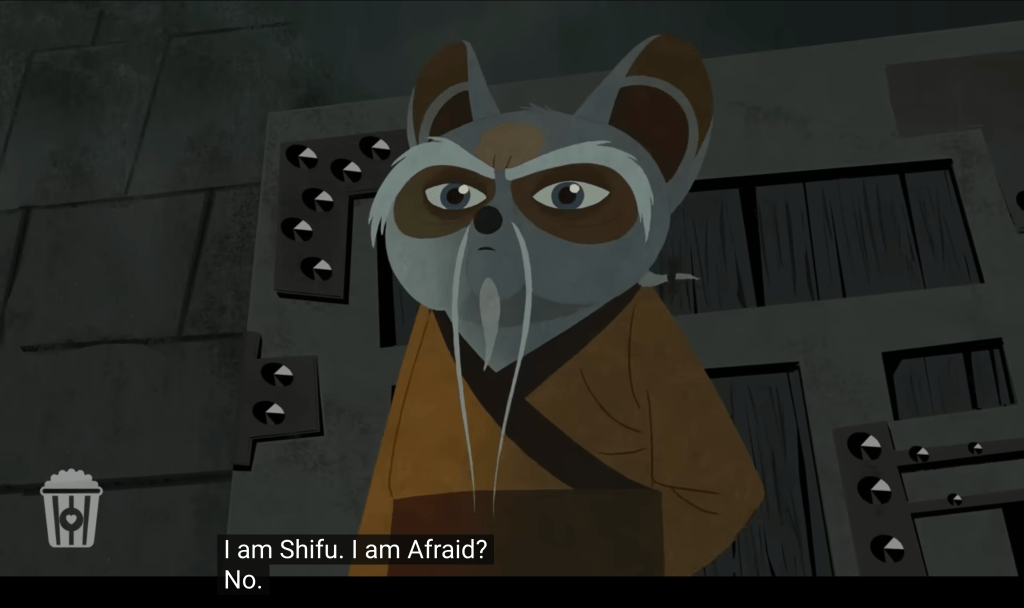
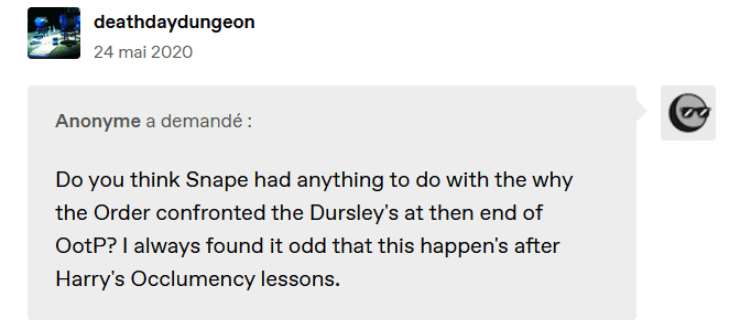
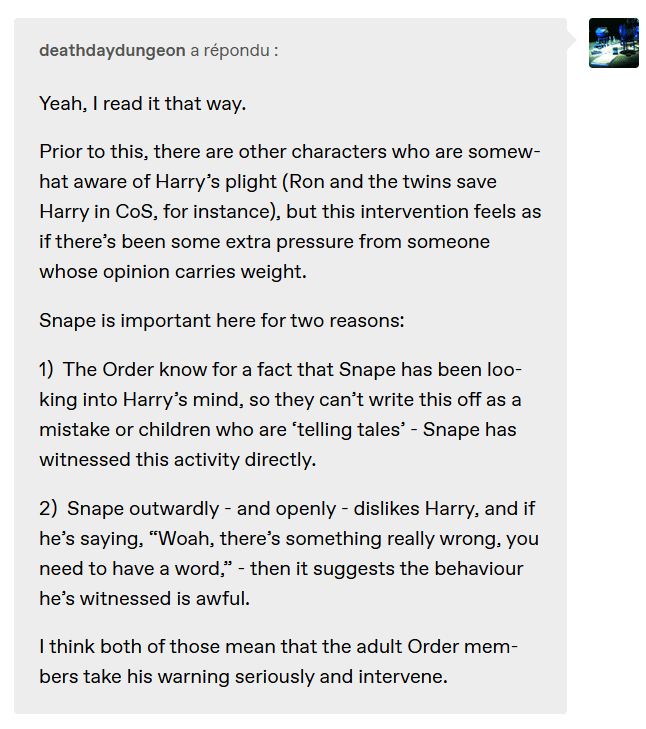
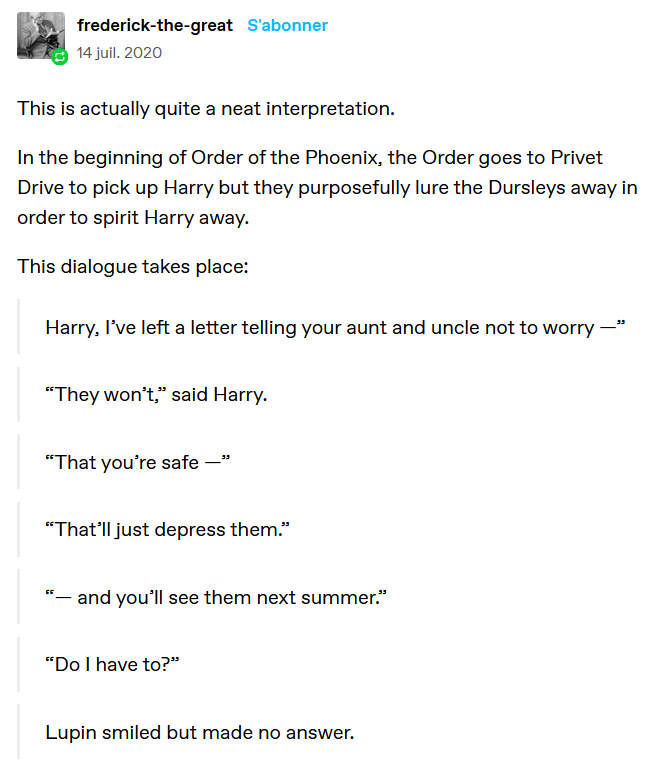
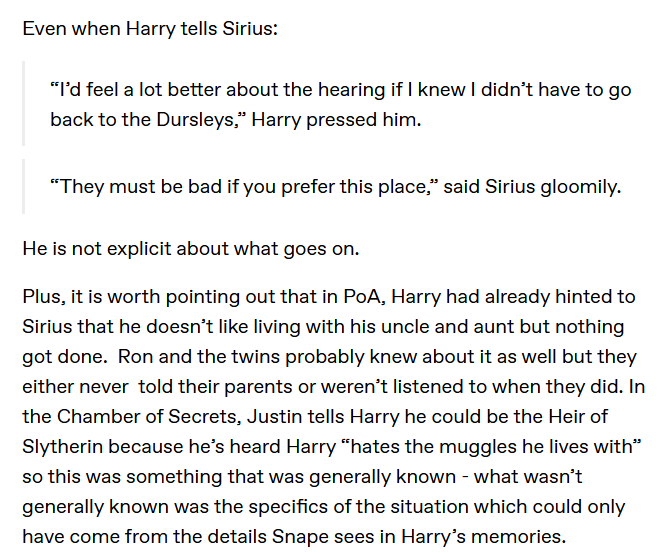
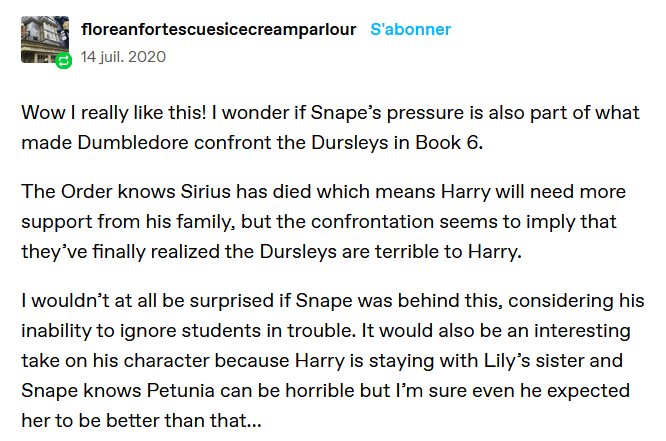
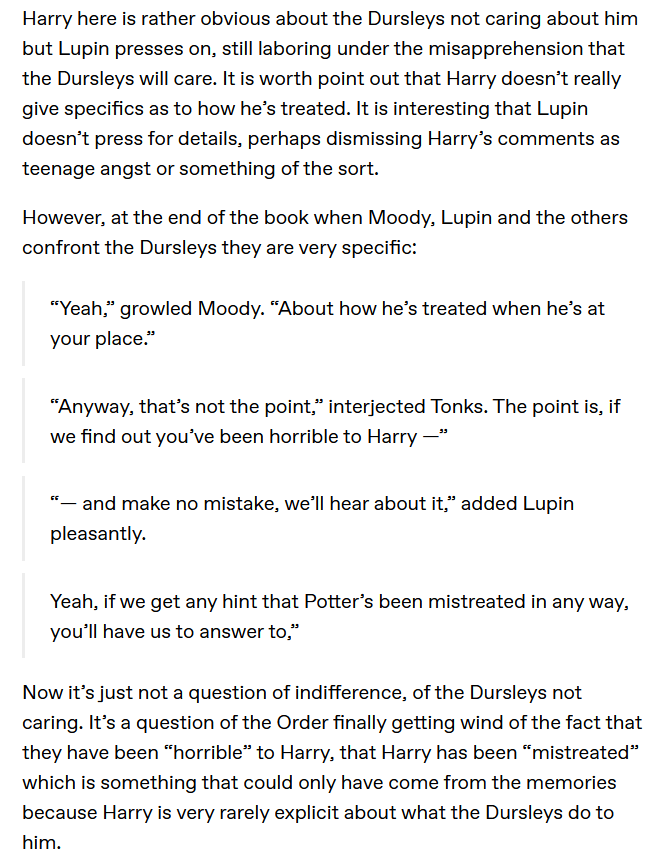
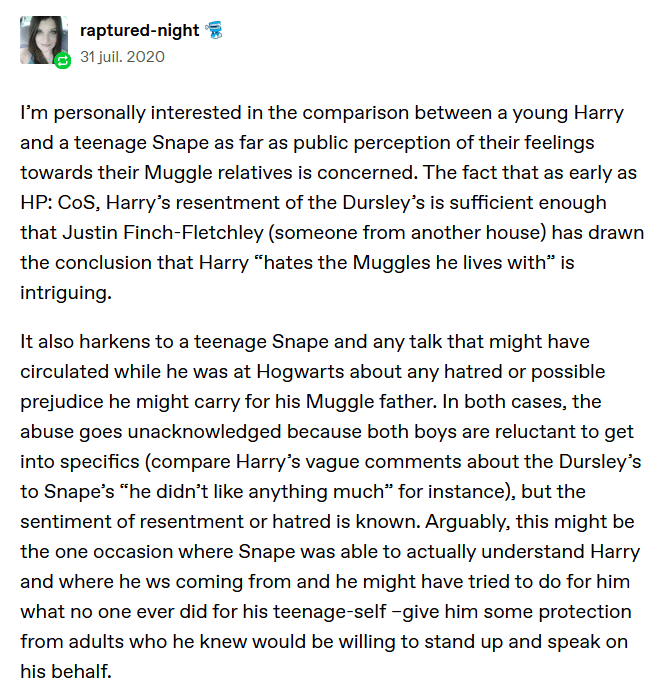
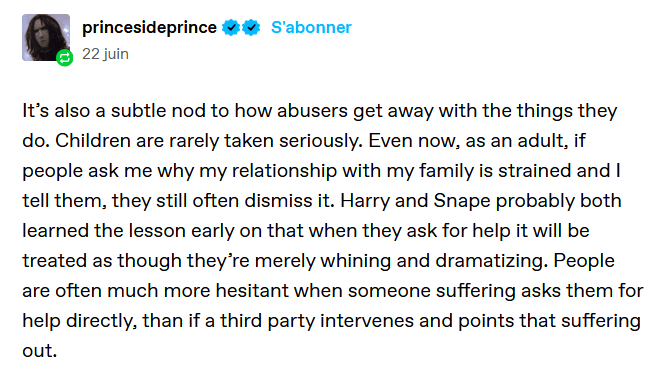
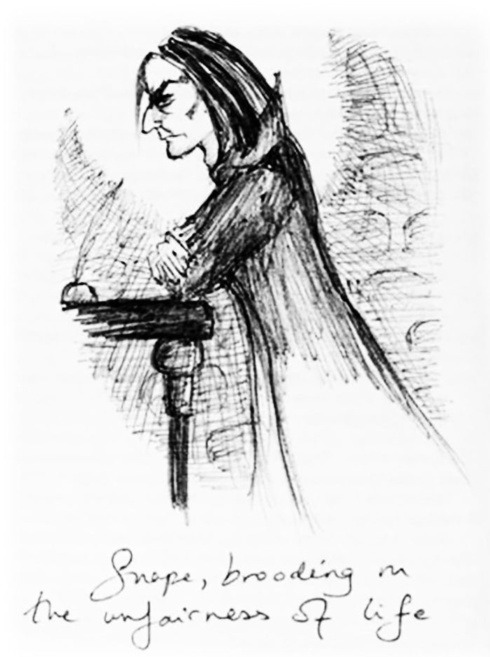
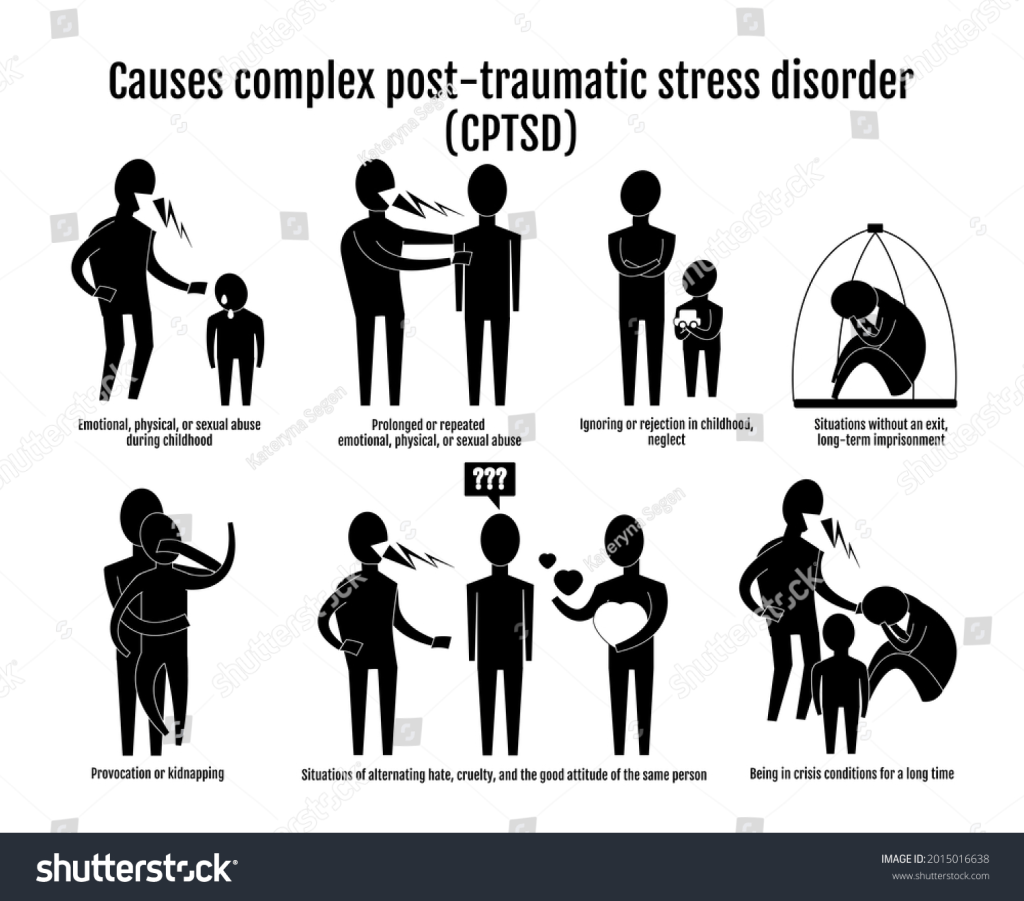
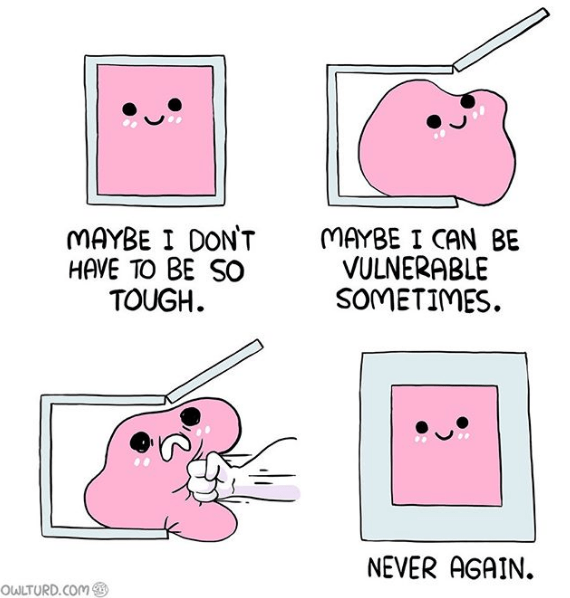
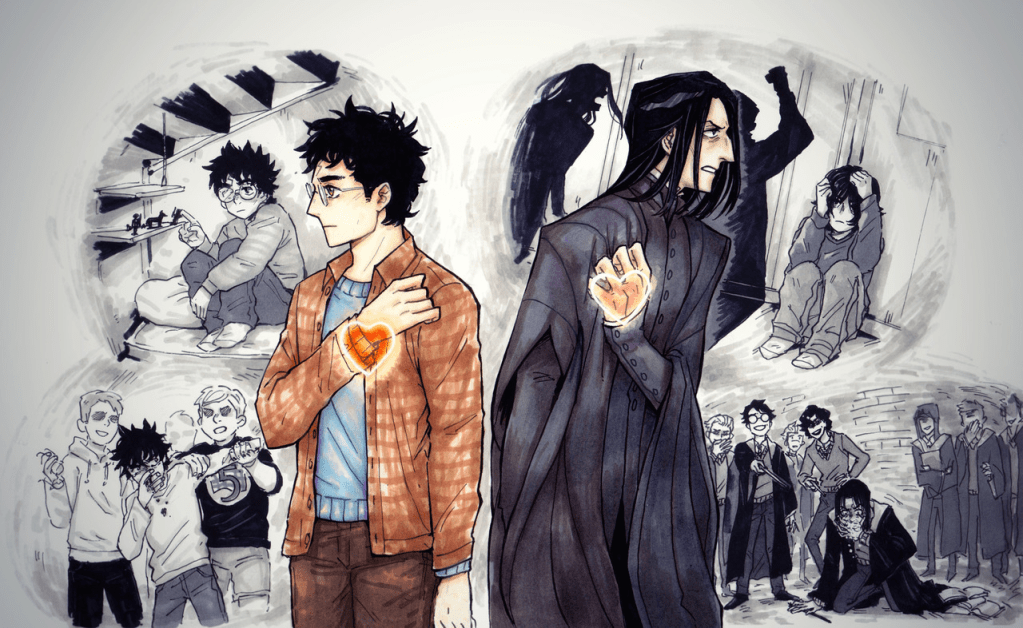
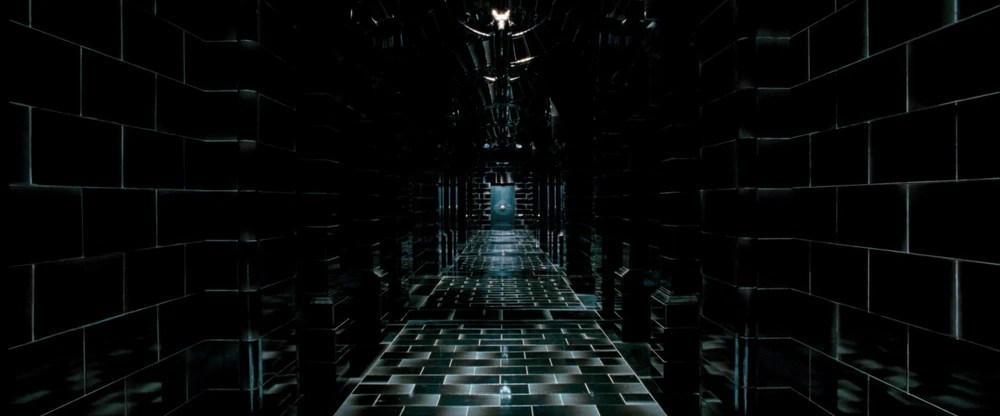


Your comment: