Was Snape evil for “outing” Lupin?
The Reveal of a Secret 2
Introduction
The HP fandom is divided on what is debated as an important crime of Professor Snape: “outing” Lupin as a werewolf. Last time, we showed that Lupin couldn’t remain a Defense teacher anyway given the numerous ways he failed his duties and proved he couldn’t be trusted with the lives of children. But you could ask yourself: if Lupin was to be punished for all the ways he fucked up during that year and in this teens, then why, according to Hagrid, did Snape tell his Slytherins that he was a werewolf? Surely Dumbledore would have fired him instead if Lupin was to be understood as a cowardly teacher who got karma’ed like his predecessors? Was it necessary for Snape to reveal his secret? Was it truly his way to punish Lupin for what he’s done? Because if not, we could suspect that he was, as many antis claim, an anti werewolf bigot who went beyond his teacher duties just to strike back at Lupin in a relatively unrelated way. Not to mention that time Snape gave the students a lesson on “how to spot and kill a werewolf”.
Well, I wanted to give a new perspective on all that.
Essay on Werewolves
Let’s first address the drama surrounding the Werewolf essay. Professor Snape wanted to teach the students about werewolves.
“Today we shall discuss —” Harry watched him flick through the textbook, to the very back chapter, which he must know they hadn’t covered. “— werewolves,” said Snape.
He has even given the students the homework on the ways to recognize and kill one.
“You will each write an essay, to be handed in to me, on the ways you recognize and kill werewolves. I want two rolls of parchment on the subject, and I want them by Monday morning.”
When Lupin asks Hermione how long she’s known he was a werewolf:
“Ages,” Hermione whispered. “Since I did Professor Snape’s essay…”
“He’ll be delighted,” said Lupin coolly. “He assigned that essay hoping someone would realize what my symptoms meant…”
The question is: does making the students write an essay on werewolves mean that Snape was trying to get Lupin fired or killed because of his lycanthropy? Was assigning the essay motivated by evil intentions? I’d like to make you consider other elements surrounding this problem.
First… Did you know that Defense Against the Dark Arts classes don’t merely consist of Harry’s year?
What I mean is that… there were already 4th, 5th, 6th and 7th years–that is, OWL and NEWT-level students–who already learned about werewolves before Lupin became their teacher. Let’s say for a moment that many of the 4th year students didn’t bother researching on their own about lycanthropy during their time under Lockhart. They’d still have to learn about them either for their OWLs, their NEWTs, or just because, you know… many times in school, we learn the same things over and over again. Besides, it’s reasonable to think that werewolves could be so fascinating that people–especially Slytherins, Ravenclaws or Hermiones–could learn what they are on their own, and they could get that information through something called a book, including the manual Lupin had the students buy.
Let’s not forget that per Pottermore, during Lupin’s childhood, “Fellow witches and wizards noticed how peaky Remus became as the new moon approached, not to mention his monthly disappearances”, prompting his parents to leave from village to town the instant those rumors started circulating. Similarly, in his adulthood: “Remus now lived a hand-to-mouth existence, taking jobs that were far below his level of ability, always knowing that he would have to leave them before his pattern of growing sick once a month at the full moon was noticed by his workmates.” I have a hard time believing that none of the students at Hogwarts (except Hermione) suspected Lupin to be a werewolf despite those telltale symptoms, which persisted into adulthood. If the students couldn’t make the connection, then their parents would have once they spoke about Lupin’s monthly ill-states. It’s not for nothing that Lupin says, in HBP: “The news would have leaked out anyway.”
Furthermore, as you’ll have noticed, Snape chose to teach a chapter that was already in the Defense curriculum. Yes, the chapter was at the end of the book, but that doesn’t mean it cannot or mustn’t be studied early on. It is very rare, in fact, that teachers actually follow the order of the textbook’s chapters. Harry’s year would already have learned about werewolves just like the older students have! Well, assuming Professor Lupin wasn’t planning on skipping this lesson at the last moment. (For that matter, did Lupin purposefully choose a textbook where the werewolf chapter was discussed last? You’d expect such a chapter to be placed early on, because it’s such a fascinating and important subject. It was part of the Defense OWL exam in 1976…) So it’s not as if Snape added that school subject out of nowhere.
But why, you ask, did Snape want the students to learn the ways to recognize a werewolf and kill one? Lupin assumes Snape wanted the students to recognize his symptoms and deduce he was a werewolf–suggesting he had evil intentions behind that essay assignment. I reserve the right to doubt what Lupin says about Snape’s intentions: after all, this is the same guy who pretended the only reason Snape hated James was out of jealousy of his talent in Quidditch, or that Snape told the truth about Lupin because he lost an Order of Merlin, when we know there were far more important motivations behind that. That’s why we could choose another interpretation.
Mere pages before the lesson, we learn that Snape suspected Lupin was in cahoots with the serial killer Sirius Black, shortly after the Fat Lady’s portrait was torn apart, and that his worries were brushed off by the Headmaster:
“It seems — almost impossible — that Black could have entered the school without inside help. I did express my concerns when you appointed —”
“I do not believe a single person inside this castle would have helped Black enter it,” said Dumbledore, and his tone made it so clear that the subject was closed that Snape didn’t reply.
So now, Snape is on his own trying to protect the castle while Dumbledore is gaslighting him on the danger Lupin represents – not just as a werewolf but as Sirius’ (potential) accomplice. Not only that, but Lupin’s taunting over not taking Wolfsbane unless Snape brings it foreshadows that at any time, he might skip his medication and become, as he says, “a fully-fledged monster” that would try to kill the children Snape teaches. You would be right to worry that Lupin could fail drinking his Wolfsbane, that’s exactly what happens at the end of the year. As we saw in our previous video, if the plot had been well constructed, then the Trio would have been severely injured or killed by their werewolf teacher. Unless Hermione had learned how to defend themselves against werewolves, killing them if necessary…
Besides, remember that Snape was a victim of a murder attempt by werewolf, and at this point in the story, he believes that all the Marauders were in on it, including Lupin. Why wouldn’t Snape teach students how to defend themselves against something that almost killed him? especially a class that had Harry Potter in it, whom he swore to protect at any cost?
What Snape did, however shady it might seem, is actually very responsible. If a wizard negligent with his medication uptake and potentially trying to murder students, must teach at Hogwarts, he might as well ensure that if the worst happens, the children know how to defend themselves. Might as well for them to be prepared. Might as well for Lupin to know that if he fucks around and tries to kill someone as a werewolf, he might face retribution for it. And that’s where we can actually see a global, long-term purpose to it.
Professor Snape is a spy who knows Voldemort will come back one day and who’s been protecting Harry from a servant of the Dark Lord already (Quirrell). He lived through a war and he knows another one will soon arrive. There are very high chances that werewolves like Greyback will join Voldemort again. Harry realized in OotP, when he founded the Dumbledore’s Army club, how important it was that his peers learn how to defend themselves for the incoming war against Death Eaters; but Snape knew that years earlier. Why would he keep the students in the dark about werewolves in a Defence against the Dark Arts class? knowing that nearly all werewolves will ally with Voldemort when he comes back? knowing Fenrir Greyback’s gonna target children again?
We know Lupin was very annoyed that Professor Snape dared giving this lesson as soon as he could… so he managed to cancel the homework, regardless it broke the students’ schedules:
Professor Lupin smiled at the look of indignation on every face. “Don’t worry. I’ll speak to Professor Snape. You don’t have to do the essay.”
I’ll tell you what: I think that Remus Lupin should have taught his students about werewolves himself. Yes. He could have at least not canceled the homework Professor Snape gave. Because what the children are learning here are very important tools for Defense Against the Dark Arts. Tools that would allow them to avoid being bitten or killed in a world where Acromantulas are your neighbors. Had Lupin taught about werewolves, then he’d have shown he was brave, selfless and responsible enough to risk that some dunderheaded students might understand what condition he’s got, as he valued their protection over his own life, in case someone like Greyback attacked or if he himself accidentally lost control and threatened to kill a child. Plus many students already learned about werewolves and Lupin wasn’t yeeted out of Hogwarts immediately so the risk this could happen at all was low. But by not giving the lesson about werewolves to the students and canceling the essay, Lupin showed again that he was an irresponsible coward who would rather let the children at the mercy of an unmedicated monster as long as he himself turned out fine. So Snape had to do his own job.
And um, in case you think that would only encourage hate or violent crimes upon werewolves…
- It’s not necessarily the case, I bet many students knew Lupin’s secret, they just ignored it like Hermione did.
- Gatekeeping students from learning about werewolves will only perpetuate ignorance, danger, fear and as such, discrimination. If Lupin wanted to make a difference in society, perhaps he should have had a discussion about lycanthropy with the students to address those prejudices!
Besides, he won’t teach about werewolves, but he gladly asks everyone to write an essay on vampires:
“Harry, Ron, come with me, I need a word about my vampire essay — excuse us, Severus —”
So I doubt Remus Lupin’s actions were a testament of his concern for the marginalized, you see.
[As a side note, while Severus Snape was never meant to be a vampire, there were indeed plans to have a vampire teacher at Hogwarts by the name of Trocar! Was that Lupin’s comeback to Snape?]
The Cursed Professors
There’s no doubt that Severus Snape despised Professor Lupin. And yet, it seems Snape’s pettiness in getting Lupin to resign at the end of the year may have been an act of mercy; an ingenious way to protect him. How could that be, you will ask?
Lupin was a Defense Professor. Given Voldemort cursed the position and not a single teacher failed to leave the post in various states of injury ever since, we know Lupin was going to suffer the price of the Defense jinx at the end of the year—one way or another. Professor Snape has taught, at this point, for 12 years at Hogwarts. He’s seen at the very least 12 teachers suffer the consequences of the DADA jinx, and if we count his years as a student, he’s seen 19 of them leave dramatically. In particular, Lupin’s most recent predecessors met a very gruesome fate: one was possessed and tortured by Voldemort until he died by Harry’s hand (Quirrell), while the other was dumped in St Mungo’s with extensive, incurable amnesia, or “mind-killed” (Lockhart). So Snape could reasonably expect that if nothing was done, then Professor Lupin was doomed to suffer… potentially, a lot.
It’s by revealing Lupin’s secret lycanthropy that Snape controlled the damage and channeled the curse of the Defense post in the safest way possible.
Mind you, Remus isn’t all that upset that the parents have learned he’s a werewolf. He’s indifferent about it, he knows it won’t make a big difference. Remember students like Hermione had already guessed it:
“But he ‘accidentally’ let it slip that you’re a werewolf, so you had to leave!” said Harry angrily.
Lupin shrugged. “The news would have leaked out anyway.”
Professor Snape has revealed Lupin’s lycanthropy, and yet, he didn’t give away Lupin’s true darkest secrets. The things that he actually doesn’t want anyone to blame him for, are those facts:
- Lupin used to roam Hogsmeade and the Hogwarts grounds as a werewolf for the last three years of his education, every month, having many near misses (= nearly killing/infecting people), even though it was unnecessary, that it didn’t help him suffer any less… just because he wanted to have fun. Plus, he hid this from Dumbledore out of selfishness and cowardice.
- He cancelled the homework on werewolves just to avoid getting spotted even though he admits that the news would have leaked out anyway, and even though it could save kids from people like Greyback or Lupin himself in case forgot his Wolfsbane.
- He withheld capital information that could have saved them lots of trouble for a year; although, as he admits, he wholeheartedly believed Sirius to be James and Lily’s murderer and got evidence of his dangerosity (slashing the portrait of the Fat Lady, tearing Ron’s curtains apart and standing over him with a twelve-inches long knife), Lupin never told Dumbledore that Sirius was a dog Animagus, or that he knew all the secret passages to Hogwarts, or even about the Marauder’s Map, all because of moral weakness: he didn’t want to admit a schoolboy mistake and wanted to look good in front of Dumbledore.
- The negligence of his lycanthropy [not drinking Wolfsbane even though he had a whole week for that, not remaining in the Shack for his transformation] nearly had Harry, Hermione, Ron and Professor Snape either mauled, infected or killed. Three children and a teacher. In particular, imagine the parents ever learned that Lupin the werewolf nearly killed the Boy Who Lived?
Now, those are valid reasons to fire Lupin, or at least force him to resign. Only, Lupin would probably have to worry for far more than some angry owls. Severus Snape totally had the power and the capacity to tell the Slytherins all the truth. This time, I reckon that even a tolerant parent would have been furious that such a teacher was allowed in the Defense post at Hogwarts. Don’t even mention the bigoted ones–they’d have a field day tracking Lupin down to lynch him. Some Ministry members could have gladly locked Remus Lupin in Azkaban, notably on the reason he acted like Sirius Black’s accomplice.
Hardcore anti-Snape users out there even argue that Snape is the sole reason that anti-werewolf laws were instituted, that it was in fact his intention. But if it truly was the case, then surely, telling everything could represent the ideal occasion to encourage lycanthrophobia throughout Britain Wizarding Society?
Severus had the full opportunity to do all that and enjoy the show. Lupin was at his mercy. But as he didn’t, I’m pretty sure he somehow found the strength to give him a chance–not only to survive the Defense curse, but also to leave Hogwarts safe and sound, with his reputation mostly intact for the outside world. Either Snape can only offer his enemies a lucky, joyful ending in his pettiest moments, or he was yet again one hell of an unsung hero.
We could argue that it might not have been Snape’s intention to save Lupin from an especially gruesome consequence of the Defense curse by fulfilling its requirements in the most harmless way imaginable. Nevertheless, how can you explain otherwise that he never revealed Lupin’s darkest secrets to the public, if he was apparently such an evil bigot? The fact that Severus did not tell the Slytherins the whole truth and effectively protected Lupin and his reputation shows that he’s far more than a petty character. He basically allowed Lupin to escape the Defense curse as safe and sound as possible, which is quite merciful of him.
It’s not the only time that Severus Snape could have done lots of harm to Remus Lupin:
“We both know he wanted my job, but he could have wreaked much worse damage on me by tampering with the potion.”
Professor Snape could have refused to brew Wolfsbane. Alternatively, he could have decided to tamper with the potion, so either Lupin got poisoned, or his Wolfsbane failed to take effect and he was naturally “outed” as a werewolf, howling in his office and everything. Snape could have “failed’ to brew Wolfsbane and justified it on the fact this potion is incredibly difficult to brew, and he could count on the bigoted parents to defend his case. Dumbledore wouldn’t fire him for this « mistake » either: Snape is too important for his cause.
He could have revealed Lupin’s secret far earlier in the year. In fact, Severus Snape could have revealed that Lupin was a werewolf for two decades, from the day he was almost manslaughtered by werewolf-Remus. You can bet Lucius and Voldemort would have loved to hear that Dumbledore had secretly allowed a highly dangerous creature in Hogwarts and that it almost ended in someone’s death. Yes, Severus might have been expelled from Hogwarts. For how long, exactly? Because I think Dumbledore wouldn’t have lasted very long as Headmaster either. His career would have been destroyed. Snape would probably have been reintegrated in Hogwarts soon enough, on the merit of great services to the school. And this time, his bullies would be out of the way. Who knows how the Wizarding War would have turned out if Voldemort had gained such information? All thanks to our dear “Padfoot” and his idea of a joke?
It took Sirius Black only 3 years before outing Lupin to their common enemy by almost making his friend’s deepest fear come true (murdering someone accidentally as a werewolf), effectively reducing him to a murder weapon, a Dark monster tool. Severus Snape kept the secret for nearly 20 years, despite the horrific pressure he suffered–notably from Lupin himself–and he only told the truth when Lupin fucked up one too many times and Snape decided that was enough.
Here’s a passage I like a lot in Lorrie Kim’s Snape: A Definitive Reading:
Dumbledore would not hear Snape’s safety concerns when he appointed Lupin to a teaching position, but it turned out that Snape was right. It was not humanly possible to guarantee anyone’s safety against lycanthropy, despite Dumbledore’s precautions and Snape’s inexorable production of Wolfsbane. The first time, another human who was in on the secret showed faulty judgement and exposed a student to the werewolf. The second time, Lupin’s own human emotions prevented his self-care. Fortunately, nobody was hurt in either instance, but Snape was right: it would be impossible to guarantee that there wouldn’t be a next time. […]
Snape once accepted Dumbledore’s order of silence when his own life was endangered by the student Lupin in werewolf form. But when the adult Lupin reneges on his own contract with Dumbledore, forgetting to take his Wolfsbane, he endangers the entire campus and grounds. Snape can no longer endure being silent. As Harry found out when he blew up Aunt Marge, it can be easier to withstand attacks on the self than threatened attacks upon others. Snape is dedicated to protecting every student against attack, even the ones he can’t stand. […]
The reader sees Snape destroying Lupin’s ability to earn a living; Snape sees himself saying enough is enough, stepping in before Lupin’s lycanthropy actually kills someone and destroys Dumbledore’s career.
Now, another issue arises: Maybe the only reason Snape brewed Wolfsbane for Lupin and never revealed his lycanthropy before is because Dumbledore intervened! Well, perhaps? Honestly, Snape was one of Dumbledore’s most valuable assets, so I don’t think he’d have been fired or truly punished if he raged too much against Lupin. Dumbledore doesn’t do anything about Snape’s refusal to teach Harry Occlumency after the Pensieve incident, for instance, and teaching Harry how to Occlude was much more important than to have some random DADA teacher. Regardless, this is an element that deserves our attention.
Dumbledore’s Involvement
To argue that Snape could never reveal Lupin’s lycanthropy before because Dumbledore forbade him so (like with a magical vow), wouldn’t help your case to cast Snape as evil. Because then it means that near the end of the year, Dumbledore has lifted this prohibition. Dumbledore’s not stupid: if he indeed spent almost two decades making it impossible for Snape to reveal Lupin’s lycanthropy because he couldn’t trust him to keep the secret, only to lift this prohibition during Harry’s 3rd year, when Snape thought Lupin was helping an ex Death Eater enter Hogwarts to kill Lily’s son, or at the end of Harry’s 3rd year, when Snape was absolutely losing his shit after Black escaped, then he would have done so with the expectation that Snape would feel finally allowed to tell the secret… and Dumbledore would be fine with it. Surprisingly enough, the subtext actually leaves the suggestion that Snape revealing Lupin’s condition to his Slytherins was not so much an act of rebellious spite in the face of Dumbledore, as it was indeed done with his permission – or even under Dumbledore’s orders. Let’s have a look at Lupin’s departure:
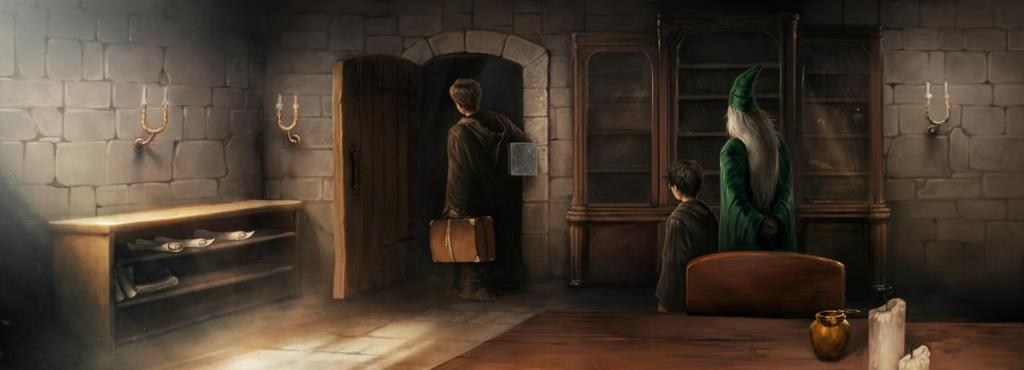
It was Professor Dumbledore. He didn’t look surprised to see Harry there.
“Your carriage is at the gates, Remus,” he said.
“Thank You, Headmaster.”
Lupin picked up his old suitcase and the empty Grindylow tank.
“[…] Headmaster, there is no need to see me to the gates, I can manage…”
Harry had the impression that Lupin wanted to leave as quickly as possible.
“Goodbye, then, Remus,” said Dumbledore soberly.
Did you see this? Dumbledore’s first comment urges Lupin to leave. Remus suggests to the Headmaster not to accompany him to the gates, and Dumbledore “soberly” finishes with a goodbye and a cordial shake of hands before Lupin takes off. He does not offer even a hint of apology for Snape’s disclosure – who ironically is now the one who faces no consequences for revealing Lupin’s secret (except the hate of some people). Remus was taking his time talking to Harry just minutes earlier, but the moment the Headmaster enters his office, he cannot meet his eyes and he tries to leave as quickly as possible.
Why is it? Well, as Remus was transformed and running loose on the grounds, Dumbledore learned the full truth from Sirius Black – about the werewolf excursions during his teens, about the info he withheld from the Headmaster during that current year. Although it turns out that Sirius himself was innocent, Lupin has his own guilt to bear. As Lorrie Kim says: “It would not have been fun to be Lupin during that morning’s job performance review with his employer.”
“Last night Sirius told me all about how they became Animagi,” said Dumbledore, smiling. “An extraordinary achievement — not least, keeping it quiet from me.”
It’s not just this particular interaction that should get our attention by the way. Lupin wasn’t the only one who failed as a teacher. Many professors in Hogwarts should have been fired – not just the evil Defence ones. Professor McGonagall and Hagrid have put children in mortal danger themselves – Harry and Neville included – with sending children to the Forbidden Forest as a punishment for a minor “crime” that was: being out of bed, out of curfew, and pissing off the Head of Gryffindor. McGonagall put Neville in mortal danger again by essentially locking him out of Gryffindor Tower when there was a serial killer that could breach through the school’s protections any moment and kill Neville just like he seemingly tried to kill Ron and a sentient portrait. Professor Hooch ought to have been fired for not ensuring student safety during flying lessons and Quidditch matches year after year, and Hagrid as a teacher made students study extremely dangerous creatures that were borderline illegal (the Blast-Ended Skrewts), making children hate Care of Magical Creatures. I could mention many other teachers who, under today’s standards in UK schools, would have been fired or even thrown in jail. Yet, those teachers were kept in Hogwarts… Not Lupin.
Furthermore, when Umbridge gets Professor Trelawney fired, Dumbledore personally intervenes to ensure Trelawney can still live in the castle, even if she can’t teach. Again, not Lupin.
Most significantly, when Hagrid was outed as a half-giant in GoF, Dumbledore vouches for him and refuses to let him leave, no matter how many angry owls they may receive from the parents:
“Not all of ’em,” said Hagrid hoarsely. “Not all of ’em wan’ me ter stay.”
“Really, Hagrid, if you are holding out for universal popularity, I’m afraid you will be in this cabin for a very long time,” said Dumbledore, now peering sternly over his half-moon spectacles. “Not a week has passed since I became headmaster of this school when I haven’t had at least one owl complaining about the way I run it. But what should I do? Barricade myself in my study and refuse to talk to anybody?” […] Dumbledore stood up. “I refuse to accept your resignation, Hagrid, and I expect you back at work on Monday,” he said. “You will join me for breakfast at eight-thirty in the Great Hall. No excuses. Good afternoon to you all.”
The Headmaster does none of this for Lupin. He never forces Lupin to keep teaching as the Defence teacher despite the angry parents. He doesn’t even offer him to stay at Hogwarts or any other place to live in. After what we read in GoF when it came to Hagrid, it becomes evident that the reason Lupin didn’t get this sermon from the Headmaster wasn’t just a matter of negligence or forgetfulness: to “let” Lupin resign and leave was something Dumbledore approved of.
Lupin wasn’t pushed to leave because the parents knew he was a werewolf. He was pushed to leave because Dumbledore didn’t want him in Hogwarts anymore, werewolf or not.
If Snape had been magically bound not to reveal Lupin’s secret, then Dumbledore lifted this prohibition at the end of the year, right when Snape had enough, with the intention for him to reveal Lupin’s secret; he may even have ordered him to release the secret out in the open. Either way, the Headmaster agreed with what Lupin got. And you see, I highly doubt that Dumbledore was lycanthrophobic after all he did for Lupin, like offering him an education, a job as a Hogwarts teacher, the post of a Prefect, exceptional lenience, defense against any suspicion thrown on Lupin’s innocence and preserving his reputation next to the Minister by pretending he was the one working for the children’s safety all along instead of Snape and obscuring the fact he nearly had the children mauled by either Padfoot or Moony, several times during the year, by his own cowardice, selfishness and stupidity. Lupin was one of Dumbledore’s golden favourites, even as an adult. So if Snape gave out the secret under Dumbledore’s orders, it can’t have been done with lycanthrophobia as a motive. It cannot have been acted on impulse and out of pure spite.
It is not just possible to have Lupin resign without it being a lycanthrophobic hate crime, but it’s also what likely happened.
The one and only event that make fans believe Snape was lycanthrophobic loses its substance if Dumbledore enters the picture. If you argue that, despite being backed up by Dumbledore who would not have Lupin resign for lycanthrophobic reasons, Snape could still have outed Lupin as a werewolf specifically because he was lycanthrophobic, then your only proof Snape did that specifically out of lycanthrophobia is the very fact that he revealed Lupin’s secret, which isn’t sufficient proof in itself and which is the event that you must justify was done out of lycanthrophobia in the first place. This whole mess becomes a circle argument, and I don’t know about you, but when you get into circle arguments to prove your claims, you’re effectively demonstrating you have no proof to back up your arguments – you’ve just injected assumptions and headcanons to interpret the books the way you wished they were written.
So we end up with no proof that Snape outed Lupin out of lycanthrophobia, while on the other hand we get evidence that Snape wasn’t lycanthrophobic: the fact he kept Lupin’ secrets since the beginning, or that he never showed hatred towards Lupin for the mere fact he was a werewolf. Rather, as we will explore in a future video-essay, it is constantly explained that Snape hated Lupin for rightful reasons, for instance, because Lupin was part of a gang of bullies that ruined Snape’s life and because he was someone who, in his eyes, once tried to kill him in a “prank”. You’d expect an ex-Death Eater to be more inclined to develop lycanthrophobia, just like men are sucked into incel culture after learning that women are human beings who get to choose who they will date or not, but Snape never failed that way. Take notes, Sirius Black.
Back to the subject. There are quite many interesting theories that explain why the Headmaster could have allowed Snape to break Lupin’s secret out in the open – evidently, without lycanthrophobia in mind. Perhaps he still wanted to cover up for Lupin’s image: it is far easier to sympathize for a teacher forced to resign for being a werewolf, than a teacher who is fired in disgrace by his superior for having gravely failed his duties. Remember that no one, except Dumbledore, Sirius, Snape and the Trio, was aware that Lupin fucked up as a teacher, so as far as everyone else in Hogwarts and Hogsmeade knows, their one good experience with a Defence teacher was with a werewolf, which is perfect to start alleviating lycanthrophobia in Wizarding Society. Perhaps Dumbledore thought as well that “enough was enough” and he couldn’t ask Snape to keep Lupin’s secret any longer as if nothing had occurred; as if Lupin hadn’t utterly destroyed Dumbledore’s trust all these years and once again nearly mauled someone to death. As if the Werewolf Incident and the Werewolf Excursions weren’t enough, now the Boy Who Lived, his friends and the Death Eater spy nearly got killed, not to mention the real Potters’ murderer escaped. All that, because Lupin refused to get his ass off his office chair and go drink his Wolfsbane for a whole week or at least tell Dumbledore the truth about the secret passages and the Animagi forms – neither in his teenage years as a Prefect, nor in his Order member years, nor in this current year as the Defence teacher.
Perhaps Snape did retaliate against Lupin on his own, without Dumbledore’s permission, but in the end, the Headmaster could not disagree with his decision, and he let it pass. Lorrie Kim again: “It is Lupin and not Snape who has disappointed Dumbledore.” (Come to think of it, none of the other teachers seem to care about Lupin’s fate either, when his lycanthropy was revealed; perhaps they too were made aware of what he did at their expense? Or did they not worry, because they knew he was bound to stop teaching because of the Defence jinx, and they’re relieved he at least survived?)
Coincidentally enough, it represented an occasion to channel the Defense curse so that Lupin would leave relatively safe and sound. It was also an opportunity for Dumbledore to reinforce Snape’s evil reputation and his good standing among Slytherins and their parents, in preparation for his re-entry in Voldemort’s ranks as a double agent. Evidently, it worked very well… too well.
Speaking of the Defense curse, it might be possible that Lupin was aware from the beginning of what he was engaging himself to when he accepted the Defense position. He’s been a Hogwarts student while the jinx was in place, so he must have noticed how all the Defense teachers had to leave at the end of the year, more or less damaged in the process – it wouldn’t be a surprise for Lupin to know that Dumbledore wanted to hire yet another Defense teacher. Maybe he and the Headmaster had made an agreement together with the contract, that at the end of the year, Lupin would resign by himself to be saved from the Defense jinx. Which would be beneficial for Lupin considering he already expected his werewolf secret to leak out, forcing him to quit the job like always. And when the time came, everything fit perfectly.
But if Dumbledore is the one to blame, if Snape revealed Lupin’s secret to save him from Voldemort’s yearly curse, or if Lupin had already agreed to resign in June to avoid it, then it truly means the fact Snape revealed Lupin’s secret just because he « lost » an Order of Merlin, was an ungrateful, defaming lie.
“The Werewolf”
If you really want to argue that Snape might be lycanthrophobic, I can provide you with those sentences:
- ‘Two more for Azkaban tonight,’ said Snape, his eyes now gleaming fanatically. ‘I shall be interested to see how Dumbledore takes this… he was quite convinced you were harmless, you know, Lupin… a tame werewolf…’
- ‘You, Potter and Weasley are out of bounds, in the company of a convicted murderer and a werewolf. For once in your life, hold your tongue.’
- ‘I’ll drag the werewolf. Perhaps the Dementors will have a kiss for him, too –’
- ‘Professor Lupin could have killed me about a hundred times this year,’ Harry said. ‘I’ve been alone with him loads of times, having defence lessons against the Dementors. If he was helping Black, why didn’t he just finish me off then?’
‘Don’t ask me to fathom the way a werewolf’s mind works,’ hissed Snape. ‘Get out of the way, Potter.’
- Consider, Minister: against all school rules – after all the precautions put in place for his protection – out of bounds, at night, consorting with a werewolf and a murderer – and I have reason to believe he has been visiting Hogsmeade illegally, too –’
Indeed. Snape repeatedly refers to Lupin – not as Lupin anymore – but as “the werewolf”. He does it enough times, and with enough spite, that we can guess he does it to dehumanize him. He implies that werewolves’ minds do not work the same way as humans without anything to back this idea up (to our knowledge) – worse, maybe, that it doesn’t matter if Lupin’s behavior is not coherent with the hypothesis of wanting to murder Harry because he is a werewolf and that explains away all those peculiarities – he cannot be anything else but guilty! He blames Harry for consorting with “a werewolf and a [convicted] murderer” as though being a werewolf was as criminal as being a convicted murderer, and worse, that Harry talking with a werewolf is a fault in itself!
We could say that he’s generally not lycanthrophobic but when it comes to Lupin, he does jibe at the fact he’s a werewolf, either because he doesn’t know he’s using prejudiced language like he would against someone like Greyback and it’s not okay to do it even if the person you’re being prejudiced against is evil, or because he does believe that Lupin’s criminality has to do with him being a werewolf but if that was another werewolf then Snape wouldn’t cast them as evil until proven otherwise, at which point he’d suspect that has something to do with their lycanthropy.
But you could also make the case of Snape buying into anti werewolf propaganda. And honestly, it wouldn’t shock me. Sure, that’s disappointing. Especially from a character who’s supposed to be redeeming himself, and from a character who we already know is at fault for having held prejudice against Muggles and Muggle-Borns. On the other hand, that’s one more thing we know Snape can improve on – and probably actually did in later books.
Unlike anti Muggle and anti Muggle-Born bigotry, which is being somewhat fought against, anti werewolf bigotry is still widespread – the word “lycanthrophobia” doesn’t even exist in-universe – so there would be nothing to make Snape confront his own biases and he wouldn’t be “vaccinated” against that kind of bigotry. On the contrary, he would get nothing but validation and more fuel to fear and, with time, hate werewolves in general. Dumbledore might have spoken to Snape about it, but Snape has legitimate reasons not to trust Dumbledore where Lupin is concerned (in fact, we can see that Snape suspected Dumbledore was being deceived by Lupin into thinking he was a ‘harmless, tamed werewolf”, making him yet another victim of the werewolf Lupin).
Ron, Hermione and Harry were at first prejudiced against Lupin upon learning he was a werewolf but quickly got over it thanks to Lupin being a nice guy to them and someone they like and who never harmed them in their eyes. Although we could question how much they really changed, seeing as Harry’s reply to the book Fantastic Beasts and Where to Find Them’s entry on werewolves is “[Werewolf]s aren’t all bad”, thus assuming that Lupin is the exception and that, as a general rule, werewolves are evil, even though the entry never once hints that werewolves are evil. Following Harry’s idea, Snape’s fault in-universe wouldn’t be lycanthrophobia but hating the wrong person. Where’s Lily when we need it?
“Why should I be any different?”
Severus, contrary to the Trio (and most people, really), has had other experiences. Having been bullied by Lupin, having almost been murdered by him and thinking that Lupin was in on the plan, gathering plausible evidence that Lupin was at it again with Harry this year (even if it turned out wrong) – but also the fact that all the werewolves we know Snape has met is Lupin, Greyback and his gang (who knows what DE Snape witnessed first-hand), and not having a single decent werewolf to indicate him that being a werewolf does not mean you are inclined to be evil in the end and is not what made Lupin, Greyback and his werewolf gang such horrible people, despite what his unfortunate experiences might empirically “prove”… (In the HP book, we only witness one innocent and decent werewolf, in OotP, and the first thing he replied to Arthur Weasley, who wanted to reassure him after he was bitten, was that he would give him another bite if he didn’t shut up, so…)
All of these would help breed bias out of genuine fear. He could develop the conviction that, unlike with Muggle-Borns, it is legitimate for once to reject werewolves, and it isn’t a question of being a bigot but of being factual… because they’re just another kind and they’re literally man-hunting predators, so that must get to their heads, right? since they become more fond of red meat after being bitten, why wouldn’t it be plausible that they become predatory and serve their werewolf side the rest of the time? and maybe Lupin is so vicious against him because just like Greyback, the werewolf is just taking a more human form when there’s no full moon… maybe Lupin is such a horrible person because he’s just like them, one more of Greyback’s kind… and there’s no “Lupin” in fact, it was the beast all along that preyed upon him… that’s why he would let his friends walk him around the school and the village as a werewolf for years despite the protections that Dumbledore put in place, it was the werewolf clouding his judgment and taking over… and isn’t it legitimate to defend oneself from that kind of Dark magical creatures…?
So indeed, maybe Snape was being bigoted against Lupin, having those “werewolf” jibes indicating that there are anti werewolf sentiments brewing inside, which are bursting to the surface at the moment he genuinely believes that Lupin has deceived them all. That Snape’s lycanthrophobia would be based on legitimate fear and bad experiences rather than buying into stereotypes and blind intolerance, does not make him entitled to be excused. He is at fault for having said “the werewolf” like he did. Because no matter how many times you were wronged by people from a marginalized community, and however plausible (to you) the reason for a supposed inclination for evilness might be, it’s never right to hate them just because of what makes them different. EVEN if the thing that makes them different actually DID make them more “dangerous” people to hang out with! It still wouldn’t be right for anyone to hate werewolves – or should I say, people with lycanthropy – for being werewolves. While we could hate the beast just like we could abhor snakes, and while we could hate Lupin for being a horrible person, we cannot hate Lupin out of the assumption that the human Lupin is the werewolf beast that we can legitimately hate.
On the other hand, I’d like to give you a challenge, relevant to what we can still witness in 2024. What if I told you that hating psychopaths/sociopaths and narcissists, for being just that, made you a bigot?
No wait, let’s go another way. What if I told you that the most horrible people you witnessed (Hitler, Netanyahu, Meloni, Orban, Trump…) or heard about or personally met in your life (your own bullies! the people who tried to destroy you and pushed you to attempt suicide and drew pleasure from it!) probably are psychopaths and/or narcissists, who we “know” literally function in evil ways?
Look at the DSM V. ASPD is literally defined by a lack of empathy and NPD as, well, pathological narcissism, as its name suggests.
If even the medical books categorize those people as having evil traits, or at least, traits that make them prone to be evil, then does that mean that hating against psychopaths and narcissists is not bigotry, that it’s totally legitimate and an act of pure self-preservation? that dealing with them is naive, foolish, and don’t cry if you find out the hard way that it’s best to leave them out of your life?
Is it okay to hate – or at least keep away from – psychopaths and narcissists and borderlines, even if their personality is categorized as a mental condition, even if due to trauma (since trauma does not give you a pass to be horrible)?
If it isn’t in your opinion, then will you keep using “psychopath” and “narcissist” as a shortcut to call someone evil?
And whatever your conclusion might be, if you knew that a colleague who did the things that Lupin has done was literally diagnosed with ASPD and/or NPD, if you believed that they deserved to be fired for having fucked up so much and the one way to make them pay for sure as well as to protect the children from further fuckery is to “accidently” reveal that they are diagnosed as a psychopath and/or narcissist (in the pathological way), wouldn’t you do it?
Is it acceptable, for you, to bargain everyone’s lives (primarily children’s) on the idealistic belief that no matter what you witnessed and experienced first-hand (Lupin/Greyback), no matter how much that person ought to stop teaching in schools and no matter the fact that they literally harmed and almost murdered repeatedly because of their (unmanaged) psychopathy or narcissism traits, it still would never be right to warn people that they’re a psychopath or narcissist to force that teacher out of there? Even if you’re one of those who believe that unmanaged ASPD/NPD is not the reason they ought to be fired, just a convenient excuse for more legitimate (and arguably more condemnable) reasons?
If you’re one of the people who are resolutely unshaken by the scenario I proposed, then congratulations. As for the others, I wonder how many of you will be incensed that I dared compare psychopaths and narcissists with the stand-in for bloodborne diseases (even though they’re closer analogies than homosexuality). And by the way, I wasn’t saying that ASPD or NPD are the real-life equivalent of lycanthropy. I’ve just been using that example because bigotry against ASPD, NPD, BPD, AVPD, low empathy autism, etc, is still so widespread (you know, all those mental disorders that make us uncomfortable since they require us to consider, for instance, that lack of empathy does not make one evil nor prone to be evil and that some people become evil as a maladaptive coping mechanism to trauma/violence evolving into a genuine mental disorder [so can we really call them evil, and if so, to what extent?]).
It would be easier for us not to stigmatize werewolves because unless there is scientific evidence or plausibility that the werewolf side sort of “corrupts” the human side in a significant amount and evil way, we could easily mentally split the werewolf from the human, which is not so evident with a personality disorder or a mental disorder in general. It helps that we are not growing in a world where lycanthrophobia is profoundly ingrained in our society. It helps that we will never be mortally threatened, over several years, of being murdered by the only werewolf you know, who’s supposed to be the most tame and decent of all. It helps that we will never come to the fact that the only other werewolves you meet, later on, are Greyback – implied to be a pedophile – and those who follow him, with all the jolly gang joining the hateful group wanting to take over the world and reduce all the “dirty-blooded” and their friends to servitude or death.
Which is also why I decided to make an example with psychopathy/sociopathy and narcissism. Because when you’re personally targeted by someone from a marginalized community who’s defined by a disease having them (potentially) make monstrous things (with at least one recorded event of them almost succeeding to murder you), when nothing in your personal experience but also in widespread beliefs indicates that it really is foolish and wrong to systematically start hating them or at least be “wary” around them when you learn that they have that disease, then suddenly you’ll start doubting if that qualifies as bigotry in the first place. The notion of not hating someone because of something that makes them different and which they cannot help, will seem so far away from your mind when your own safety or that of the most important person in your life is the price to pay if you make a mistake. And the threat is real.
Beyond the comparison with ASPD and NPD, if you lived in a world full to the brim with cis het people with only a few dozens of gays (how boring, I know), and almost all those gays were arguably evil people with one notable for being a pedophile and his group joining an organization that people consider Nazis, and the only gay person that’s told to be the most decent and loveable of gays is someone who constantly bullied you and once tried to murder you with his friends, then yeah I’d get why you’d start having your doubts.
On a serious note: people brew hatred for far less than that.
I’m not saying it wouldn’t be right to call Snape out for reducing Lupin to “the werewolf”. Or for being full-blown lycanthrophobic if he was. Bigotry kills innocents. What I’m saying is that it’s easy to be the first one to cast the stone, when you don’t want to deal with the uncomfortable reality that Snape had legitimate reasons to fear Lupin for being a werewolf and that lots of people – if not you, then probably your friends or family – would repeat the same patterns if in his place.
If Snape really was lycanthrophobic, we know that his hatred wouldn’t stem out of a feeling of superiority or mere “stupid” bias, like Bellatrix and Voldemort who consider people with lycanthrophobia, animals. We also know that he later saved Lupin during the Battle of the Seven Potters and he never, to our knowledge, made a jibe about Lupin being a werewolf again (or Greyback either), so it’s possible that whatever resentment he held against Lupin and his being a werewolf died out after the events of Harry’s 3rd year.
But I’ll get to the point of this essay: Did Snape out Lupin because he was lycanthrophobic?
No. Even if Snape was prejudiced against werewolves. Even if he enjoyed the opportunity to stab Lupin right where it hurt the most. Because in the end, what tipped the scales wasn’t his mere werewolf condition. If that were the case, then Dumbledore would be guilty of indirectly committing a hate crime through at least letting Lupin suffer the consequences of the secret’s reveal when we know Dumbledore could have forced him to take refuge in Hogwarts and become, for instance, the new Care of Magical Creatures teacher for the next year (instead of Hagrid). You can blame Dumbledore for many things – lycanthrophobia isn’t one of them. However much Lupin suffers from being a werewolf, if he fails to manage his condition and ends up harming the school population, then he’s got himself to blame for getting fired with parents alerted of the danger he proved to represent.
Conclusion
What happened at the end of Prisoner of Azkaban is not the equivalent of a man “outing” a homosexual or a seropositive just because of that. It is – let’s say – analogous to a teacher who’s sick with COVID, refuses to wear a mask, keeps coughing all over the place and resigns because the parents are told that he’s gay rather that he was infecting all the students with COVID and nearly had some of them die because of it. Or if we really want to keep on the comparison with AIDS, this is like a man who, year after year after year, nearly transfers HIV to his romantic/sexual partners, by either “forgetting” to wear protection or having sexual intercourse and betting on his ability not to ejaculate inside his partners – who are, until the last moment, unaware that he has HIV and thus do not expect to be infected with a life-long, potentially lethal disease because of his negligence. And Snape, in that matter, would be like a survivor of a set-up… non consensual night with that man – who stays quiet on the fact he has HIV until six too many partners (including Snape himself) are nearly infected with the disease that he refuses to take care of seriously. At this point, the survivor decides that for the partners’ safety, they must know the truth.
In HP, it is the case of a professor managing to get another teacher to resign because that teacher almost mauled or infected three children and their professor, and overall left the terrorized students of a school in constant mortal danger for a whole year, for the sake of his own image. Lupin doesn’t deserve to be fired just for being a werewolf. No, he deserves it for having failed too many times: as a student, as a member of the Order, as the Defense teacher, as an adult; later, as a husband and a father. He failed Dumbledore and the Hogwarts staff, the world he was supposed to save, the children he was meant to protect. The curse of the Defense post made him pay the price.
For having guarded secrets he shouldn’t have kept for the sake of his own reputation, he sees his biggest secret revealed to the grand public. For having proven himself unable to ensure no danger befalls anyone, because of his irresponsibility when handling his werewolf condition, the public is now warned of the threat he represents. It is karma at work.
Don’t get me wrong, I’m not saying it’s okay that Lupin gets hated for being a werewolf. What I’m saying is that while Severus Snape might have been guilty of some anti-werewolf prejudice, his telling the truth about Lupin’s lycanthropy wasn’t done out of bigotry and in many ways he protected Lupin more than he could have ever harmed him. He may have forced Remus out of Hogwarts by revealing he was a werewolf, yet he kept other, more incriminating secrets for him: that he was the werewolf who almost killed Severus as a child, who allowed his friends to walk him transformed through Hogwarts and Hogsmeade and that so many people have met thinking they were done for; the teacher who prevented the children from learning essential tools of Defense against werewolves (notably Greyback); who was enabling “n°1 Wanted Man” Sirius Black to break into the school; the werewolf who almost killed three children and a teacher, and countless others as a teen; that he, Remus Lupin, was the werewolf who nearly slaughtered the Boy Who Lived.
Professor Snape “outing” Lupin as a werewolf was an act of mercy that saved Lupin’s life. He allowed him to resign safe and sound, with his dignity and most of his image intact. A miracle, considering that nearly all those cursed by the Defense post leave either dead, crippled, severely injured or traumatized. And it mustn’t be lost to the reader that thanks to Snape’s direct intervention, out of the 7 DADA teachers we meet, Lupin got the easiest way out of the Defense jinx – whether or not Dumbledore was the one behind it. Later, Severus Snape will go against Dumbledore’s order and risk his position as a spy just to try and save Remus Lupin from a Death Eater in the Battle of the Seven Potters. He puts his own life on the line just to save his personal enemy, someone who was at the time inclined to kill him, because it was the right thing to do. And I don’t know about you, but I find this pretty noble coming from the man who perhaps rightfully hated Lupin the most.
 The Sneep Project
Your comment: