The Redemption Arc of the Half-Blood Prince
The Tale of the Bravest Man
The Concept of Redemption
“Snape is unredeemable.” “Regulus or Draco should have been given a redemption arc, not him.”
I will start this essay by saying that redemption is not something to be given, not even to earn, but to achieve. “Redemption” is a religious-anchored concept that defines itself by “salvation from sin”, and salvation from sin, in christianism, in whose themes the Harry Potter saga is deeply imbued (it includes a Bible quote and iirc Rowling talks of Harry having been christened), has been permitted by the sacrifice of the son of God, Jesus. This sacrifice was done for everybody, meaning that everybody, down to the foulest persons that have ever existed, who have done things that you’d wish you’d never imagine (think: the Epstein files), have the right to enter Paradise as long as they repent. Salvation from sin and redemption, then, are also acquired by the sinner’s true efforts and genuine intention to assume full responsibility for their actions and repay for the damage done as much as they can.
Snape, thus, is not unredeemable. Not only by the very concept of redemption, but also because if Harry can offer Voldemort salvation as long as he tries to feel regret for what he’s done, making Voldemort a theoretically redeemable character in canon even if he cannot feel love, then Snape certainly can claim this right:
But before you try to kill me, I’d advise you to think about what you’ve done… Think, and try for some remorse, Riddle… ”
“What is this?”
Of all the things that Harry had said to him, beyond any revelation or taunt, nothing had shocked Voldemort like this. Harry saw his pupils contract to thin slits, saw the skin around his eyes whiten.
“It’s your one last chance, ” said Harry, “it’s all you’ve got left… I’ve seen what you’ll be otherwise…. Be a man… try… Try for some remorse…”
(Oh oh – what do you mean by “be a man”, Harry?)
Hermione speaks of the way to heal a soul split by the making of a Horcrux – a christian analogy of how to repent for a deadly sin ie the sin that kills the soul – and it is an example of what redemption is:
“Isn’t there any way of putting yourself back together?” Ron asked.
“Yes,” said Hermione with a hollow smile, “but it would be excruciatingly painful.”
“Why? How do you do it?” asked Harry.
“Remorse,” said Hermione. “You’ve got to really feel what you’ve done. There’s a footnote. Apparently the pain of it can destroy you. I can’t see Voldemort attempting it somehow, can you?”
Snape certainly has proven he regrets what he’s done and the fact that he wanted to die answers to the risk of pain so excruciating that it can “destroy” you:
“Is this remorse, Severus?”
“I wish… I wish I were dead…” […]
“You know how and why she died. Make sure it was not in vain. Help me protect Lily’s son.” […]
“Very well. Very well. But never — never tell, Dumbledore! This must be between us! Swear it! I cannot bear… especially Potter’s son… I want your word!”
“My word, Severus, that I shall never reveal the best of you?”
As you can read just above, Severus even answers to the christian commandment:
And when thou prayest, thou shalt not be as the hypocrites are: for they love to pray standing in the synagogues and in the corners of the streets, that they may be seen of men. Verily I say unto you, They have their reward. But thou, when thou prayest, enter into thy closet, and when thou hast shut thy door, pray to thy Father which is in secret; and thy Father which seeth in secret shall reward thee openly.
In other words: the most virtue is found when you do good in secret rather than in the open for everyone else’s praise. What has Snape been doing all these years again?
Second, it makes no sense to say that Snape shouldn’t have been given a redemption arc because he’s been evil in his life. Redemption can only be achieved if, by definition, you’ve done evil and seek to amend. It cannot be attained if you’ve never done something evil.
Here’s Paarthurnax, from Skyrim:
“What is better: to be born good or to overcome your evil nature through great effort?”
Redemption says it’s the latter.
Moreover, saying that Snape has been given a redemption arc implies that he’s been redeemed for what he’s done… meaning that you cannot call him an evil character anymore, let alone the “equivalent of a wizard nazi” (or what I’d rather call, in French, “fâché pas facho”, “angry not fascist”). Even if redemption was conditional, allowable only to those who haven’t done “the unforgivable”, if Snape has redeemed himself, then it means he hasn’t done evil that made him unredeemable. I’m stating the obvious here, but apparently this needs to be done.
(« Regulus/Draco should have been given the redemption arc » also implies that Regulus and Draco have failed to achieve redemption, making Snape morally superior to them. Redemption is not a pie to slice and share; Regulus and Draco could have achieved redemption too, together with Snape. If they didn’t, that’s “their problem”, or rather, just who they are as characters: unredeemed despite their potential.)
People confuse redemption with forgiveness. Forgiveness is an entirely different concept, a personal one. Forgiveness should be earned, and it can be done through the act of redemption. But it’s not something to force someone to give. In fact, the damaged party can decide to never forgive the offending party, ever. This is their right.
But forgiveness isn’t what determines if redemption was achieved; it doesn’t determine if someone is still evil or not, still loathsome or not.
For example, Harry seems to have decided to forgive Snape for all that he’s done. This is his right. Viewers – although they technically cannot forgive a fictional character who by definition cannot harm them – have the right not to “forgive” Snape, and that’s okay. We are not asking you to like him, to forgive him, least of all to pretend he’s done nothing wrong, which is objectively false.
What you cannot pretend is that Snape has been redeemed. We will prove it to you below.
To Leave a Cult
Raw Bravery
Snape’s journey from evilness to goodness truly started when he begged Voldemort to spare Lily and then met Dumbledore at the Hilltop to ask him to protect her. From then on, he betrayed Voldemort and his followers, and as Dumbledore said:
“I have given evidence already on this matter, ” he said calmly. “Severus Snape was indeed a Death Eater. However, he rejoined our side before Lord Voldemort’s downfall and turned spy for us, at great personal risk. He is now no more a Death Eater than I am.”
This alone is heroic. Why?
I’ll cite pet-genius, who shows that Voldemort’s side is not just a political hate group but a whole cult: https://www.reddit.com/r/harrypotter/comments/g4g3rv/the_death_eaters_as_a_cult/
But we know his reign of terror was dreadful – what I’m interested in is the way he treated his own followers. We know very little about how he treated them in the first war, but we do have what Sirius had to say about Regulus’s fate:
From what I found out after he died, he got in so far, then panicked about what he was being asked to do and tried to back out. Well, you don’t just hand in your resignation to Voldemort. It’s a lifetime of service or death.
We know the real story of Regulus’s disappearance, and it’s different. Kreacher tells us that Regulus died in the Horcrux cave – but more telling is that Regulus forbade Kreacher from telling his parents what had happened to him.
Why did he feel the need to do that? This suggests that Regulus knew LV destroyed traitors’ families, which is a tactic used in cults and other abusive dynamics. We know LV would leverage Draco’s welfare against Lucius for his failure in the Department of Mysteries, too.
Voldemort “dies” about two years after that, having successfully recruited about 400 followers (“the death eaters outnumbered us [the Order] 20:1” – Lupin). We can’t say if all these people were genuine Death Eaters or people who had been Imperiused or otherwise coerced, or allies like Narcissa, but the fact that coercion is used to recruit shows that Voldemort did not take his own followers’ ambitions and wishes into account. People who use outright coercion don’t suddenly draw the line at manipulation.
Because as pet-genius explained earlier:
This is how Dumbledore describes Tom’s original gang, who were the proto-Death Eaters:
As he moved up the school, he gathered about him a group of dedicated friends; I call them that, for want of a better term, although as I have already indicated, Riddle undoubtedly felt no affection for any of them. This group had a kind of dark glamour within the castle. They were a motley collection; a mixture of the weak seeking protection, the ambitious seeking some shared glory, and the thuggish gravitating toward a leader who could show them more refined forms of cruelty. In other words, they were the forerunners of the Death Eaters, and indeed some of them became the first Death Eaters after leaving Hogwarts.
Rigidly controlled by Riddle, they were never detected in open wrongdoing, although their seven years at Hogwarts were marked by a number of nasty incidents to which they were never satisfactorily linked, the most serious of which was, of course, the opening of the Chamber of Secrets, which resulted in the death of a girl. As you know, Hagrid was wrongly accused of that crime.
Dumbledore explains what motivated people to join Tom: some were afraid, some ambitious, some cruel. He controlled his so-called friends, and already started framing others for his own crimes (Hagrid’s framing was followed by Morfin’s and Hokey the house elf’s).
And to complete their explanation:
“Voldemort doesn’t march up to people’s houses and bang on their front doors, Harry, ” said Sirius. “He tricks, jinxes, and blackmails them. He’s well-practiced at operating in secrecy. [OotP]
Continuing:
The Death Eaters’ behavior at the graveyard reflects what was expected of them during the first war. LV refers to his Death Eaters as his “true family”, and yet:
Then one of the Death Eaters fell to his knees, crawled toward Voldemort, and kissed the hem of his black robes.
“Master… Master…” he murmured.
The Death Eaters behind him did the same; each of them approaching Voldemort on his knees and kissing his robes, before backing away and standing up, forming a silent circle, which enclosed Tom Riddle’s grave, Harry, Voldemort, and the sobbing and twitching heap that was Wormtail. Yet they left gaps in the circle, as though waiting for more people.
If this is how anyone in your family has EVER treated you, go to the police. No: Death Eaters were expected to crawl on their knees and to kiss their master’s robe. He had enforced such discipline, that 13 years later, they all remembered their place in the circle. He expected to be worshiped, and humiliated his own people.
He also tortures them, for their failure to try to find him and resurrect him:
“It is a disappointment to me… I confess myself disappointed….”
One of the men suddenly flung himself forward, breaking the circle. Trembling from head to foot, he collapsed at Voldemort’s feet.“Master!” he shrieked, “Master, forgive me! Forgive us all!”
Voldemort began to laugh. He raised his wand.
“Crucio!”
He also manipulates them:
“Get up, Avery,” said Voldemort softly. “Stand up. You ask for forgiveness? I do not forgive. I do not forget. Thirteen long years… I want thirteen years’ repayment before I forgive you. Wormtail here has paid some of his debt already, have you not, Wormtail?”
He looked down at Wormtail, who continued to sob.
“You returned to me, not out of loyalty, but out of fear of your old friends. You deserve this pain, Wormtail. You know that, don’t you?”
Why does LV feel that Peter owes him anything? Peter resurrected him. But pleasing LV is impossible. He needs his followers to be driven by loyalty, not fear – they are not even allowed to be self-interested in the sense of wanting not to die. Peter might deserve pain, but one must ask why does LV feel this way – Peter never hurt him.
Then, he expects Peter to show gratitude for what he would have had in the first place, if LV hadn’t taken it away from him: a hand. Peter falls for it:
“Yes, Master,” moaned Wormtail, “please, Master… please…”
“Yet you helped return me to my body,” said Voldemort coolly, watching Wormtail sob on the ground. “Worthless and traitorous as you are, you helped me… and Lord Voldemort rewards his helpers….”
[…]
“My Lord,” he whispered. “Master… it is beautiful… thank you… thank you.”
That’s how Voldemort rewards his helpers: He stops the pain that he himself inflicted.
These [next cases] are Death Eaters with obvious vulnerabilities for Voldemort to exploit:
In Snape’s case:
Snape’s vulnerability is glaring. I analyze it here, but in a nutshell, his extreme poverty and the neglect and abuse played a part in his decision to join the Death Eaters, and there’s a reason why Lucius is seen patting him on the back as soon as he is sorted – perhaps the policy was to groom all newcomers. Like Barty, he might have looked for a father figure. Harry notices the many similarities between Snape and Voldemort, and these are all things Voldemort must have used on young Snape as well.
Snape is an example of how disposable Voldemort’s followers were to him – he sent him to Hogwarts to get the cursed DADA job, meaning he was willing to let a potentially horrible fate befall him within the year. Even after Snape had ascended to #2 by killing Dumbledore (on LV’s order, no less), LV killed him to gain mastery of the wand Snape became master of by doing LV’s bidding.
Snape also explains the Dark Mark:
“There,” said Snape harshly. “There. The Dark Mark. It is not as clear as it was an hour or so ago, when it burned black, but you can still see it. Every Death Eater had the sign burned into him by the Dark Lord. It was a means of distinguishing one another, and his means of summoning us to him. When he touched the Mark of any Death Eater, we were to Disapparate, and Apparate, instantly, at his side.”
A famous cult in my country did this: The leader made his followers tattoo pictures of him and his name on their body. It’s this association that originally made me think of the Death Eaters as a cult. LV branded his followers like cattle, and he expected them to drop everything they’re doing to run to him whenever he wants.
Snape was constantly tested, too. He was assigned a servant he despised, for one, and tasked with killing Dumbledore. Even after he had accomplished that, Voldemort did not fully trust him:
“Yaxley. Snape,” said a high, clear voice from the head of the table. “You are very nearly late.”
This is a threat, since they’re not actually late; I think it’s meant as a “hey, remember when I tortured you once for being late?”
(User pet-genius seems to be referring to GoF where Snape was absent from Voldemort’s “resurrection-day” meeting. If Voldemort tortures his followers for being late, imagine what he could have done to Snape for being absent. There’s a reason Snape’s face was pale and Dumbledore stood silently for a while after his departure. More below*.)
It is followed by:
“Saturday… at nightfall,” repeated Voldemort. His red eyes fastened upon Snape’s black ones with such intensity that some of the watchers looked away, apparently fearful that they themselves be scorched by the ferocity of the gaze. Snape, however, looked calmly back into Voldemort’s face and, after a moment or two, Voldemort’s lipless mouth curved into something like a smile.
LV is using legilimency – he still does not trust Snape, he still needs to interrogate him so carefully that the others are afraid to look.
Next, there is this:
“Do you recognize our guest, Severus?” asked Voldemort. Snape raised his eyes to the upside-down face. All of the Death Eaters were looking up at the captive now, as though they had been given permission to show curiosity.
That the Death Eaters all knew not to look up at the gruesome sight without permission, goes to show, again, how fun it must have been to be a Death Eater. In general, I think the best way to read “Dark Lord Ascending” is to pay attention to where people are looking, and how – it’s important in general, but especially in this chapter.
Together with pet_genius’ essay, I found this, from Rose2Jam on tumblr:
His options were to remain genuinely loyal to Voldemort, be genuinely loyal to Dumbledore while pretending to still be loyal to Voldemort, or be tortured/killed as punishment. Which is why it was MASSIVELY brave of him to turn away in the first place. […]
Severus does make one important deviation from the typical cult member mold, however. In the end, he manages to break away from the cult. The scales fall from his eyes. In a figurative sense, the LSD has worn off. What made him sober up, was the threat to his last lifeline to the light. The one good thing he’d ever had in his miserable life. He was brought back by genuine love. You know, the ENTIRE MESSAGE OF THE HP SERIES.
Another citation (I’d like to find the permalink again, if anyone finds it, please let me know so I can add it):
Can I just say: as a Jew, and as a politics student who has studied radicalisation, I actually have a lot of respect for people who turn away from white supremacist or other hate groups, because I know how easy it is to join, and how difficult it is to leave.
The thing a lot of people don’t understand is that it’s REALLY, REALLY EASY to fall victim to radicalisation. And typically, from religious cults to white power groups to ISIS, the process is fundamentally the same: young, emotionally vulnerable people are targeted. Often they’re befriended by someone in the group who validates their feelings that the world is out to get them.
I’ve read that the most significant predictor of radicalisation is disruption in the family/home. Often, young people don’t join hate groups because they necessarily believe in the ideology at first – they want to belong to a “family,” they want to feel valued, they want to feel like they’re a part of something, and they’re willing to adopt whatever ideology they need to in order to gain that.
And you can’t just leave. Many people become trapped this way – they become disillusioned and want to leave, but they know that if they do, they face retribution. The group WILL send members after them, with the intent of serious violence. It takes courage to leave.
How this pertains to Severus Snape: I don’t think a lot of people realise that Snape is a textbook case of radicalisation. And given the relevance of the issue in today’s world, I don’t think this gets talked about enough. An insecure, bullied young boy from a broken home, who already had some inkling of pureblood supremacist ideology, was scooped up by older kids who groomed him into a Death Eater. He later turned away from that ideology, but as far as the death eaters were concerned, he never strayed.
*Back to the “hey, remember when I tortured you once for being late?” part:
« And here we have six missing Death Eaters… three dead in my service. One, too cowardly to return… he will pay. One, who I believe has left me forever… he will be killed, of course… and one, who remains my most faithful servant, and who has already reentered my service. »
Translation:
- Karkaroff, too cowardly to return, will pay;
- Barty Jr, who remains my most faithful servant;
- Severus, who I believe has left me forever… he will be killed, of course.
This is what Severus confirms in HBP:
“The Dark Lord’s initial displeasure at my lateness vanished entirely, I assure you, when I explained that I remained faithful, although Dumbledore thought I was his man. Yes, the Dark Lord thought that I had left him forever, but he was wrong.”
Ah yes, the Dark Lord’s “displeasure”… what an euphemism for several rounds of Crucio. If that did happen, then Snape had immense mental fortitude to survive.
This is the thing that Severus had to leave, mentally as well as physically. Mentally because he had to break out from all the lies and mentality that had been carved into his brain, and physically because he risked death and insanity for leaving the cult.
What am I saying? Severus did not just leave a cult. He undermined it for nearly twenty years until his death.
Let’s talk in terms of non-military life. Imagine being a victim of horrific domestic abuse from a very powerful man who also hunts other women to abuse them together with his friends and wants to generalize this practice throughout society. A masculinist, if you want. Instead of divorce, instead of divorce and suing a man who’ll try to torture and kill you for leaving his side (thus a decision that’s already immensely brave), you stay as his wife for twenty more years just so you can save countless other people and take him down, only for him to kill you just because you accidently inherited something he wants.
Or as rose2jam said:
[Snape] then spent the rest of his life actively attempting to destroy it, and atone for the mistakes he’s made, in an effort to bring back the world he’d been excited for, as an 11-year-old kid, so full of hope.
Leaving Voldemort’s cult was a bombastic way for Snape to begin his journey to goodness.
But for some… it’s not enough.
“If Neville had been the Chosen One, Snape would have remained a faithful Death Eater!”
This accusation goes along with “Snape hated Neville because he could have been the Chosen One (and thus Lily wouldn’t have died) ». I discuss it in more detail in a dedicated essay, so let’s focus on the most important:
- Lily was in danger whether or not Neville/Harry/someone else was the Chosen One, so he would have defected sooner or later;
- That Snape loved Lily made it incompatible with remaining a Death Eater;
- In fact, it is illogical for Severus to have joined the Death Eaters in the first place given he leaves them when Lily is in danger, which was the case even before Harry was Chosen.
I’ll just add that we have no proof whatsoever that Snape ever knew Neville could have been the Chosen One and thus hated him for it. Snape never even hated Neville – he was just pissed off because Neville always failed in class (see: Snape as a Hogwarts Teacher). Furthermore, he knew Harry was the Chosen One, and yet, does he ever blame Harry for Lily’s death? Never. The only person he blames is himself:
“Is this remorse, Severus?”
“I wish… I wish I were dead…”
If we want to play with what ifs, we could develop a scenario where Neville was the Chosen One and see where that leads us.
If there isn’t a Snape for the Longbottoms and no one gets to convince Voldemort to give a chance to Frank or Alice, or if Voldemort settles for not killing them but rather torture them or just throw them out, Neville’s parents are not able to cast sacrificial protection unto Neville. Meaning that when Voldemort sends the Avada… Neville dies. The first Chosen One is discarded, and Voldemort sets out to try and kill Harry, the second Chosen One. This, in turn, puts Lily in mortal danger, which means that Snape will defect from the Death Eaters eventually.
In the case Voldemort doesn’t try to kill Harry (or Neville), he would take over Wizarding Britain, because he doesn’t mark any Chosen One as his equal and strays away from the hope that the Prophecy gave. Lily is, again, in mortal danger. At this point, it’s reasonable to think that Snape leaves the Death Eaters – again. Either he tries to put up a resistance against Voldemort, seeking out Dumbledore or other countries to work against him, or if Lily was killed, he could commit suicide (“I wish I were dead.”). Either way, I doubt he would remain really “loyal” to the Dark Lord.
Let’s say, however, that Neville survives the Avada and Voldemort is blasted away for the next decade. Logically, we can expect Bellatrix, Rodolphus, Rabastan and Barty Crouch Jr to go and torture the Potters.
And this is where the absurdity of this accusation to Snape is revealed.
Do you really think Snape would prefer Lily to be tortured to insanity rather than get a swift, painless death? Do you really think he wished Neville was the Chosen One? I don’t think so. I don’t think Snape would wish Lily a sentence worse than death.
And so, in a universe where Lily has been utterly destroyed and Severus can witness it first-hand, it’s logical to expect that he would still defect from the Death Eaters. Perhaps he would become even more determined to make Lily’s torturers pay.
Either way you take it, from the moment Voldemort and the Death Eaters start becoming too much of a threat to Lily’s life, which is inevitable, Snape will betray them in favour of the Order. That’s a certainty, and that’s good enough.
As for my third point, let’s handle the next accusation:
“But he left for the wrong reasons! He just did it for Lily! If she hadn’t died, he would have remained a loyal Death Eater for Voldemort!”
There are three arguments to discuss here:
- that if not for Lily, Snape would have remained a loyal Death Eater;
- that leaving the Death Eaters for Lily, or rather thanks to his love for her, is a bad reason;
- that he’s only switched sides after Lily died.
First: That Snape joined the Death Eaters despite them clearly representing a danger to Lily means that he was somehow convinced Muggle-Borns like Lily wouldn’t be in mortal danger because of Voldemort, which means in turn that:
- Voldemort initially only targeted Muggles and not Muggle-Borns and Snape didn’t care in his early youth,
- and/or that he was brainwashed into thinking Lily (and maybe Muggle-Borns/Muggles in general) weren’t really in mortal danger as the rumors from Dumbledore’s side said.
JK Rowling on that theory:
« Well, that is Snape’s tragedy. Given his time over again he would not have become a Death Eater, but like many insecure, vulnerable people (like Wormtail) he craved membership of something big and powerful, something impressive. He wanted Lily and he wanted Mulciber too. He never really understood Lily’s aversion; he was so blinded by his attraction to the dark side he thought she would find him impressive if he became a real Death Eater. »
[J.K. Rowling and the Live Chat, Bloomsbury.com, July 30, 2007 (2.00-3.00pm BST). : https://www.accio-quote.org/articles/2007/0730-bloomsbury-chat.html]
He wasn’t that wrong either at first, given Voldemort has offered Lily to join his side. Was it because she was popular… or because young Severus Snape asked him to do it when he realized something was wrong?
It’s also plausible that Snape thought Voldemort wasn’t that bad of a person, after all, this is 17 years-old imperialistic Albus Dumbledore in his letter to his dear Grindelwald (as a reminder: a bad guy of the likes of Voldemort):
Gellert —
Your point about Wizard dominance being FOR THE MUGGLES’ OWN GOOD — this, I think, is the crucial point. Yes, we have been given power and yes, that power gives us the right to rule, but it also gives us responsibilities over the ruled. We must stress this point, it will be the foundation stone upon which we build. Where we are opposed, as we surely will be, this must be the basis of all our counterarguments. We seize control FOR THE GREATER GOOD. And from this it follows that where we meet resistance, we must use only the force that is necessary and no more. (This was your mistake at Durmstrang! But I do not complain, because if you had not been expelled, we would never have met.)
Albus
I discuss this topic in more detail in the essay “The Death Eater Days, part 1: A textbook case of radicalization”.
There’s one thing that could be considered.
If we assume that Snape was doomed to become a Death Eater due to Voldemort’s influence and James Potter’s psychopathy, and that Lily was THE reason that truly pushed Snape to betray Voldemort, then who would Snape be if she hadn’t existed?
That’s a lot of conditions that go against the canon events, but that’s where “he only did it because of Lily” could make sense. The scenario where if she hadn’t existed, in a world where the Marauders still bullied him, maybe he wouldn’t have aspired to redeem himself. For some people, that makes his redemption conditional and as such invalid, which I heavily disagree with, as you see… pretty much everywhere here.
Who would Snape be without Lily? Well, that’s simple: a Snape without Lily isn’t Snape. We’re talking about a completely different person, who must be treated as such, just like you do for other characters. See: Invincible and his alternative selves, the characters of Butterfly Effect (other than the protagonist), and of course, The Alters. (Don’t judge my references.) But also, Harry with his biological family alive or the Dursley parents treating him like their own son, or… Harry without a mother that Severus still loves whether she loves him back or not.
What if indeed. That’s why alternative universes as a trope bore me: it renders the story pointless…
Also, you might want to hate Cedric Diggory if you clutch onto what ifs. In book 8, he becomes a Death Eater in a universe where he was humiliated during the Triwizard Cup. Somewhat of a parallel with Snape, implying he wouldn’t have become a Death Eater if James Potter hadn’t exposed his genitals to the whole school which found it extremely funny. And if you think that Lily gets the whole credit for Sev’s redemption, then James Potter gets the whole blame for Sev’s initial fall to evil. Yeah…
Second, about love being a bad reason to start to repent:
Love thy neighbor
commonly leads us to goodness. It’s what allows us to fight fascism. I am writing this part of the essay during the mouth of Pride: “love is love”, right? Isn’t love the thing to inspire against the damage done by hatred and indifference?
In Harry Potter, Love is literally a superpower:
« There is a room in the Department of Mysteries that is kept locked at all times. It contains a force that is at once more wonderful and more terrible than death, than human intelligence, than the forces of nature. It is also, perhaps, the most mysterious of the many subjects for study that reside there. It is the power held within that room that you possess in such quantities and which Voldemort has not at all. »
Love is what has differentiated Severus & Harry, from Tom Riddle, who is unable to love at all:
“You are protected, in short, by your ability to love!” said Dumbledore loudly. “The only protection that can possibly work against the lure of power like Voldemort’s! In spite of all the temptation you have endured, all the suffering, you remain pure of heart, just as pure as you were at the age of eleven, when you stared into a mirror that reflected your heart’s desire, and it showed you only the way to thwart Lord Voldemort, and not immortality or riches. [#capitalism] Harry, have you any idea how few wizards could have seen what you saw in that mirror? Voldemort should have known then what he was dealing with, but he did not!
Because of this lack of love, Tom Riddle has committed the unforgivable. Thanks to love, Severus and Harry have saved the world.
Another quote from JKR on that line of thinking:
Sirius’s great redeeming quality is how much affection he is capable of feeling. He loved James like a brother and he went on to transfer that attachment to Harry.
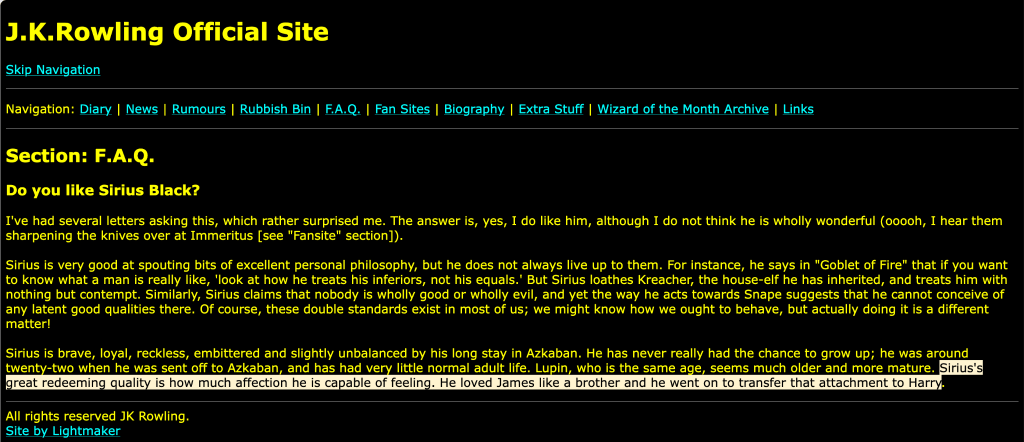
In the Watsonian perspective, that Snape switched to Lily’s side out of love for her is literally a virtue. (That’s not counting the fact that Lily is treated as the Virgin Mary and that loving her is thus a virtue in itself… anyway.)
What about the Doylist perspective?
Well, oftentimes, what makes you start to break off from a cult is often not based upon a question of Good vs Bad. You can be afraid for your life, or someone else’s. You can realize something’s off about all this. You can find the things you hate the most in the very people who teach you the others have them. There are plenty of real-life examples of people who break from a radicalized group and/or cult and by no means would I call those reasons invalid.
It’s not realistic at all to expect everyone to break away from a hate group / cult because they are driven by noble morals and because they want to fight for the “right” reasons, from the very beginning of their salvation. A cult poisons everything in you that could put a resistance to it. It corrupts your morals in a way that sustains the cult and defends its ideology. You might come to have the greatest conviction that you are doing the right thing! At this moment, it can become impossible to see if following the cult is truly a good idea, to even realize if you are in a dangerous cult, if you need to get out of this… and let alone if it’s worth the risk. To require that everyone magically knows they’re doing the wrong thing before they leave a cult is unrealistic and frankly dangerous.
Finally, as the Jew political student I cited said:
Yes, we’re all responsible for our own choices. But it isn’t as simple as that. Sometimes we aren’t strong enough to choose what is right over what is easy, so we make bad choices. Sometimes, our true character is revealed not through our good choices, but how we handle our bad ones.
And the fact that so many people can’t wrap their heads around this, to me, is just scary.
So, that loving Lily was Snape’s rope to goodness, wasn’t a bad thing at all. I mean, for heaven’s sake, would you say Lily saved Harry for the wrong reasons – “just because she loved her own son”?
pet_genius again:
He joined the Death Eaters for very powerful reasons, and left them for a very weak reason, in terms of benefit to his own self. And yet he remained faithful to the good side after the failure of his original goal (saving Lily) and very much against his own interest, for nearly his entire adult life. His sacrifices for the good side were innumerable.
Three: “Snape switched sides after Lily died” is so blatantly incorrect that a single quote debunks it:
“I have given evidence already on this matter, ” he said calmly. “Severus Snape was indeed a Death Eater. However, he rejoined our side before Lord Voldemort’s downfall and turned spy for us, at great personal risk. He is now no more a Death Eater than I am.”
I could add:
“Hide them all, then, ” he croaked. “Keep her — them — safe. Please. ”
“And what will you give me in return, Severus?”
“In — in return?” Snape gaped at Dumbledore, and Harry expected him to protest, but after a long moment he said, “Anything. ”
Can’t keep a dead person safe from death, I reckon. Even the movie got it right.
Speaking of Lily…
The Power of Love
« Snape only changed because of Lily »
This accusation is not just irrelevant, it is deeply untrue:
- By the same rhetoric, we could defend Snape becoming a Death Eater because of his father, the Marauders, Dumbledore, Lucius, his Slytherin peers and Voldemort, as we have seen above.
There were undoubtedly many external factors that led him to this path. Even Rowling seems to implicitly cast James as the reason Snape became a Death Eater and a mean teacher:
“James could certainly have been kinder to this boy who was a bit of an outcast. And he wasn’t. And these actions have consequences. And we know what they were.”
Dumbledore reflects that idea: « some wounds run too deep for the healing » (OotP).
In fact, Rowling even argues that Snape became a Death Eater because of Lily, because he loved her:
He wanted Lily and he wanted Mulciber too. He never really understood Lily’s aversion; he was so blinded by his attraction to the dark side he thought she would find him impressive if he became a real Death Eater.«
But evidently, while antis discredit Snape’s heroic feats on account of « being forced » by Dumbledore or Lily, they refuse this line of logic when it’s taken the other way around. In fact, some blind themselves to any influence that the Marauders, for instance, had in the making of Death Eater Snape, which… they obviously had? That’s often how radicalization works ya know? But nevermind, antis do have a point: ultimately, it was Snape’s choice to become a Death Eater. (If we’re assuming he wasn’t blackmailed or something, which could totally have happened, but we have no proof of that.)
- Which leads to the core point: the importance of agency in Snape’s character arc. Just as it was Snape’s choice to join the Death Eaters, it ultimately remained Snape’s choice to defect.
Lily didn’t force Snape to do anything, HE chose to act upon that commitment. HE is the reason he was redeemed.
Snape decided that Lily mattered more than whatever he hoped for or believed in as a Death Eater, including his own life. He chose to ask Voldemort to spare Lily even though it was suicidal. He chose to meet Dumbledore and tell him to hide her, regardless that he expected to be killed on sight and that it put him in a vulnerable position; because at this point, Voldemort could kill him for betrayal. Snape chose, on his own, to offer, not just his services in the protection of the Potters, but « Anything« ; and though Dumbledore certainly manipulated the conversation, it is undeniable that Snape was being genuine when he offered « anything » to save Lily and her family. He decided that he would protect Lily and James’ son, decided so once more every time he had to intervene for Harry’s sake. All of what he did later, for his students, for the war, for Lily–all of them were testaments of his own choices and his own commitment.
- Snape changing cannot be explained by Dumbledore forcing him, because every time Dumbledore offers him a choice, and every time Snape decides to stay at his side.
- Snape was not « carried on » by his love for Lily either; it was a guide, but ultimately, it was up to him to choose to do the right thing and make the effort. He made that love matter.
Look at what happens when someone loves James and Lily but doesn’t make the effort to honor them: Lupin, unwilling to sacrifice a bit of Dumbledore’s initial trust in him, regardless that his refusal to act, his silence, in enablement, put Harry in mortal peril. Loving someone is no guarantee, at all, that you will do the right thing, as it is insufficient to drive someone to make the right decisions. (Re: the essays on Reveal of a Secret.)
- That leads me to another point: Snape’s actions had way more to do than with Lily.
He didn’t just save Harry. He saved all those he could: “Lately, only those whom I could not save.”
He valued human life, and not just Harry’s or Lily’s, because he ultimately went against Lily’s sacrifice as he sent Harry to his death (who would have died anyway because of the Horcrux inside him) so the world could be saved. Severus grew enough that his moral compass was independent from what Lily personally wanted, sending Harry to his death, definitely damning himself in Lily’s eyes – an idea shared by Aberforth that if Dumbledore truly loved Harry then he’d have sent him to the other end of the Earth. To protect Harry, Lily said:
“I’ll do anything –”
and Snape went against that… textually beating Lily in the question of who’s morally better. (Although that’s not something I’d hold against her.)
This idea that Snape grew his own moral compass was reused and made explicit in Cursed Child:
One person. All it takes is one person. I couldn’t save Harry for Lily. So now I give my allegiance to the cause she believed in.
Judging by his actions, Snape believed in this cause long before that. It just took him years to realize it.
Again, Snape is the one who, at some point during his growth, decided that the cause Lily believed in, Dumbledore’s side, mattered more than her and what she died for. Which is why he says:
And it’s possible — that along the way I started believing in it myself.
- This last point refutes another criticism against Snape: « He didn’t do it for the right reasons ».
At which point is wanting to save everyone a bad reason to redeem oneself? At which point is believing in love a bad motive at all?
Here’s another way to put it.
In Frieren: Beyond Journey’s End, the great demon Aura is surprised that Frieren wastes her mana cancelling Auserlese, Aura’s obedience spell, on the decapitated heroes that try to kill Frieren. Aura remarks that she didn’t do that the last time they met, just shooting the soldiers left and right. Frieren answers that she changed because Himmel scolded her about it.
Aura: « Then that’s all the more reason not to do this. »
Frieren: « Why? »
Aura: « Himmel is long gone, isn’t he? »
Frieren freezes (yes, that was a pun), then says: « I see. You demons are monsters after all. I can kill you without mercy. »
Did Frieren change but “not for the right reasons »? This scene precisely disproves it. As Aura says, Himmel was dead for 28 years at this point, so there was no practical reason for Frieren to keep the fallen heroes’ honor and their corpses unharmed, at the cost of her mana and (in Aura’s point of view anyway) at a risk to her life. Frieren did, because Himmel changed her; because she believed in him and decided to follow his example. That’s what opposes Great Mage Frieren and Great Demon Aura.
Demons are, by nature, incapable of love, redemption or morality. Aura the Guillotine is one of the Seven Sages of Destruction, a 500 years-old Greater Demon, a monster, who would never do something in the name of love, because by definition, love is absent in demons. Frieren cares because true love doesn’t cease to exist when the other is dead.
For Snape, it’s the same. Lily was long gone. If he was heartless and selfish, he wouldn’t have cared to be a good person for a dead woman who rejected him. But he does care, because Lily loved him and he loved her, loved her years after they parted ways, so much that it changed him. The Doe Patronus, radiating the feeling of safety, serves as a powerful symbol of that profound, radical change.
That’s why the reveal of Snape’s true allegiances was a huge flex on Voldemort. Voldemort thought that Snape only desired Lily because that’s the only thing he could understand as a motive to keep her alive; he was fooled all along because Snape actually loved Lily and worked against him the second he dared threatening her. In terms of parallels in this scene, Voldemort is Aura, Lily is Himmel and Severus is Frieren. (Hell, Frieren and Snape even share the theme of concealing a key part of themselves to deceive monsters and bring them to their fall. Only, Frieren personally hunts and kills demons, while Snape never directly kills anyone safe Dumbledore.)
I once saw a comment that said:
« Good redemption arcs are not motivated by romance, because then the REAL motivation is to be in a relationship ».
This is exactly the problem of… James Potter’s supposed « maturing », a character whose fans openly praise the fact he changed for Lily. It becomes even more ironic when it’s revealed by Sirius and Lupin that it was all just a big fat lie, which only seems to be confirmed in Pottermore and the semi-official Prequel. The same fans who keep arguing that Snape’s redemption is invalidated because he changed « just because of Lily » praise the exact same romantic trope when applied to James Potter; a solid case of double-standards.
More ironic is that this problem doesn’t apply to Snape because:
- It’s not confirmed whether his feelings were romantic (like Ron/Hermione) or rather platonic (like Harry/Hermione). He never asked Lily out. What truly mattered was that, as Snape said and Lily confirmed, they were best friends. If anything, the fact his Patronus is female like Lily’s indicates that his love was not sexually-driven but sister-like, as a doe cannot mate another doe (as far as I know).
- Being in a friendly relationship with Lily was not enough to « change him », and he eventually left her alone when she ended their friendship. He was rather interested in Dark Arts, Mulciber and Lucius, so it seems he wasn’t that interested in a deeper relationship with her, as long as she stayed alive.
- She was married to James Potter and had a child with him, not Snape. And yet, he quickly decided to protect all the family with his life even if it seemed hopeless. [see The Self-Fulfilling Prophecy for those who want to argue that Snape wanted Harry and James dead: it’s not that simple]
- Lily was dead for the following 16 years of his service as an undercover agent, so all hopes for a romantic relationship were gone if he had any, and yet he kept on fighting.
- And in case you still think Snape wanted some ghost pussy, he calls his ex-best friend « Lily Potter », openly acknowledging her (poor) choice of a husband, so he clearly wasn’t interested in any competition on whoever would get to fuck her: “Everything was supposed to be to keep Lily Potter’s son safe.”
On the other hand…
Snape’s love for Lily isn’t really what redeems him, nor is love a requirement for his redemption arc
« Snape only cared about Lily.” “Actually Snape didn’t truly care about Lily.” “Snape didn’t care about Harry. »
Now isn’t that so contradictory.
“But this is touching, Severus,” said Dumbledore seriously. « Have you grown to care for the boy, after all?”
“For him?” shouted Snape. “Expecto Patronum!”
You might be surprised to learn that Snape swiftly avoided a moral trick.
What if he had answered: « Well yes, I do care (affectionately) for Harry after all »? What happened the last time it was said that Snape wanted to protect someone out of love? Oh yeah, that he was selfish. That the only reason he cares at all if someone lives or not is because he feels personal affection for them; that if Snape didn’t love them, then he wouldn’t mind them dying! (Mind you, Snape is the only one who’s insulted for trying to save someone’s life because he loves them, even though that’s normally something to be praised. See again: The Self-Fulfilling Prophecy.)
Had Snape said that he did love Harry after all, antis would have argued that between the Hilltop scene and the Horcrux-Harry drama 17 years later, Snape never changed.
But he swiftly avoided that « gotcha » moment by answering that he didn’t care for Harry – or, more precisely, did not love him. Since his indignation at knowing that Harry was raised like a pig for slaughter cannot be explained by Snape loving Harry (in fact, the very notion upsets him), we have to dig deeper than that: Snape may not care for Harry affectionately, but he does care for that boy’s welfare and whether he can outlive the war. Regardless of whether he loves Harry personally or not, he is outraged to learn that a boy, the boy Lily died for, was raised as a tool for war and a sacrificial lamb by the man who could not manage to fulfill his part of the contract, failing to save Lily’s life just like Snape.
But before he could finish this jinx, excruciating pain hit Harry; he keeled over in the grass. Someone was screaming, he would surely die of this agony, Snape was going to torture him to death or madness —
“No!” roared Snape’s voice and the pain stopped as suddenly as it had started; Harry lay curled on the dark grass, clutching his wand and panting; somewhere overhead Snape was shouting, “Have you forgotten our orders? Potter belongs to the Dark Lord — we are to leave him! Go! Go!”
Sure you don’t care about Harry, Severus… Look how instant and visceral his reaction is when a Death Eater starts Crucio’ing him. That’s not something you fake without a split second of hesitation or indifference if Snape was telling the truth.
This is consistent with the fact that Snape tries to save as many people as he can, which he illustrates by attempting to save Lupin from a Death Eater. Snape didn’t personally love each person he saved, he even loathed some of them, but he did it nonetheless. Because it was the right thing to do.
Now Harry was flying alongside Snape on a broomstick through a clear dark night: He was accompanied by other hooded Death Eaters, and ahead were Lupin and a Harry who was really George… A Death Eater moved ahead of Snape and raised his wand, pointing it directly at Lupin’s back —
“Sectumsempra!” shouted Snape.
But the spell, intended for the Death Eater’s wand hand, missed and hit George instead —
Loving Harry wouldn’t have redeemed Snape, because Harry is not god. Similarly, loving Lily doesn’t redeem anyone (James included) because Lily is not the Virgin Mary nor the goddess of virtue or anything, however much Rowling wants to pretend she is.
That is why the fact Snape said that he didn’t affectionately care for Harry, and even hated him, is not a flaw. It does not invalidate his redemption arc and his growth at all.
In fact, it proves the contrary.
Doing the right thing regardless if he loves someone or not gives Severus Snape a unique strength in HP: he is not limited by a lack of love (would Sirius protect Draco or a random Slytherin?), and he is not limited solely by love itself either (like Lily and Dumbledore were). This quality is reflected in Harry who, if you remember, took the same decision as Snape regarding who they believed to have betrayed Lily: do not kill them, but deliver them to the Aurors.
If you want to know what a man’s like, take a good look at how he treats his inferiors, not his equals.”
You got it Sirius (you hypocrite).
A Revengeful Anti-Hero?
“Snape just did it for revenge”.
Another reason, it seems, to discredit him, because then his redemption arc would be motivated by selfishness and not because he believed in morality.
Again, it isn’t really fair, because in HP revenge against evilness is celebrated:
[…] and yet, Harry, despite your privileged insight into Voldemort’s world (which, incidentally, is a gift any Death Eater would kill to have), you have never been seduced by the Dark Arts, never, even for a second, shown the slightest desire to become one of Voldemort’s followers!”
“Of course I haven’t!” said Harry indignantly. “He killed my mum and dad!”
“You are protected, in short, by your ability to love!” said Dumbledore loudly. “[…] In spite of all the temptation you have endured, all the suffering, you remain pure of heart, just as pure as you were at the age of eleven, when you stared into a mirror that reflected your heart’s desire, and it showed you only the way to thwart Lord Voldemort, and not immortality or riches. […]”
“But, sir,” said Harry, making valiant efforts not to sound argumentative, “it all comes to the same thing, doesn’t it? I’ve got to try and kill him, or — ”
“Got to?” said Dumbledore. “Of course you’ve got to! But not because of the prophecy! Because you, yourself, will never rest until you’ve tried! We both know it! […]”
Fifteen year-old Harry is envisioning to kill someone out of revenge. Yes, it’s Voldemort. Yes, Voldemort killed his parents. But it’s still killing someone. Would you be able to kill someone? Would you be able to kill even your worst enemy? Take a moment and think. Can you imagine yourself raising a gun to someone’s head and pulling the trigger?
The Avada takes a special mindset to be accomplished. It takes guts. It took enormous suffering and exposition to violence for someone like Harry to achieve a Crucio… that he performed out of revenge for McGonagall:
“I see what Bellatrix meant, ” said Harry, the blood thundering through his brain, “you need to really mean it.” […]
“Potter, that was foolish!”
“He spat at you, ”said Harry.
“Potter, I — that was very — very gallant of you — but don’t you realize — ?”
Surprisingly, McGonagall praises Harry for Crucio’ing a Death Eater just because he spat at her. Would you be able to torture someone just because they spat at someone you love?
I may not be fair with Harry: it is karmic for Amycus Carrow, the Dark Arts teacher who forced students to try Crucio on each other, to be Crucio’ed himself. But Amnesty International wouldn’t be happy, and it is still disturbing how violent Harry is at such a young age.
It’s not really the subject here – and I do not want to brand Harry as a bad person for what he did there, he too is much more complex than that. What I mean is: revenge is totally a good reason to want to defeat Voldemort in the books.
Revenge is also a good motive for non-HP characters, although it often is attributed to anti-heroes. For example, Urbosa from TLoZ:BotW wants to avenge her own death, her friends’ death, the fall of Hyrule and the reputation of the Gerudo by nuking Ganon with Divine Beast Vah Naboris.
What about real-life? Well, everyone has their own idea whether or not revenge is a valid motive for redemption, although technically, if we take redemption to its most puritan religious form, revenge is condemnable.
However, the line between revenge and justice is thin. And this is very relevant for Snape’s character.
There isn’t a single quote that indicates Snape is motivated by revenge against Voldemort. We know for sure that he is motivated by love; take the movies’ quote, for a change (though we’re not counting the movies as canon here):
“If you truly loved her…” [Dumbledore, DH part 2]
I often think that Snape bullied Harry as revenge against his father James, but there’s not even a quote for that. There is a quote, however, for whom he believed to have betrayed the Potters and gotten Lily killed, Sirius (and Lupin):
“Vengeance is very sweet, ” Snape breathed at Black. “How I hoped I would be the one to catch you… ”
Justice here would have required Snape to want to catch Sirius Black because he’s a criminal. Here, Snape wants to catch Sirius because it’s personal: Sirius Black, to his knowledge, has killed his ex- best friend Lily after fooling everyone for a year as Voldemort’s faithful spy.
But he doesn’t kill Sirius Black by his own hands, even if he’s got plenty of reasons by now. Instead, he wants to deliver him to the justice system of the magical world: the Minister and his Aurors. Snape’s desire for revenge, here, does not let him stray from his professorial and military duty: unlike Sirius who twice tried to kill Pettigrew by his own hands, Severus follows the law.
If Snape was primarily or solely motivated by revenge, then why didn’t he kill Sirius personally, send him to a Dementor by himself, or at least torture him before delivering him to the Minister, when Sirius was unconscious and defenseless by the lake? Sirius was wanted alive or dead, remember? Why put him on a stretcher, when Sirius certainly did not bother doing that for Snape?
And what when Snape realizes Pettigrew’s the traitor? Sure, Snape treats him like garbage and reduces him to the role of a bound House Elf, and he’s a master of espionage so he could hide his hatred perfectly, but if he was meant to be understood as a character led by revenge like Sirius, then why is there no mention of Snape swearing he will get Pettigrew’s head or something?
Actions speak louder than words: revenge may have been part of his motive here, but in the end, his belief in justice took over. Which is surprising given that the justice system has failed him so many times. Amnesty International would be half-proud. Half because technically Severus is delivering a criminal to fates worse than death; but what were his other options? kill Sirius Black by his own hands and discovering only later that he was in fact innocent regarding the Potters’ death? or let an alleged criminal escape?
Here’s an essay going in a bit more detail and presenting Snape as « lawful-neutral to his own detriment »: https://www.tumblr.com/the-witches-son/183015921022/something-endearing-about-snape
Two more pieces of evidence that Snape was meant to be a justice character is Rowling’s drawing describing Snape as “brooding on the unfairness of life” and the OotP movie’s Snape snarling that “life isn’t fair”, obviously disgusted by this fact: https://youtu.be/BWET244zbu0?si=OolrEp–_Clvi94g&t=72
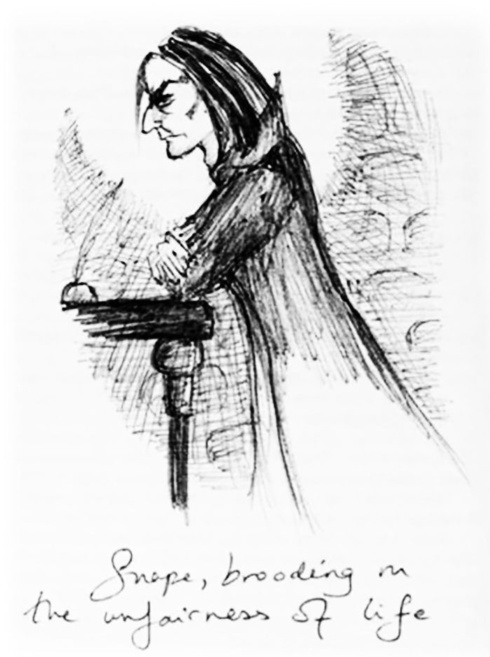
He’s a character who fights for life to be more fair, having suffered from injustice himself ever since he was born. Fighting for justice is a typical trait of a true hero.
I once asked anti-Snape fans why they thought that revenge against Voldemort was a bad motive, and for some it was made clear that the motive of revenge by itself was not a bad thing. Rather, they despise Snape on the belief that it is his sole motivation, one they argue is selfish; I mean, yeah, antis had to come up with a reason to explain why Snape would save people left and right, fight against Voldemort until it got him killed if he’s evil in everything he does.
Coming back to our argument that Snape is primarily motivated by love and justice, Harry’s explanation for Snape’s defection goes against the idea that Snape’s leading motive was revenge, and that is our next point:
- Snape switching sides and becoming Dumbledore’s spy cannot be explained away by him wanting to avenge Lily since she wasn’t dead yet when he defected. There was nothing to avenge.
“Of course he told you that, ” said Harry, “but he was Dumbledore’s spy from the moment you threatened her, and he’s been working against you ever since! Dumbledore was already dying when Snape finished him!”
After Lily dies, Snape’s first motive to keep on fighting is to protect her son for when the Dark Lord rises once more, so that her death won’t be in vain. Again, not vengeance. Harry makes it clear that the « fil rouge » in Snape’s story arc, from childhood to death, was rather love.
- Revenge doesn’t explain everything Snape does, and it somewhat goes against his character.
It does not explain protecting Harry. It does not explain Snape getting upset that a student is killed by the Slytherin monster, his indignation that Harry was « raised like a pig for slaughter », or « Only those whom I could not save. » It goes against him sparing and later protecting Sirius Black and Remus Lupin, who are, as a reminder, his personal enemies, and did not make much of a difference in the war, so he could have afforded to let them be killed if he’d wanted it. (Sirius stayed at his mom’s house, Lupin failed to spy on werewolves in an attempt to make them join Dumbledore.)
- Even if you make a case of Snape being a vengeful hero, it does not strip him of the quality of being a repentant hero as well. Revenge does not invalidate Snape’s other motives to do good. And he is certainly not evil for wanting to avenge the death of Lily Potter by taking on the Dark Lord himself.
Here’s an extract from « Snape, Sirius and Revenge » by tumblr user merlosaurusunactive that sums it all up:
Sirius is a vengeful hero, driven by righteous anger. A cunning and vindictive Gryffindor. His greatest weakness is recklessness.
Snape is a repentant hero, driven by remorse. A brave and self-sacrificing Slytherin. His greatest weakness is pettiness.
This is a really important difference. Sirius’ story is about revenge. His thirst for justice gives him the strength to escape prison. You can argue that his primary motivator is revenge on James’ murderers. Meanwhile his bravery, in the form of reckless hubris, is the fatal flaw that propels him through the Veil.
In perfect contrast, Snape’s bravery is his saving grace. HOWEVER, in Snape’s narrative, vengefulness is misdirected and childish. He bullies Harry. He taunts Sirius. He outs Remus. Even his perfectly justified revenge on Wormtail becomes petty because all he can do is make Wormtail clean his house.
[…]
The night the Potters died, we know the immediate reactions of both men. Sirius goes after Wormtail. His destructive energy is turned outward. Snape says, “I wish I were dead.” His destructive energy is turned inward. (Snape-haters might argue that he’s just being a whiny baby, but this is Snape. When JKR writes his dialogue, it’s always loaded and important. We can assume he means it.) If he was a wholly vengeful character, he would be going after Sirius–whom he already hated and now thinks was the traitor. But even as Dumbledore’s tells him about the betrayal, Snape will not be distracted from his self-destructive grief.
That night both Sirius and Snape were seized with hatred for the man they saw as responsible for the Potters’ deaths. Sirius wants to kill Pettigrew. Snape wants to kill himself.
Dumbledore sees this. He turns Sirius’ anger toward the cause. He uses Snape’s guilt in the same way. You’re obligated to live to make up for what you did. And this is why Snape can’t be a vengeful hero. He may want revenge, he may be just as angry as Sirius is–but this is just another similarity that highlights their differences. Vengeance is not at Snape’s core. The reason he does all that he does for Dumbledore is guilt. It’s a story of redemption, not revenge.
Snape changed, deeply
Switching sides because you believe in a particular set of moral rules isn’t, in my opinion, virtuous by itself. Everyone has their own idea of morality, and these ideas of what is moral or not often are in conflict with each other. So which kind of morality is to be taken as a reference if we want to judge Snape? I believe morality is not only subjective but also a human concept and not a rule of nature, not something that objectively exists. The only morality that “exists” is the one that humans create by shaping their own actions around it. In that sense, judging Snape’s redemption arc is kind of irrelevant; judging his moral compass based on your own idea of morality is pointless, especially given that it will inevitably bump into someone else’s idea of morality. What we are discussing, then, is not so much morality or redemption but Snape’s actions, whether he did good or not. After all: actions speak louder than words. So, what did he do that would warrant, for some of you, the title of “redeemed character”/”good person”?
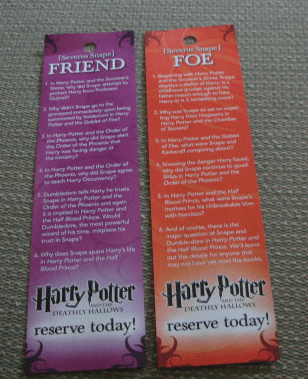
Some have argued that the HP books are laid like a detective intrigue. It seemed to have been the case when it regarded Snape, because Rowling wanted her readers to wonder until the end whether or not he was working for the good or the bad side. Snaters argue that all along, Snape was a thoroughly evil man, and the chapter of the Prince’s Tale was a last-second attempt to turn him into a good guy, out of the blue and for no reason… but that’s not what happened. In-universe, characters keep questioning Snape’s true loyalties, with some of them firmly believing he was working for Dumbledore and others thinking that was all an act – each with their own arguments to explain why. Not even the Trio was set on the question. For years, HP forums were full of discussions on where Snape’s true loyalties lay, to the point that bookmarks and stickers were sold on whether you believed that Snape was a traitor or a good guy after all, before the final reveal:
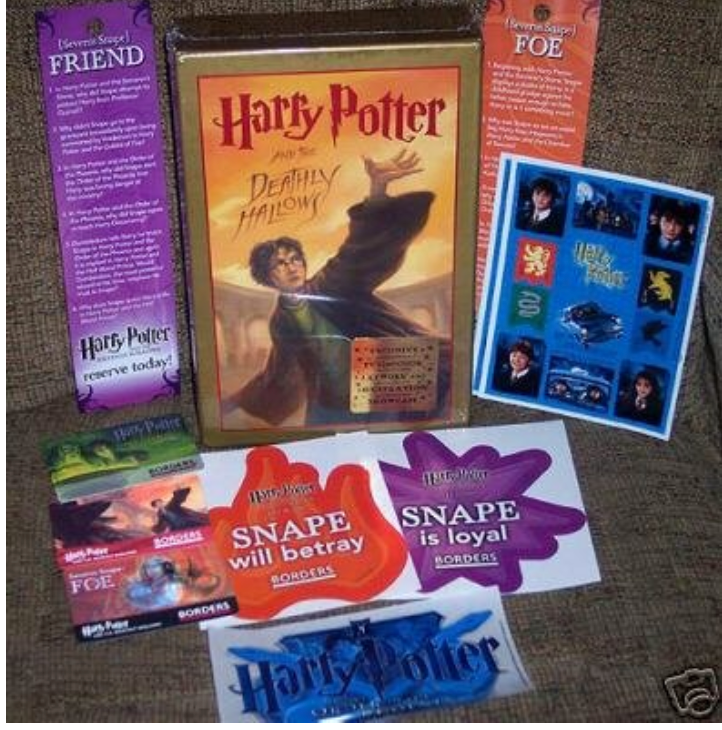
There wouldn’t have been such heated debate if everything so far indicated that Snape was just an evil man. There wouldn’t have been so many people feeling betrayed when Snape killed Dumbledore in HBP. What happened is that clues were laid throughout all the books, some indicating he was an evil traitor, some showing he was a hero; some that could be used to argue Snape merely pretended to have had a change of heart, others that could prove he was pretending to be a bad guy so he could work for the Light side as an undercover agent. A side was chosen: it turned out that Snape was a quadruple agent who had (almost) always worked for the right cause, until he died for it. The Prince’s Tale was not so much a redemption chapter… as it was a revelation chapter. It doesn’t contain all of his redemption arc on its own. It gives us the final answer, that finally explains to the reader how to re-interpret everything that Snape did throughout the books.
All of this to say: you cannot pretend that Snape’s “sole redeeming action” is contained within the Prince’s Tale while all the rest indicates that he was evil, because that’s simply untrue. Let’s have a look at all the heroic things he did, including before the Prince’s Tale.
Extraordinary Heroism
It turns out we already have listed them, haven’t we? I’ll just re-use an extract from the essay “Snape as a Hogwarts Teacher”:
Safety is Snape’s top priority, as should be any teacher’s.
- He stops Ron from hitting Draco (calm compared to McGonagall’s OotP outburst against Harry and George);
- Discourages Lockhart from making Neville duel his peers on the fear he might seriously hurt them or himself (with prior evidence of Neville hurting himself and his classmates by accident);
- Upon hearing that a student had been taken into the Chamber [Ginny], he was so distressed that he had to grab a chair « very hard » to endure the news (even though his Slytherins alone were not in danger)
- he’s the one who nags Lupin to drink his potion, and not the other way around;
- In an attempt to save the Trio, he runs to face an alleged mind-wrapped mass-murdering Death Eater and his werewolf accomplice on the verge of transformation, in the same place he was almost murdered in as a teen by the same individuals;
- When the egg opens in GOF, he runs toward the sound of someone screaming as though they’re being tortured in the middle of the night;
- The next year, he interrupts the Occlumency lesson the moment he hears a girl or a woman screaming above his office then runs to her help when it happens again (it’s Trelawney getting fired);
- The next year again, he runs toward Myrtle’s cries of a murder, not knowing who was hurt or how and what danger he might face there;
- Runs towards Myrtle’s cries that someone has been murdered in the school, which enabled him to save Draco from Harry’s messy Sectumsempra;
- he supplies Umbridge with fake Veritaserum (which saved Harry, Sirius, and probably lots of other students);
- Orders Harry to release Neville when he thinks Ron and Harry are fighting him;
- saves Neville from being choked by Crabbe, antagonising Umbridge further even though she’d just put him on probation;
- Upon hearing that Montague finally reappeared from limbo into a toilet bowl, he leaves Harry to attend to the student (wrongly trusting him not to peer into his Pensieve and leave as he was told);
- he agrees with Dumbledore to kill him in an attempt to spare Draco’s soul;
- Makes an unbreakable vow to protect Draco, and keeps it (mind you: he never had to make a vow of suicide if he failed, he’d already agreed to protect Draco as much as he could, but I guess it wasn’t enough for him, he had to promise death to himself if he failed his mission of protecting Draco);
- Steers Hermione and Luna out of harm’s way before the Astronomy Tower battle against the DEs;
- And he is the one Dumbledore assigned to keep students safe during DH. Snape did not have to stay at Hogwarts at that point, both of them knew Harry wouldn’t be attending next year, so this had nothing to do with the original mission, Dumbledore just trusted him that much, and rightly so – nobody is reported to have died during Snape’s year as headmaster, even though it was being run by Death Eaters at the peak of Voldemort’s overtaking of the British Wizarding World, which is more than can be said for Dumbledore or his predecessor. Within this, he sent the Silver Trio to Hagrid as a form of « punishment » for trying to steal the sword, risking cover to spare them a session of torture.
Only in one of these cases is Harry even in the picture (that Snape knows of before springing into action). In one case, he leaves Harry to go see what’s going on. We could also mention that Snape:
- is the only teacher who bothers to try and save Harry from a jinxed broom in first year, becoming referee in the second match to prevent Harry from further harm despite the humiliation it must have represented, and despite the fact he’s not at ease with flying on a broomstick;
- Keeps an eye on Harry all throughout the year to protect him from Quirrell; for that matter, made a direct confrontation with Quirrell to discourage him from attempting anything funny (we as a reader know the danger Snape has put himself in because Voldemort was listening and watching everything he did, and Snape had to answer to all that bullshit in GoF when Voldemort reincarnated);
- he attempts to teach Harry Occlumency to shield him from Voldemort’s mind assaults despite the danger it represents since Voldemort can spy on him through Harry’s eyes;
- sends a rescue party for Harry and his friends at the Ministry while he searches for the group in the Forbidden Forest for hours in case they’re still there;
- After killing Dumbledore, Harry tries to curse Snape, including an attempt at Crucio, yet Snape risks breaking cover to spare Harry pain. And his reaction is visceral:
- “No!” roared Snape’s voice and the pain stopped as suddenly as it had started […]
- Guides Harry to the Sword of Gryffindor to help him in the fight against Voldemort – you might say that this is just his job as a spy, and it’s true, but isn’t he spying in the goal of saving as many people as he can, especially Harry, and taking down the threat that Voldemort represents against his students and colleagues? I’d say it accounts for something.
We could include multiple instances of Snape saving students at little risk to himself or to his cover by brewing Potions or using his Dark Arts expertise:
- he prepares the Mandrake Restorative Draught to cure the Petrified (imagine Snape spraying Sir Nicolas with the draught);
- He’s the one who taught students the disarming spell Expelliarmus when it became evident they were learning nothing of use in Defence class (Harry gives credit to Professor Snape when he and Ron protect themselves from Lockhart’s first attempted Obliviate); it’ll become Harry’s signature spell;
- In an elegant demonstration of Slytherin pride, he advises Draco to use Serpentsortia. This prevented Harry from getting harmed with Expelliarmus, Rictusempra or another offensive spell without any option to protect himself (thanks to Lockhart’s incompetence). Snape immediately walks over to vanish the snake. If Harry hadn’t shown he could speak in Parselmouth, Snape might have advised Draco to use Protego when it was Harry’s turn to attack, which Draco would have done loudly, indirectly teaching everyone in the room how to use the Shielding Charm (which would have definitely helped the Trio in their upcoming adventures). In one unofficial lesson, Snape would have taught all the students – notably Harry – how to protect oneself, and how to disarm the opponent;
- he’s likely the one who had to brew the “ten different potions” meant to heal Hermione after she got hit by Dolohov’s Dark curse, as well as the Skele-Gro that healed Harry’s arm, just as he brewed the Mandrake Restorative Draught on the reason that he was “the Potions Master at this school” ;
- He saves Katie Bell from Draco’s cursed necklace (where Pomfrey would have failed).
Does saving staff members count? Because if so:
- he stuns Flitwick in DH to hide him from the Death Eaters that are flooding the castle in HBP;
[“I was so stupid, Harry!” said Hermione in a high-pitched whisper. “He said Professor Flitwick had collapsed and that we should go and take care of him while he — while he went to help fight the Death Eaters — ” She covered her face in shame and continued to talk into her fingers, so that her voice was muffled. “We went into his office to see if we could help Professor Flitwick and found him unconscious on the floor… and oh, it’s so obvious now, Snape must have Stupefied Flitwick, but we didn’t realize, Harry, we didn’t realize, we just let Snape go!”]
- he saves the Headmaster from an early death by the Horcrux and later, spares him a painful death at his demand (Dumbledore repeatedly asks Harry to fetch Snape after he is gravely poisoned by the Drink of Despair: perhaps he trusted Snape to heal him, perhaps he trusted Snape to euthanize him in dignity).
Here is Harry describing the feeling that Snape’s Patronus gave off:
“Her presence had meant safety.”
Indeed.
But also:
- 31. Snape tries to save people who have fallen into the claws of the Death Eaters. He protected and guided his Slytherins. The results are amazing. Under Slughorn’s tenure, countless Death Eaters were born: Bellatrix, Lucius, Mulciber, Avery, Rosier, Regulus, Crabbe and Goyle Sr, Amycus and Alecto, Barty Crouch Jr, Severus… Voldemort himself. Under Severus Snape, only three Slytherins are confirmed Death Eaters: Vincent Crabbe, who killed himself with his own Fiendfyre, Gregory Goyle, who became harmless, and Draco Malfoy, who after failing to kill Dumbledore on his own, remains pretty harmless for the rest of the series, and is allowed to become neutral or even good after the war is over. This happened because Snape made his Slytherins feel loved and taken care of, so they wouldn’t feel the need to find protection amongst the wrong group (remember how Dumbledore explained that many joined Voldemort for protection, out of fear, not just to be bullies). And in that case, Snape’s “favoritism” of Slytherin House, if it indeed can be called favoritism fairly, served a greater purpose that saved lives. His whole life was dedicated to a world where everyone would get free from that poisonous group, including the “bad guys”, whom he wanted to be redeemed.
- 32. Speaking of Draco, we can safely say that his Head of House, Professor Snape, saved him from that cult. He swore an Unbreakable Vow to Draco’s mother. He never had to take an Unbreakable Vow to save Draco’s soul, he already had planned to protect him with Dumbledore; but against all the rules of self-preservation, and likely against what Dumbledore would recommend, Snape shows that he offers himself no chance to fail this mission, and he says, in the most literal sense: “I will save that boy or I will die trying.” He protected Draco from being murdered by Voldemort, and he also preserved his innocence. He saved Katie Bell from the necklace Draco had cursed, allowing Draco not to become a murderer. Later, Snape took the risk of mangling his own soul, and committed what was likely his first kill, so Draco wouldn’t have to break his own.
And that is just Snape’s good deeds as a teacher. As a spy:
- The mere fact that he requested that Lily be spared allowed Voldemort to give her the choice to sacrifice herself for Harry; if he hadn’t done that, Lily would have had no choice but to die, and Harry would never have obtained sacrificial protection; Harry would be dead, and unless a miracle occurred, Voldemort would have won the war long ago;
- Snape protected Sirius hidden in Grimmauld Place by giving Umbridge fake Veritaserum (an act of resistance);
- Snape protected Lupin during the Battle of the 7 Potters, although he missed it a bit by cutting off George’s ear, the intention and the deed were there;
- The mere fact that Snape worked for the Order made him a war hero who made Harry’s camp win. Among his key actions:
- he conveyed the idea of using Polyjuice Potion for the Battle of the 7 Potters,
- he relegated the Gryffindor sword that would be used to destroy the Horcrux,
- he gave crucial information for Harry to win the war (even if it required him to die);
- Snape didn’t just die, death itself doesn’t make you a hero, but he died for war, on a mission. His death is subliminal to say that he was so far down the road to redemption, so sincere when he said he would do anything to save Lily — and in a sense repent — that he actually gave his own life for the purpose of saving the world even after she died.
- Oh, and you must know how much I love those lines by now:
“Don’t be shocked, Severus. How many men and women have you watched die?”
“Lately, only those whom I could not save,” said Snape.
Snape saved everyone he could.
I think… that is to commend him for his war efforts. “Always” is beautiful, but this is epic. Yes, I’ll make you remember it. Dumbledore himself says it: Snape is shocked that Harry has to die after all. He genuinely wanted him to survive the war.
In fact, that doesn’t just apply to Harry; as we said, it once applied to whichever student had been taken to the Chamber of Secrets, knowing that Slytherins would be spared (and not knowing it was Ginny):
“It has happened,” she told the silent staffroom. “A student has been taken by the monster. Right into the Chamber itself.”
Professor Flitwick let out a squeal. Professor Sprout clapped her hands over her mouth. Snape gripped the back of a chair very hard and said, “How can you be sure?”
Dumbledore once asks Snape whether he is tempted to join Voldemort if he resurrects:
“I am not such a coward.”
Damn right. And Harry approves:
“Albus Severus, ” Harry said quietly, so that nobody but Ginny could hear, and she was tactful enough to pretend to be waving to Rose, who was now on the train, “you were named for two headmasters of Hogwarts. One of them was a Slytherin and he was probably the bravest man I ever knew. ”
(Out of canon, Rowling says Harry would ensure Snape’s portrait was placed among all the other Head portraits.)
One last thing: Dumbledore’s euthanasia.
Euthanasing someone you love requires immense mental strength. Think Homura killing Madoka in Mahou Shoujou Madoka Magica: https://www.youtube.com/watch?v=FjgiXPeyO-c
There’s even a page from the comic Bloody Harry on that:
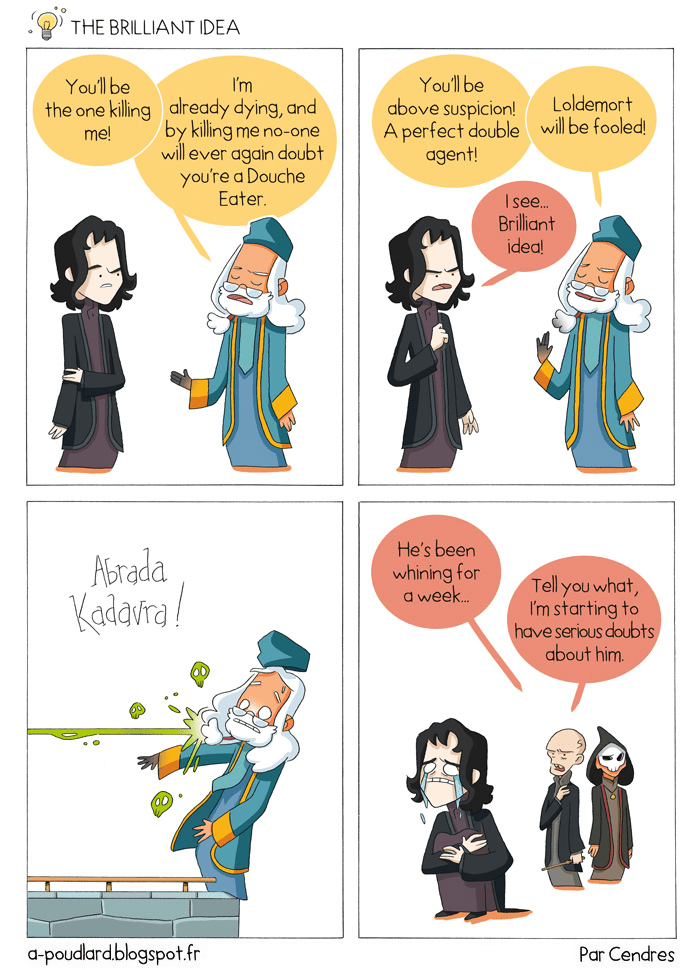
Anyway.
Snape is so horrified by the prospect of killing his mentor he’s on the verge of cancelling the plan altogether:
“After you have killed me, Severus —”
“You refuse to tell me everything, yet you expect that small service of me!” snarled Snape, and real anger flared in the thin face now. “You take a great deal for granted, Dumbledore! Perhaps I have changed my mind!”
“You gave me your word, Severus. And while we are talking about services you owe me, I thought you agreed to keep a close eye on our young Slytherin friend?”
Snape looked angry, mutinous.
“That small service of me” – an obvious antiphrasis. It certainly isn’t a small service, neither for Draco [“That boy’s soul is not yet so damaged, I would not have it ripped apart on my account”], nor for Dumbledore [“I ask this great favour of you, Severus”], let alone Snape himself.
It is very clear that the “hatred and revulsion” on Snape’s face when he kills Dumbledore are directed at himself – a perfect parallel to Harry who, a few hours earlier, was “repulsed” and “hating himself” for seemingly torturing Dumbledore. This is called a chiasmus, the perfect figure of speech to show that, even in words, Severus and Harry are mirroring each other. Neither of them wanted Dumbledore to suffer, and both preferred not to kill, even in war.
- Hating himself, repulsed by what he was doing, Harry forced the goblet back toward Dumbledore’s mouth and tipped it, so that Dumbledore drank the remainder of the potion inside.
“No…” he groaned, as Harry lowered the goblet back into the basin and refilled it for him. “I don’t want to… I don’t want to… Let me go…”
- Snape gazed for a moment at Dumbledore, and there was revulsion and hatred etched in the harsh lines of his face.
“Severus… please…”
But Harry didn’t have to kill Dumbledore. Snape had. That takes guts that you cannot imagine. Just look at Snape’s state when he has to defend himself from Harry:
“Kill me then,” panted Harry, who felt no fear at all, but only rage and contempt. “Kill me like you killed him, you coward — ”
“DON’T — ” screamed Snape, and his face was suddenly demented, inhuman, as though he was in as much pain as the yelping, howling dog stuck in the burning house behind them — “CALL ME COWARD!”
And yet, Dumbledore trusted him all along.
There’s a theory I like however. Look at this:
Snape raised his wand and pointed it directly at Dumbledore.
“Avada Kedavra!”
A jet of green light shot from the end of Snape’s wand and hit Dumbledore squarely in the chest. Harry’s scream of horror never left him; silent and unmoving, he was forced to watch as Dumbledore was blasted into the air. For a split second, he seemed to hang suspended beneath the shining skull, and then he fell slowly backward, like a great rag doll, over the battlements and out of sight.
If you remember well:
Dumbledore had wordlessly immobilized Harry, and the second he had taken to perform the spell had cost him the chance of defending himself.
The word “forced” may indicate that the spell was still active, until Dumbledore died. Meaning that Dumbledore died only after he toppled over the Tower and hit the ground. Meaning that… Snape’s Avada may not have been that effective.
He really did not want Dumbledore to die.
No character other than Severus Snape has given us a full Redemption Arc of this magnitude. As someone once said (can’t find the source, tell me if you did):
The majesty of his redemption is that 17 years later he is so transfigured that he is willing to lay down his life for the same society that abandoned him, for his so-called enemies, for those who genuinely HATE HIM.
Keep Calm and Trust Severus Snape
Severus Snape changed so much that nearly everyone – save the Golden Trio, Mad’Eye Moody, and Sirius only after he learned that Snape has indeed been a Death Eater at the end of GoF – either trusts him or at least doesn’t think he could be a traitor to the cause.
The essay “Snape as a Hogwarts teacher” shows how much he was trusted by the staff; I’ll re-use the relevant extracts.
Hagrid gets furious when the Trio accuse Snape of trying to steal the Stone and kill Harry at Quidditch:
‘I’m tellin’ yeh, yer wrong!’ said Hagrid hotly. ‘I don’ know why Harry’s broom acted like that, but Snape wouldn’ try an’ kill a student! Now, listen to me, all three of yeh – yer meddlin’ in things that don’ concern yeh. It’s dangerous. You forget that dog, an’ you forget what it’s guardin’, that’s between Professor Dumbledore an’ Nicolas Flamel –’
In HBP, Hagrid would rather think Harry was knocked on the head and suppose that Dumbledore told Snape the spy to go with the Death Eaters – which is right, as we learn later – than think a second that Snape killed him.
“He’s dead. Snape killed him… ”
“Don’ say that,” said Hagrid roughly. “Snape kill Dumbledore — don’ be stupid, Harry. Wha’s made yeh say tha’?”
“I saw it happen.”
“Yeh couldn’ have.”
“I saw it, Hagrid.”
Hagrid shook his head; his expression was disbelieving but sympathetic, and Harry knew that Hagrid thought he had sustained a blow to the head, that he was confused, perhaps by the aftereffects of a jinx…
“What musta happened was, Dumbledore musta told Snape ter go with them Death Eaters,” Hagrid said confidently. “I suppose he’s gotta keep his cover. Look, let’s get yeh back up ter the school. Come on, Harry… ”
And Hagrid was right!
Professor Burbage begs Snape to save her from Voldemort, calling him by his first name:
As she revolved to face the firelight, the woman said in a cracked and terrified voice. “Severus! Help me!” […] “Severus… please… please…” […] For the third time, Charity Burbage revolved to face Snape. Tears were pouring from her eyes into her hair. Snape looked back at her, quite impassive, as she turned slowly away from him again.
You know Snape wished hard that he could save her. But he couldn’t and had to shut down all signs of sympathy as Burbage was tortured, killed, then eaten by Nagini. In the movie, Burbage even says they’re friends.
Slughorn seems definitely happy whenever Snape’s mentioned, except when he learned what Snape had done to Dumbledore:
“Snape!” ejaculated Slughorn, who looked the most shaken, pale and sweating. “Snape! I taught him! I thought I knew him!”
As Harry figures out since first year:
‘But we’ve got no proof!’ said Harry. ‘Quirrell’s too scared to back us up. Snape’s only got to say he doesn’t know how the troll got in at Hallowe’en and that he was nowhere near the third floor – who do you think they’ll believe, him or us? It’s not exactly a secret we hate him, Dumbledore’ll think we made it up to get him sacked. Filch wouldn’t help us if his life depended on it, he’s too friendly with Snape, and the more students get thrown out, the better, he’ll think. And don’t forget, we’re not supposed to know about the Stone or Fluffy. That’ll take a lot of explaining.’
Or as McGongall summarizes:
“Snape, ” repeated McGonagall faintly, falling into the chair. “We all wondered… but he trusted… always… Snape… I can’t believe it… ”
She could not believe that Snape would be a traitor indeed. She will learn that she was right… only after he’s dead, of course.
After learning the truth about Snape, Harry is so sure of Snape being Dumbledore’s man all along, since the moment Voldemort threatened Lily, that he makes everyone in the Hall hear it. Voldemort cannot die without knowing Snape was in fact Dumbledore’s man.
pet_genius wrote the essay “Snape was a good person who went bad and then good again, and his remorse was true”, in which they explain:
3. Dumbledore thinks Snape is good:
“I have given evidence already on this matter,” he said calmly. “Severus Snape was indeed a Death Eater. However, he rejoined our side before Lord Voldemort’s downfall and turned spy for us, at great personal risk. He is now no more a Death Eater than I am.”
“Rejoined.” Dumbledore seems to think Snape was good, went bad, and then good again. Very good – he is no more a Death Eater than Dumbledore is! No one is less a Death Eater than Dumbledore. And that’s what Dumbledore has to say long before Snape started saving Harry’s life all the time and so on.
I can add that indeed, in HBP, when Snape had long proven he is a man of his word, we get:
“I believe it to be the greatest regret of his life and the reason that he returned —”
And:
“Er, ” he said, “Mr. Bagman… ”
“…has never been accused of any Dark activity since, ” said Dumbledore calmly. […] “No more has Professor Snape,” he said.
Dumbledore has always believed that Snape is like a sheep who went astray but found the right track again.
“But Snape is racist!”
pet_genius has something to say about it:
Here is all the evidence of child Snape being racist: The brief pause before he told Lily it does not matter if she’s Muggle-born. Awful, I know! I read him as being hesitant to answer, because he does not know the answer, or because he is worried about being a half-blood himself. He is not even aware of the Slytherin blood-bias, since he wants Lily to be in the same house as him, so let’s move on.
[…]
There is also this:
“So she’s my sister!
“She’s only a —”
Maybe he was going to say “she’s only a jealous cow.” Whatever he was going to say about Petunia (but didn’t), it was called-for: Petunia had just insulted Lily and Severus for being wizards, why wouldn’t he say she is only a Muggle?
I’ll specify that Snape is also the first one to tell Lily that being Muggle-Born makes no difference:
“Does it make a difference, being Muggle-born?” Snape hesitated.
His black eyes, eager in the greenish gloom, moved over the pale face, the dark red hair.
“No,” he said. “It doesn’t make any difference. ”
Next on pet_genius’ essay:
He has every reason to hate Muggles by the time he arrives at Hogwarts: his dad is abusive toward him and his witch mom, and Petunia mocks his poverty multiple times.
Also, the fact that Petunia knows his family by reputation suggests that the Snapes were viewed negatively by a larger part of the town, and likely Severus had to deal with the consequences of his family being considered “white trash”. So, very likely he was bullied by other Muggle kids.
[…]
Why would Snape like Muggles? The Muggle world has been cruel to him. Sadly, Gryffindors (James and Sirius) start antagonizing Snape as soon as they lay their eyes on him, and never stop (including attempted murder and sexual assault, covered up and enabled by the leader of the Order of the Phoenix). So we see that he was pushed away from the “good side” by everyone, except Lily.
Look who is being kind:
Harry walked with him to the stool, watched him place the hat upon his head. “Slytherin!” cried the Sorting Hat. And Severus Snape moved off to the other side of the Hall, away from Lily, to where the Slytherins were cheering him, to where Lucius Malfoy, a prefect badge gleaming upon his chest, patted Snape on the back as he sat down beside him.”
The Slytherins are cheering, and Lucius takes this 11 year old with a clear Muggle last name and who definitely looks poor under his wing immediately. The grooming begins.
[…]
If Snape is so racist, how come the two people he hates the most (James and Sirius) are purebloods? How come nobody ever accuses him of racism, in real time or in retrospect, except Lily, who only finds his racism problematic when it’s directed at her, and who in fact, bothers to make excuses for him for years and is surprised that he sees something in Avery and Mulciber?
Like it or not, if Snape threw the M-word around (which we don’t actually see), he did not use it more than was generally acceptable.
One of the comments on pet-genius’ essay said:
« — to call me Mudblood? But you call everyone of my birth Mudblood, Severus. Why should I be any different? »
He struggled on the verge of speech, but with a contemptuous look she turned and climbed back through the portrait hole…
Severus Snape called all muggle borns mudbloods. He didn’t deny it. Lily was an exception for him. It wasn’t a one-off mistake.
The problem is that we don’t know why he hesitated. Every time Snape talks, Lily cuts him off (she constantly refuses to listen to him in The Prince’s Tale), and she didn’t let him explain himself at that moment either. An equally valid theory is that people kept making rumors about him and he was stunned to learn that Lily believed he was calling people Mudbloods left and right.
If Severus was indeed a full-blown racist as a teen, then why is it that Lupin and Sirius never make mention of it? They only say that James bullied him partially because he hated the Dark Arts, and in SWM, they attack him just because they’re bored. Why is it that Severus calls himself The Half-Blood Prince? As Harry says:
“I don’t see where you get that from, ” said Harry heatedly. “If he’d been a budding Death Eater he wouldn’t have been boasting about being ‘half-blood,’ would he?”
There’s something I’d like to discuss about this moment. It’s not just the fact that Snape said a horrible word as he was lashing out from a deeply traumatic moment, making this one moment poorly representative. Not just the fact he could have simply repeated the most hurtful word he could imagine because that was ingrained in his mind for years by his Slytherin peers.
It’s the fact that saying “Mudblood” is technically Snape’s right.
Rowling once said that Snape is not Muggle-Born, yet she also said:
« Non-bigots in the wizarding world would say half-blood. Pure blood supremacists would say mudblood.«
So Severus is a Mudblood himself – he is an equal to Lily on that point. There are transgender people who prefer to call themselves transsexuals even if it’s now an offending term. Black people can claim the N-word without being branded as racist. What if Snape thought it was okay to say that word because he’s a Mudblood himself, and stopped because Lily’s rejection made him believe even he couldn’t?
Second, and that’s where I disagree with the TERF-y author: Severus is also technically a Muggle-Born, unlike Harry who is technically a first generation pureblood. Indeed, he was literally born from Muggle parents: his father and his grandparents on his father’s side at the very least. It’s also possible that Eileen Prince was herself Muggle-Born or Half-Blood – nothing, nothing in the books says that she was pureblood, unlike most of the fandom might think.
Snape is thus a target of bigotry, him, his family and his close ones.
He is not just a Muggle-Born / Half-Blood / Mudblood. He is the product of a Muggle and a Blood-traitor: an abomination in the eyes of bigots. I believe the only reason he was spared is because Voldemort himself was in a similar posture… and even then, Bellatrix refuses to believe he was a Half-Blood, in the Department of Mysteries, because she hates them:
“Shut your mouth!” Bellatrix shrieked. “You dare speak his name with your unworthy lips, you dare besmirch it with your half-blood’s tongue, you dare — “
“Did you know he’s a half-blood too?” said Harry recklessly. Hermione gave a little moan in his ear. “Voldemort? Yeah, his mother was a witch but his dad was a Muggle — or has he been telling you lot he’s pureblood?”
“STUPEF — ”
[…]
“He dared — he dares — ” shrieked Bellatrix incoherently. He stands there — filthy half-blood — ”
“WAIT UNTIL WE’VE GOT THE PROPHECY!” bawled Malfoy.
Meaning that at the very least, Severus cannot be judged like a pureblood would, let alone a racist one.
Later in life, he has no problem being friends, at least cordial, with Filch the Squib, whom everyone else despises. The school Squib ridiculed by the students — not least by Ron making fun of him for being a Squib suffering from his condition, by Hagrid calling him a « sneakin’ Squib », and by Harry experimenting with the Half-Blood Prince’s book using Filch as a target.
Another scene, from CoS:
“I’m quite surprised the Mudbloods haven’t all packed their bags by now, ” Malfoy went on. “Bet you five Galleons the next one dies. Pity it wasn’t Granger —”
The bell rang at that moment, which was lucky; at Malfoy’s last words, Ron had leapt off his stool, and in the scramble to collect bags and books, his attempts to reach Malfoy went unnoticed.
“Let me at him,” Ron growled as Harry and Dean hung onto his arms. “I don’t care, I don’t need my wand, I’m going to kill him with my bare hands —”
“Hurry up, I’ve got to take you all to Herbology,” barked Snape over the class’s heads, and off they marched, with Harry, Ron, and Dean bringing up the rear, Ron still trying to get loose. It was only safe to let go of him when Snape had seen them out of the castle and they were making their way across the vegetable patch toward the greenhouses.
Lorie Kim on that scene:
Hypervigilant Snape has an uncanny ability to sense and punish Gryffindor aggression against any Slytherin, especially Draco. But here, Ron spends several minutes under Snape’s supervision lunging at Draco, growling death threats, forcibly restrained by two other Gryffindors. Snape might miss the occasional moment, but not a struggle that lasts the entire walk to the castle doors. Through careful use of the passive voice – “his attempts to reach Malfoy went unnoticed” – Rowling hints that Snape saw Ron’s anger but let it pass unremarked. We don’t know yet that Snape has any history around Slytherin boys wishing death on Muggle-borns girls. We only know that something about Draco’s comment overrides Snape’s usual eagerness to take Draco’s side against Gryffindors, the only instance such a thing happens in the series.
“But Snape didn’t punish Draco!”
It’s reasonable to think that his position as a spy prevented him from openly punishing Draco for saying Mudblood, a word taught and encouraged by his family. It is his refusal to take action against Ron that’s to be noted. Compare with the previous year, for a similar crime:
Ron dived at Malfoy just as Snape came up the stairs.
“WEASLEY!”
Ron let go of the front of Malfoy’s robes.
“He was provoked, Professor Snape, ” said Hagrid, sticking his huge hairy face out from behind the tree. “Malfoy was insultin’ his family.”
“Be that as it may, fighting is against Hogwarts rules, Hagrid, ” said Snape silkily. “Five points from Gryffindor, Weasley, and be grateful it isn’t more. Move along, all of you. ”
The most direct and famous evidence that Snape isn’t racist, or has ceased to be, is as follows:
“Headmaster! They are camping in the Forest of Dean! The Mudblood — ”
“Do not use that word!”
Snape shuts Phineas Nigellus immediately for using the word Mudblood. Not content with betraying the group of purists and stopping discriminating against Muggle-borns — even his classes are accessible to serious people without wizarding heritage, like Hermione — he actively rejects a purist’s “Mudblood” insult when he can afford to without risking his spy position — thus defending Hermione from a former Slytherin Headmaster.
If all that isn’t evidence he isn’t racist, or that he may have once but ceased to be as part of his redemption, I don’t know what to tell you.
“Snape is obsessed with the Dark Arts though”
For once, that indeed is something that did not really change. Although… didn’t it? After all, Snape always wanted to teach Defense Against the Dark Arts, and when he does obtain the post, he teaches Defense, and not the Dark Arts themselves. We know he was once in love with the Dark Arts, at least that’s what Snape tells Bellatrix:
“He wouldn’t give me the Defense Against the Dark Arts job, you know. Seemed to think it might, ah, bring about a relapse… tempt me into my old ways.”
(He talks about it as though it was an addiction.)
Yet ironically, Bellatrix complains that Snape’s sole sacrifice was not being able to teach Defense, his favorite subject. Did she in fact mean “the Dark Arts”, or has she always known that Snape was in fact (also) in love with the subject of Defense?
It suits the character. Didn’t Snape always have to defend himself throughout his childhood, in particular from harmful spells?
Either way however, that Snape loves the Dark Arts is not a bad quality at all. First, because loving the Dark Arts does not make you evil, as we have demonstrated in the essay “Misconceptions on the Dark Arts”. Second, because that gives Snape a unique quality in HP: his passion for the Dark Arts but also Defense Against the Dark Arts makes him the only person that we know of who is able to directly heal wounds from a Dark curse, reverse the effects or at least slow down the damage.
As Dumbledore said, after Snape saved Katie Bell from Draco’s deadly curse:
“[…] Luckily Professor Snape was able to do enough to prevent a rapid spread of the curse — ”
“Why him?” asked Harry quickly. “Why not Madam Pomfrey?”
[…] “Professor Snape knows much more about the Dark Arts than Madam Pomfrey, Harry.”
Snape brewed the Mandrake Restorative Draught to free those Petrified by the Basilisk:
“Professor Sprout recently managed to procure some Mandrakes. As soon as they have reached their full size, I will have a potion made that will revive Mrs. Norris.”
“I’ll make it, ” Lockhart butted in. “I must have done it a hundred times. I could whip up a Mandrake Restorative Draught in my sleep — ”
“Excuse me, ” said Snape icily. “But I believe I am the Potions master at this school. ”
Petrification is a super-strong Dark spell:
“She has been Petrified, ” said Dumbledore (“Ah! I thought so!” said Lockhart). […] “No second year could have done this, ” said Dumbledore firmly. « It would take Dark Magic of the most advanced — ”
This is Snape saving Dumbledore from a Horcrux, you know, one of the “Magick Moste Evile” in HP, worse than the Unforgivables:
It was nighttime, and Dumbledore sagged sideways in the thronelike chair behind the desk, apparently semiconscious. His right hand dangled over the side, blackened and burned. Snape was muttering incantations, pointing his wand at the wrist of the hand, while with his left hand he tipped a goblet full of thick golden potion down Dumbledore’s throat. After a moment or two, Dumbledore’s eyelids fluttered and opened. […]
“It is a miracle you managed to return here!” Snape sounded furious. “That ring carried a curse of extraordinary power, to contain it is all we can hope for; I have trapped the curse in one hand for the time being —”
Dumbledore raised his blackened, useless hand, and examined it with the expression of one being shown an interesting curio.
“You have done very well, Severus. How long do you think I have?” […]
“If you had only summoned me a little earlier, I might have been able to do more, buy you more time!” said Snape furiously.
Dumbledore values Snape’s skills greatly:
“I am fortunate, extremely fortunate, that I have you, Severus. ”
Snape healing Harry’s catastrophic Sectumsempra:
Pushing Harry roughly aside, he knelt over Malfoy, drew his wand, and traced it over the deep wounds Harry’s curse had made, muttering an incantation that sounded almost like song. The flow of blood seemed to ease; Snape wiped the residue from Malfoy’s face and repeated his spell. Now the wounds seemed to be knitting. […]
“You need the hospital wing. There may be a certain amount of scarring, but if you take dittany immediately we might avoid even that… Come… ”
And this is the Weasleys unable to even heal an ear from the same curse:
[…] Mrs. Weasley and Ginny were still tending to George. Mrs. Weasley had staunched his bleeding now, and by the lamplight Harry saw a clean, gaping hole where George’s ear had been.
“How is he?”
Mrs. Weasley looked around and said, “I can’t make it grow back, not when it’s been removed by Dark Magic. But it could have been so much worse… He’s alive. ”
(Can ears really bleed that much? We’re not talking about a severed arm, but mostly cartilage…)
Again, this suits the theme of this character. Because he’s once fallen to the Dark side but then has extracted himself from it, he masters both the Dark Magic and the tools to defeat it: “Light” magic that other characters are unable to perform.
That Snape was obsessed with the Dark Arts turned out to be an excellent thing that allowed the heroes to win the war against Voldemort. Indeed, would they have been able to if Dumbledore had died before HBP?
Lorie Kim says, in her book “Snape: A Definitive Analysis”:
What is Snape chanting to heal Draco’s wound? Harry can’t understand the words yet. He’s too innocent. He’s never yet had to grieve the harm done to someone entrusted to his care. He hasn’t yet felt that he failed to protect someone vulnerable or young, or that the harm stemmed from his own weakness.
She compares Snape’s incantation to a phoenix song, the only thing that could save Harry from the venom of the Basilisk. Then:
Few moments in the series are as starkly beautiful as the tableau of Snape singing shut Draco’s Sectumsempra wounds, performing magic that nobody else in the world could cast, suffusing the song with all his grief and regret that his long-ago evil is still doing harm in the world, still hurting this child who has spent all year trying to kill people and yet doesn’t deserve this because nobody deserves this. Draco has been pushing Snape away all year, descending deeper into horror, yet when he is in danger, Snape’s protective response is absolute: I came as soon as I could. You’ll be all right. I’ve got you. I’m here. This is a merciful gift to Snape, a second chance to make right the damage he caused.
But it’s not just about Snape mastering anti-Dark Magic. The spells he has created are repeatedly designed and/or used for self-defense. Muffliato allows one to talk without being heard. Langlock prevents someone from casting a spell (unless they master non-verbal spells, which requires a strong mastery of magic, not accessible for many mages). Levicorpus may have been an attempt to create a Levitating spell, just like Lily was able to “fly” from the swings at such a young age – and Severus does learn how to fly unsupported later in his life, an extraordinary skill shared only by Lily and Voldemort. Finally, the four times Sectumsempra has been used in the series was for self-defense.
Harry against Draco who attempted to Crucio him:
[…] and Harry slipped as Malfoy, his face contorted, cried, “Cruci —”
“SECTUMSEMPRA!” bellowed Harry from the floor, waving his wand wildly.
Harry against the Inferi:
A few of them stumbled, one or two of them bound in ropes, but those climbing onto the rock behind them merely stepped over or on the fallen bodies. Still slashing at the air with his wand, Harry yelled, “Sectumsempra! SECTUMSEMPRA!”
Severus against James who had waterboarded him with soap, insulted him and said the problem was that he existed, by that point:
But too late; Snape had directed his wand straight at James; there was a flash of light and a gash appeared on the side of James’s face, spattering his robes with blood.
(To be honest, we’re not sure it was Sectumsempra, but let’s assume for now that it was.)
Finally, Severus trying to protect Lupin in the Battle of the Seven Potters:
A Death Eater moved ahead of Snape and raised his wand, pointing it directly at Lupin’s back —
“Sectumsempra!” shouted Snape.
But the spell, intended for the Death Eater’s wand hand, missed and hit George instead —
Severus Snape is like the snake: in his venom you find the cure. This is why the snake makes the Rod of Asclepios, the symbol of medicine: it is the dosage that makes the poison. Incidentally, Snape’s first lesson taught Harry that a bezoar heals from most poison, which allowed him to save Ron in sixth year. As the Potions Master, he has taught generations of students how to brew antidotes. It is Snape who teaches Harry his future signature Disarming spell “Expelliarmus”, which de-escalates violence. But perhaps the most telling is his Patronus:
And then the source of the light stepped out from behind an oak. It was a silver-white doe, moon-bright and dazzling, picking her way over the ground, still silent, and leaving no hoofprints in the fine powdering of snow. She stepped toward him, her beautiful head with its wide, long-lashed eyes held high.
Harry stared at the creature, filled with wonder, not at her strangeness, but at her inexplicable familiarity. He felt that he had been waiting for her to come, but that he had forgotten, until this moment, that they had arranged to meet. His impulse to shout for Hermione, which had been so strong a moment ago, had gone. He knew, he would have staked his life on it, that she had come for him, and him alone. […]
Caution murmured it could be a trick, a lure, a trap. But instinct, overwhelming instinct, told him that this was not Dark Magic. […]
Though the darkness had swallowed her whole, her burnished image was still imprinted on his retinas; it obscured his vision, brightening when he lowered his eyelids, disorienting him. Now fear came: Her presence had meant safety.
Snape’s Patronus is so powerful, so bright, that she blinds Harry for a moment. The imprint of the doe remains on his retina after she disappears. Snape’s Patronus is so « pure » that Harry instinctively knows he can trust her: « she had meant safety ».
You know the saying: Snape is the only Death Eater who is able to cast a Patronus. People have pointed out that Umbridge was able to cast a Patronus too, meaning that evil people can also cast it and thus making that argument pointless. Yet what Harry feels when approaching it is drastically different from the Doe: he knows that Umbridge is drawing her happiness from her position of power and persecution of the « dirty blooded »:
The Patronus, he was sure, was Umbridge’s, and it glowed brightly because she was so happy here, in her element, upholding the twisted laws she had helped to write.
If Umbridge’s Patronus could make Harry feel the sadism that produced it, then Snape must have drawn his happiness from the feeling of safety (for Harry, and/or for himself) and from being (or trying to be) a good person.
« Snape is not a saint! »
Technically speaking, lots of saints too did horrible things (take St John or Paul or Moses). So Snape having « sinned » greatly is certainly not an argument to say he can’t be a saint, especially if his years as « sinner » were followed by great remorse and pain in penance. Religions love that kind of story.
Snape could not be perfect, because he had to be realistic enough so we could believe he was human – but most of all because he had to be ambiguous enough for fans to ponder on his true loyalties. The heroes of our world are just humans with their fair share of darkness and unforgivable things.
This does not invalidate his redemption arc – in fact, it’s precisely because Snape hasn’t been perfect that he could achieve redemption, and that he still remains a wonderful character to analyse. Again:
“What is better: to be born good or to overcome your evil nature through great effort?”
I would like to present this poem extract:
And I know things now,
Many valuable things.
That I hadn’t known before.
Do not put your faith in a cape and a hood,
They will not protect you
The way that they should.
And take extra care with strangers,
Even flowers have their dangers.
And though scary is exciting,
Nice is different than good.
“I Know Things Now”, by Stephen Sondheim
Severus Snape didn’t need to be born a saint, nor to become “nice” to the protagonists, to become a good person – or a good person again.
« Just because he did one good thing at the last minute doesn’t make him a hero »
As we have proven until now, Snape certainly did not do “one good thing at the last minute” (if you don’t believe this, I encourage you to re-read this essay from the start). Assuming that this argument is true, it doesn’t apply to Snape, but to characters like Narcissa.
In the very last hour of the Battle of Hogwarts, Narcissa lied to Voldemort as she realized that Harry was basically unkillable and when she was told that her dear son was alive. She did have interests in undermining Voldemort, who posed a threat to her family, and in getting Harry’s support by seemingly helping him, as there was reason to think he would win the war (he came back from the dead). What she did was patently selfish, if somewhat brave (which she became because of her status as a mother worried sick for her child). There would be no doubt that Narcissa would crush any Mudblood for her son’s sake.
Meanwhile, Snape worked for the good side and did good, heroic things starting from 20 years-old, before Voldemort’s first death, and kept it till the end of his life. That’s 17 years of penance for, what, a few weeks or months of DE services? 17 years of spying, of lying to Voldemort’s face. Narcissa just cannot compare, nor could any other HP character that had the potential for redemption.
What about Snape’s professorship?
“But Snape was a bad teacher! How can he be redeemed when he’s the worst teacher Hogwarts has ever had, second only to Umbridge!?”
In the essay “Snape as a Hogwarts teacher”, we have proven that Snape isn’t actually a bad teacher, and that in fact, he was one of the best of Hogwarts; he was very flawed, yet he was far better than Professors McGonagall, Hagrid and Lupin, to cite a few. Per Hogwarts’ standards, he certainly wasn’t abusive. Please check it out even if it is just the conclusion. If you’re too lazy or busy for that, at least consider that repeatedly saving the children of Hogwarts, ultimately at the cost of his life, greatly makes up for being a jerk. It’s a redemption on its own, as we have shown above.
Besides, Snape’s professorship could not discredit his Redemption Arc because his redemption was never about having been a mean teacher. It was meant to atone for his time as a Death Eater. It was about Snape the spy, not Snape the instructor.
The Price of Penance
Here’s another anti-Snape argument that pet_genius tackles:
Oh, he was playing both sides!
This one is one of my favorite arguments, it’s just so stupid, you gotta love it.
Snape did not know he [would] be Dumbledore’s killer before the summer between OOTP and HBP. By this point he had already risked himself to protect Harry multiple times. When Dumbledore summoned Snape after he had gotten himself nearly killed, Snape could have simply done nothing and take credit for finishing Dumbledore then. When he did find out he’ll have to kill Dumbledore, he did not want to do it. But even if this was somehow part of some grand scheme, he was only playing both sides from the moment he killed Dumbledore. Except even this is ridiculous.
A) Why send Harry the Silver Doe and lead him to the real sword of Gryffindor?
He could have simply done… nothing.
B) Why follow Dumbledore’s plan to the letter? In case you’ve forgotten, Dumbledore’s plan was as follows:
There will come a time when Lord Voldemort will seem to fear for the life of his snake.”
“For Nagini?” Snape looked astonished.
“Precisely. If there comes a time when Lord Voldemort stops sending that snake forth to do his bidding, but keeps it safe beside him under magical protection, then, I think, it will be safe to tell Harry.”
[…]
“So the boy . . . the boy must die?” asked Snape quite calmly.
“And Voldemort himself must do it, Severus. That is essential.”
Snape prevents others from killing Harry:
“No!” roared Snape’s voice and the pain stopped as suddenly as it had started; Harry lay curled on the dark grass, clutching his wand and panting; somewhere overhead Snape was shouting, “Have you forgotten our orders? Potter belongs to the Dark Lord — we are to leave him! Go! Go!”
Snape must have fed Voldemort that line, or at least manipulated Voldemort’s arrogance so that he’ll continue to insist on killing Harry himself, even though he is the one person who cannot kill Harry. Preventing them from torturing Harry was just a cover-blowing moment, though.
Voldemort himself:
“I must be the one to kill Harry Potter, and I shall be.”
Snape follows Dumbledore’s plan exactly:
“I have thought long and hard, Severus. . . . Do you know why I have called you back from the battle?”And for a moment Harry saw Snape’s profile: His eyes were fixed upon the coiling snake in its enchanted cage.“No, my Lord, but I beg you will let me return. Let me find Potter.”
He also did not tell Voldemort that he is not the master of the Elder Wand; we know how that worked out for him (not very well). But, say he hadn’t died. Say he hadn’t died, and Harry hadn’t returned from the dead to clear his name. In this scenario, Snape looks like #1 Death Eater, Dumbledore’s killer, who opened the Gates of Hogwarts to let Voldemort in. Rather than playing both sides, that’s how you buy yourself a Dementor’s kiss, or if you’re lucky, death by [a] raging mob.
Had he chosen to simply do none of that after killing Dumbledore, Voldemort would have won, and Snape would have had a very nice life.
Instead, Snape chose the hard way, the right way: fighting Voldemort even if his life and sanity was down the line. By the end of the war, he’s described several times as a living corpse:
- He had forgotten the details of Snape’s appearance in the magnitude of his crimes, forgotten how his greasy black hair hung in curtains around his thin face, how his black eyes had a dead, cold look.
- And now Snape looked at Voldemort, and Snape’s face was like a death mask. It was marble white and so still that when he spoke, it was a shock to see that anyone lived behind the blank eyes.
This was before Voldemort made it clear he wanted to kill him.
Snape is so tired, he barely speaks. This is him answering Minerva, a few hours before his death:
Snape made a slight flexing movement of his left arm, where the Dark Mark was branded into his skin.
His final hours are spent in absolute terror, begging Voldemort in a way reminiscent of Lily begging for Harry life. Look how much he stammers:
- “My — my Lord?” said Snape blankly. “I do not understand. You — you have performed extraordinary magic with that wand. ”
- “No, my Lord, but I beg you will let me return. Let me find Potter.”
- “But my Lord, he might be killed accidentally by one other than yourself –”
- “My Lord knows I seek only to serve him. But — let me go and find the boy, my Lord. Let me bring him to you. I know I can — ”
- “I have told you, no!” said Voldemort […]
- “I — I cannot answer that, my Lord.”
- “I — I have no explanation, my Lord.”
- “My Lord — let me go to the boy —”
- “My Lord!” Snape protested, raising his wand.
Lily in her last hour:
“Not Harry, not Harry, please not Harry!”
“Stand aside, you silly girl… stand aside, now. ”
“Not Harry, please no, take me, kill me instead — ”
“This is my last warning — ”
“Not Harry! Please… have mercy… have mercy… Not Harry! Not Harry! Please — I’ll do anything — ”
“Stand aside. Stand aside, girl!”
This is heartbreaking.
I wouldn’t be surprised if he’d committed suicide right after the war if he’d survived. Sorry for those who hope he survived Nagini in secret – the war wore him down that much.
The Foe Glass certainly knew on which side Snape was standing:
Harry, still staring at the place where Moody’s face had been, saw Albus Dumbledore, Professor Snape, and Professor McGonagall looking back at him out of the Foe-Glass.
Why would anyone go as far as he did if they were “just playing both sides”? He held on, goddamn he held on, and died believing that the only person who knew the truth would die soon anyway and take his secrets to the grave. Look at his life and tell me at which point it was desirable or even sustainable for any of you. I know I wouldn’t be able to do it, even if many were on the line. What if Snape believed in the afterlife – how would he imagine a meeting with Lily and Harry, whom he both indirectly killed?
Snape could have decided to leave the country and lead another life. He could have decided to pretend to help Dumbledore and either undermine his plans or wait until he was dead to finally, completely change sides. But he didn’t, he stayed true to the right cause, and he paid the price.
There’s a parallel to be made with Harry:
‘Look what he asked from me, Hermione! Risk your life, Harry! And again! And again! And don’t expect me to explain everything, just trust me blindly, trust that I know what I’m doing, trust me even though I don’t trust you! Never the whole truth! Never!’
Compare with:
“You have used me. […] I have spied for you and lied for you, put myself in mortal danger for you. Everything was supposed to be to keep Lily Potter’s son safe. Now you tell me you have been raising him like a pig for slaughter — ”
Frederick-the-great has something to say about that, in their essay “Why we love Snape, or the character who was unkindly written”:
Snape thought Dumbledore was raising Harry as a pig for slaughter, but he is wrong. It is him whom Dumbledore is raising to die. The fact that this is never openly stated, and is purposefully obfuscated by the language, is somewhat cowardly. Dumbledore barely apologises, he barely recognizes it. If he did, the readers would be horrified. As in the case of Lily, Snape is sacrificed in favour of apparently “better” characters whom the narrative wants the readers to like more.
Harry’s Forgiveness
There is one thing that I think is important to address: the resentment from antis over Harry forgiving Snape. Let’s assume that Harry did forgive Snape entirely. It may not be a matter of just slandering the character out of misplaced hatred; I think that there are people who genuinely have a problem with this scene because it touches a sensitive subject: forgiveness. Or, more precisely, early forgiveness.
Very often, stories have involved a moralistic lesson that the hero is a perfect victim but also a great trauma survivor because they forgave the villains. There is a huge culture of guilt-tripping victims of abuse into forgiving their abusers, on the presumption that forgiveness is the right and the most mature choice. It’s very insidious too because it disguises as an opportunity for the victim to heal over what was done to them, to not let it affect them and get over it–an opportunity to take back control. Forcing victims to forgive their abusers is born from and reinforces trauma invalidation, notably because it’s then used as an excuse to undermine the severity of what happened (“they forgave them, so it can’t have been that bad”). It’s used to pretend that the victim is not only “weak” and a “loser”, but also the bad person in the story–and not the one who’s hurting them. It leads to unhealthy trauma recovery, and of course, enables more abuse. Because apparently, forgiving someone is a free pass to take on some more violence while shutting up about it. It went so far that victims were forced to forgive their bullies before they even made the effort of apologizing and acknowledging that what they did was wrong. Many victims of toxic relationships have become trapped this way: they’re abused, they’re forced to forgive their abusers, who of course never plan to stop their ways, and the cycle repeats.
Now, take someone who identifies with Harry in hating a bully and never wanting to forgive them for what they did. Adult Harry’s choice in the Epilogue can feel like a betrayal or, worse, like the story of HP morally condemns the reader for refusing to forgive their abusers. It wouldn’t be the first time: remember when Harry and Hermione called Snape pathetic for still hating the Marauders to this day for a matter of “pranks”? Granted, they didn’t know the full context, but the books repeatedly undermine Snape’s trauma. If not the books, the fans: we’ve seen way too many antis despising Snape for not forgiving his abusers, for “not growing up”. Which is ironic, considering that many times, they were the same who hated Harry for forgiving his own bully…
In any case, there are reasons for the reader to worry that Harry has unfairly forgiven his teacher. And not just because of the books’ content or the reader’s personal triggers: because of the way the story was constructed.
Between the Prince’s Tale and the Epilogue, there are barely 3 chapters to process that Snape was actually not a villain who murdered Dumbledore but a war hero deserving of Harry’s empathy and respect. More importantly, between the moment Harry openly declares that Snape was on his side, and the moment we see him calling his son Albus Severus “19 years later”, there is less than a chapter worth of text, so the reader only has an hour to process everything. As such, it gives the impression that Harry forgave Snape way too quickly.
But it wasn’t the case.
Harry had 8 years to mull over his feelings about the deceased spy, before making his son his namesake. That’s quite a long time–it’s more than the duration of Harry’s education. He also never says that Snape was perfect or that he did nothing wrong after all. Cursed Child makes it pretty clear:
HARRY: Those names you have — they shouldn’t be a burden. Albus Dumbledore had his trials too, you know — and Severus Snape, well, you know all about him —
ALBUS: They were good men.
HARRY: They were great men, with huge flaws, and you know what — those flaws almost made them greater.
Cursed Child has a lot of problems. Having Harry specify that while Snape was immensely brave, he had huge flaws–this is not one of them. And it’s not out of character for Harry to think that either.
It would be wrong to say that he forgave Snape just because he matured. This is not a matter of maturing mentally. Nor is it about « doing the right thing ». What could be considered mature is that Harry is able to acknowledge that Snape had both huge qualities and huge flaws; to pretend otherwise, that Snape is either a perfectly good guy or the devil reincarnated, would be… childish, to say the least.
Finally, I have serious doubts that Harry honored Snape because he fell into the harmful mindset that he must forgive his bullies. Given how hateful and prejudiced he became against his teacher throughout the books, going so far as to accuse him of Sirius’ death, claim that he would never forgive him, and wish that the Defense curse finished him off (see: OotP and HBP), I doubt Harry would have made a 180° on his opinions without a solid good reason.
Now, is it bad that Harry forgave him? Does it send a bad message?
First, it is important to realize that just because Harry chose to forgive Snape, doesn’t mean you are not valid for not forgiving your own bullies. It is your own choice, which should primarily be dictated by what makes you feel better. Whether or not there are people elsewhere who forgave those who harmed them.
Second, the Epilogue does not, in fact, give the message that we should forgive the bad guys if we want to prove we’re good and mature people. Sure, it says that Snape was the bravest man Harry ever knew, and that he was enough of an inspiring figure to consider that it’s okay for his son to be Slytherin. It strongly indicates that Snape was not an utterly evil piece of trash. But the act of forgiveness in itself is never presented as morally superior. It is an indication of Harry’s thoughts about Snape and his choice to bury the hatchet, which are also valid. Harry, in-universe, as the one who took Snape’s vendetta in the face, is the only one who gets to decide if he wants to forgive him or not. It was his right to forgive Snape, just as it was his right not to. He is not problematic for making a choice that you, personally, might not have made. If the scene makes you uncomfortable, remember that Harry’s case and yours are not the same. And that is okay.
Here are French articles that talk about Trauma and Early Forgiveness to better understand the subject (use automatic translation):
And here is a formidable essay that details some reasons Harry forgave Snape, by adreamermusing: https://www.reddit.com/r/harrypotter/comments/l2sbpt/harry_identified_and_reluctantly_admired_snape/
Conclusion
Either we go by the narrative and Snape is redeemed… Or we analyze him through a more objective point of view and he is still redeemed.
The darker Snape’s past might have been, the brighter his Redemption Arc becomes, because it speaks of how much he changed for the better.
He truly… became « the light in the darkness ».
Sources
Pet’s essays:
Snape was a good person who went bad and then good again, and his remorse was true:
https://www.reddit.com/r/harrypotter/comments/eke04f/snape_was_a_good_person_who_went_bad_and_then/
The Death Eaters as a Cult:
https://www.reddit.com/r/harrypotter/comments/g4g3rv/the_death_eaters_as_a_cult/
Why it was Practically Inevitable that Severus Snape Would Join A Cult (rose2jam):
https://rose2jam.tumblr.com/post/656998135072194560/why-it-was-practically-inevitable-that-severus
But Snape is just nasty, right? (Whitehound):
http://members.madasafish.com/~cj_whitehound/Fanfic/good_or_bad_Snape.htm
Snape, Sirius, and revenge (merlosaurusunactive):
https://www.tumblr.com/merlosaurusunactive/152279667713/snape-sirius-and-revenge
Something endearing about Snape (the-witches-son):
https://www.tumblr.com/the-witches-son/183015921022/something-endearing-about-snape
Harry identified with and (reluctantly) admired Snape even before ‘The Prince’s Tale’ (adreamermusing):
https://www.reddit.com/r/harrypotter/comments/l2sbpt/harry_identified_and_reluctantly_admired_snape/
Trauma et pardon, part 1 and 2 (dcaius):
Why do we love Snape, or the character who was unkindly written (frederick-the-great):
Snape: A Definitive Analysis (Lorie Kim)
Psychological Perspectives on Radicalization (Allard Feddes, Lars Nickolson, Liesbeth Mann, Bertjan Doosje)
 The Sneep Project
Your comment: