Rowling’s Failed Romance
And why James Potter is a Failed Character
We have already discussed James’ Desire. This essay is meant to be its continuation, which is why I really, really recommend you read that meta to understand the following, to understand why James Potter has failed as a character and Jily as a desirable romance.
Pride & Prejudice
The following is the biggest evidence of why Rowling failed James’ characterization. I present you:
“By you, I was properly humbled”: The Reformation of Lily’s Suitors
by terri_testing
https://archiveofourown.org/works/10532415?view_adult=true
A comparison of Pride and Prejudice and JKR’s romances between James/ Lily and Severus/Lily.
Like many fans, I assumed before DH (back in my innocent youth, when I was willing to accept what JKR said about her characters, rather than minutely examining what she showed) that James as a boy might have been a bully and over privileged jerk, but that he’d grown out of it before Lily accepted his suit. I assumed that SWM was James’s nadir, that the werewolf “prank” followed it, and that the realization that he and his friends had almost killed someone had sobered James. (I’d also assumed that James had in fact rescued Severus at least in part because, like Harry with Dudley and the Dementors, he was too decent to stand by and let even an enemy die when he could do something. Remus’s assurance that James had rescued Snape “at great risk to his life” had assured that parallel for me—until years later when I realized that James had always had the option of turning into his stag form and saving himself. )
So I accepted what I thought was Rowling’s line about James: that pre-prank, James had been a bullying idiot, but that post-Prank, James straightened up, stopped hexing people for fun, and became responsible and virtuous enough to merit being made Head Boy and winning Lily’s love.
Then JKR decided to destroy that reading by making SWM follow the prank.
So if the Marauders’ near-manslaughter had no effect whatsoever on James’s attitude and behavior, to what were we supposed to credit his supposed reformation? Why did Rowling expect us to believe that a sadistic bully whom she showed us torturing someone for giggles and whom she told us repeatedly endangered the lives of innocents for thrills became a hero worthy of Saint Lily? What did she think the mechanism of his change was? And Rowling is obviously confident that she did show us enough to make James’s reformation plausible; she expects her readers to just ‘get’ how that James became one of the heroes of his age.
Well, I think we’re supposed to understand that James, like Severus (too late), was Reformed by the Love of a Good Woman. And JKR thinks that she showed us the endpoints of the process and gave us the model she followed, so that her readers should just connect the dots.
JKR has mentioned being a fan of Jane Austen. I think that James was supposed to be a rewrite of Austen’s best-known hero, Mr. Darcy, and that (lower-born, but it’s SO rude to harp on that) Lily’s rejection of him in SWM was supposed to be James’s Pride and Prejudice moment.
“The turn of your countenance I shall never forget, as you said that I could not have addressed you in any possible way, that would induce you to accept me…. By you, I was properly humbled. I came to you without a doubt of my reception. You shewed me how insufficient were all my pretensions to please a woman worthy of being pleased.” (Mr. Darcy, P&P, Volume III, Chapter XVI)
The Lizzie-Darcy romance, shorn of Austen’s sparkling prose, is: Proud rich boy meets lower-born (but still acceptable to all but the worst snobs in his class) girl. Boy alienates girl with his arrogance. Girl is impertinent to boy; boy falls for her. Boy proposes. Girl rejects boy with stinging criticism. Girl finds out that her own prejudice had led her to wrong boy. Boy, humbled, changes his arrogant behavior; girl is touched and flattered by the change. Boy secretly saves someone he despises for the sake of girl’s peace of mind. Girl falls hard for boy, who still loves her. He approaches her again, this time without presumption. And they both live happily ever after.
*
Or, at any rate, they marry.
*
Mr. Darcy’s flaw was unregulated pride; the misbehavior resulting from that flaw was behaving with no consideration to those he considered beneath him. His reformation occurred off-stage; his turning point came not when he heard Lizzie’s criticism, but when he finally accepted it and applied himself to changing his ways. “Your reproof, so well applied, I shall never forget: ‘had you behaved in a more gentleman-like manner.’ Those were your words. You know not, you can scarcely conceive how they have tortured me—though it was some time, I confess, before I was reasonable enough to allow their justice.”(Mr. Darcy, P&P, III: XVI)
Here is Darcy’s full confession to Lizzie of his errors, after months of self-examination:
“I have been a selfish being all my life, in practice, though not in principle. As a child I was taught what was right, but I was not taught to correct my temper. I was given good principles, but left to follow them in pride and conceit. Unfortunately an only son, (for many years an only child) I was spoilt by my parents, who though good themselves, … allowed, encouraged, almost taught me to be selfish and overbearing, to care for none beyond my own … circle, to think meanly of all the rest of the world, to wish at least to think meanly of their sense and worth compared with my own.” (P&P, III:XVI)
So. Was James Potter supposed to be a modern Fitzwilliam Darcy? Spoiled only son in a rich and well-born family, check. Blessed in addition with above average looks and talents, check. “Taught what was right… given good principles, but left to follow them in pride and conceit,” check, per JKR. (James was, after all, always on what JKR assures us was the “right” side regarding those delicate questions of sorting into Gryffindor vs. Slytherin, pureblood politics, and Dark magic, even while he strutted around Hogwarts felling other children left and right with his hexes.) Surprised and chagrined when the lower-born girl turned him down, check. Secretly saved someone he despised who was connected to the girl (James knew full well that Severus at least had been Lily’s friend), check. Changed his behavior for the girl’s sake, check.
And Lily’s equally obviously modeled on Lizzie. She’s both of lower birth than her suitor and nominally his equal according to all but the worst snobs (she’s a powerful witch, if a Muggleborn, as Lizzie’s a gentleman’s daughter); she’s easily superior to her “better-born” rivals in talent and intelligence (Head Girl). Lily’s manners, like Lizzie’s, were sportive, lively, playful—and impertinent, but charmingly so.
“Now be sincere: did you admire me for my impertinence?” “For the liveliness of your mind, I did.” (P&P, III: XVIII)
“Vivacious, you know. Charming girl…. Very cheeky answers I used to get back too. (Slughorn on Lily, HBP, IV)
And, of course, both Lily and Lizzie rejected their suitors with the utmost disdain, as though “insensible to the compliment of such a man’s affection.” (P&P, II: XI)
Here’s Lizzie refusing Darcy, and his reaction:
“You could not have made me the offer of your hand in any possible way that would have tempted me to accept it.” Again his astonishment was obvious; and he looked at her with an expression of mingled incredulity and mortification. (P&P, II: XI)
And here’s Lily refusing James, and his reaction:
“I wouldn’t go out with you if it was a choice between you and the giant squid,” said Lily.
…
“What is it with her?” said James, trying and failing to look as though this was a throwaway question of no real importance to him. (OotP, SWM)
Rowling’s language is markedly less elegant than Austen’s, but the parallel is exact.
So I think Rowling gave us the beginning (or middle) in SWM, gave us the ending (Reader, I married him, to quote another classic), told us through Sirius and Remus that James had “deflated his head” to win Lily, and just expected us to fill in the gaps. The hero was humbled; the heroine realized that the hero had been a better man all along than she’d been willing to give him credit for. Every reader already knows this storyline. So Rowling felt no need to SHOW us James’s reformation, or what made Lily decide that James was a better person than she had previously thought him to be.
Moreover, since Lily did decide in James’s favor, so too should the readers. We all know, after all, that Lizzie’s prejudice against Darcy had led her astray in judging him; her reassessment (once Darcy had deflated his head a bit) that he was a worthy partner was correct. So Rowling didn’t need to show us James becoming a good and virtuous man: his winning Lily was all the proof we should need.
Finally, if Lily is supposed to be Lizzie, that makes sense of Rowling’s interview assertion that Lily could possibly have loved and chosen Severus. Because Lizzie, in canon, acknowledged but was unmoved by Darcy’s wealth, good looks, social status, and even intelligence (though she could not have loved someone she disdained as her intellectual inferior). Instead, Lizzie’s first preference was for a talented man of inferior birth to her own and no money at all. She was weaned of that preference only when she became convinced that her first choice, Wickham, held moral standards that were unacceptable.
If Lily were a Lizzie, then, so too must Lily have been unswayed by James’s surface attractions, and been attracted only when James had established his MORAL superiority to her other suitor. And Lizzie’s reason for coming to love Darcy (well after she’d decided that Darcy was worthy of her general approbation) was explicitly her gratitude for his loving her enough to change in response to her criticisms:
“But above all, above respect and esteem, there was a motive within her of good will which could not be overlooked. It was gratitude.—Gratitude, not merely for having once loved her, but for loving her still well enough to forgive all the petulance and acrimony of her manner in rejecting him, and all the unjust accusations accompanying her rejection…. Such a change in a man of so much pride, excited not only astonishment but gratitude—for to love, ardent love, it must be attributed.” (P&P, III: II)
So had Severus (James’s equal in being “a man of so much pride,” if not in wealth, looks, or social status) changed in time, attended to Lily’s criticisms instead of giving up after her stinging rejection and allying himself with the Death Eaters, obviously Lily might have loved him instead.
Indeed, Severus in canon might even have been Lily’s Wickham, her lower-born but talented first choice—though there’s little canon support for the contention that Lily ever found Severus sexually attractive (one blush when he looked at her “intently”, which might as easily have been embarrassment as reciprocal sexual awareness). Still, he was at least her acknowledged “best friend” during the period that she was overtly scorning James. If so, like Wickham, Severus insisted on proving himself unworthy of her.
There’s a further parallel between Wickham/Severus and Darcy/James besides that both Wickham and Snape proved themselves ultimately unworthy of a good woman’s affections. Darcy had to save Lydia’s good name to save Lizzie’s reputation and peace of mind. He forced the marriage between Lydia and Wickham, paid up Wickham’s debts and settled money upon her, and left Lizzie’s happy sister to “all the claims of reputation which her marriage had given her.” (P&P, III, XIX)
Darcy did this with absolutely no wish whatever of saving Wickham. But save Wickham he did: from debtor’s prison and from permanent infamy. Helping Wickham was the unpleasant consequence of saving others: Lydia from the consequences of her impulsive folly, Lizzie from an unmerited on her part, but overwhelming and probably permanent, loss of family reputation.
Similarly, James Potter saved Severus from the werewolf, not for Severus’s sake, but because James had to in order to save those he DID care for. Saving Severus was a unfortunate side effect of saving Sirius from his impulsive folly in setting Snape up to be killed, and Remus from being exposed as a werewolf. And James clearly scorned Severus as much (or more) after the rescue as before—as Darcy did Wickham.
[In one particular, however, Severus is more like another Austen villain, Willoughby of Sense & Sensibility, than Wickham. Austen’s readers never see Wickham mourn his (deserved) loss of Lizzie more than casually. Willoughby, on the contrary, betrayed his love Marianne—and then grieved (though not as extravagantly as the Half-Blood Prince) over his self-inflicted loss, readers are told, to the very end of his days. And when Willoughby believed that his betrayal had brought the woman he still loved into danger of death, he took himself to his enemy to confess and to make what poor amends he could:
“Tell me honestly”—a deeper glow overspreading his cheeks—“do you think me most a knave or a fool?” (Willoughby in S&S, XILIV)
Severus’s fans and detractors are still debating that question regarding Snape’s joining the DE’s.
*
So that’s the model Rowling was following, and she thought the parallels were perfectly plain.
Yet if that was Rowling’s intent, why didn’t it work for me once I looked more closely at the characters? Why did her assertion that Lily could possibly have chosen Severus fall flat, and why do I have trouble believing in James’s reformation?
*
The problem is, James Potter was no Darcy. Nor was Severus another Wickham. And that in turn made Lily no Lizzie when she chose the one over the other.
The first issue I have with reading James as Darcy could, if it stood by itself, simply be an example of Rowling’s recurring “tell don’t show” problem. Seeing is believing. Austen showed us Darcy’s reformation; she showed him exerting himself to be polite to people whom previously he would have ignored or scorned. Austen showed too Lizzie’s astonishment at the change:
“Why is he so altered? From what can it proceed? It cannot be for me, it cannot be for my sake that his manners are thus softened. My reproofs at Hunsford could not work such a change as this. It is impossible that he should still love me.” (P&P, III: I)
Rowling, in contrast, had James’s two best friends (hardly unprejudiced witnesses) assure Harry that James had changed—but we readers were never shown ANY example of James’s “after” behavior that solidly demonstrated James’s newfound humility and maturity. In fact, the prequel instead showed James and Sirius behaving much the same as ever.
That, if it stood by itself, could just indicate that Rowling expected us to take her (or Sirius and Remus’s) word for it. Which, way back when I felt I could trust Rowling’s moral judgment, was okay if artistically unsatisfying. However, once I realized I was dealing with an author who thought using the Cruciatus could ever be excused as gallant (IOIAGDI), that didn’t work so well. I wanted to see how post-reformation James had ACTED, to judge his behavior for myself.
The second problem can’t be explained away as artistic misjudgment on Rowling’s part. Austen’s Darcy changed his behavior, not in hopes of influencing Lizzie, but because he accepted her reproofs as justified. He expected never to see Lizzie again. Darcy altered his behavior rather in the hope of making himself a person who would in principle merit Lizzie’s esteem, than in the hope of changing Lizzie’s actual opinion.
Darcy explicitly said as much to Lizzie. However, readers were not required to take Fitzwilliam’s word for this. Darcy had earlier tried (to Lizzie) to excuse his incivility to strangers as being due to innate lack of ability at seeming interested in their concerns—and Lizzie had retorted that she didn’t blame her lack of mastery of the piano on lack of ability, but on not taking the trouble to practice enough.
So the mere fact that Darcy was able to demonstrate mastery of the art of conversing politely with the Gardiners in front of Lizzie proves that he must have been at pains at practicing the uncongenial exercise ‘being polite to strangers’ during the intervening months when he’d expected never again to see her.
Darcy didn’t change to impress Lizzie. He changed because he acknowledged that Lizzie’s rebukes had been well-founded, and he wanted to be a better man, to live up to Lizzie’s standards. Even though Darcy thought that Lizzie would never learn of his changed behavior, and thus would never alter her previous (and justified) bad opinion of him.
James, however, did the EXACT opposite. He changed his behavior in front of Lily (and in front of authorities whose reports on his behavior might get back to Lily), but his friends admitted that he continued his previous misbehavior behind her back.
It is canon that James continued hexing at least one person, Severus, and concealed this from Lily when she believed that he’d stopped entirely. As others have pointed out, the Head Boy had no need to resort to hexes to defend himself from Snape’s attacks, if the problem were simply that Snape had started egregiously attacking James. The Head Boy could simply have taken points from the offender, and let Slytherin House put pressure on the miscreant. So even if Severus were instigating their brawls by then, James was hexing by preference, not necessity.
Moreover, the fact that James COULD conceal his hexes so entirely from his girlfriend suggests that it was, at least much of the time, the person who had an invisibility cloak, the Marauder’s Map, and a rat Animagus lookout, who picked the fights. Severus had neither any motive nor any known means of keeping their continued hex-war a secret from Lily. In fact, had Severus known Lily admired James for having stopped hexing others, that she thought that this showed maturity and restraint on James’s part, he had a strong motive for the exact opposite, for making sure that Lily had occasion to see James preferring to resort to violence instead of point-taking when provoked.
But if James was picking the venue of their “fights,” he had to have been the instigator, at least some of the time. At the best, he might have been “maturely” taking points from Snape in public when Snape hexed him—and then privately “getting him back” later. (As Lupin admitted, “… you couldn’t really expect James to take that lying down, could you?” (OotP, XXIX) ) At the worst, James might have been continuing to instigate most of their encounters as he did with the one we witnessed in OotP: using the map and cloak to ambush Snape, possibly with benefit of superior numbers, and enjoying Snape’s furious and humiliated attempts to defend himself against superior firepower. While letting Lily think that James had given up all such pleasures.
So James, unlike Darcy, never felt that his initial behavior was truly wrong and that he ought to live up to Lily’s standards—just that it was impolitic to let Lily observe him behaving in certain ways.
He didn’t truly change; he manipulated Lily into thinking he’d changed, in order to manipulate her feelings about him.
He assumed the semblance of virtue, rather than becoming virtuous. Which is rather more the behavior of a Wickham than a Darcy.
Or to invoke another literary reference—consider Les liaisons dangereuses. The wicked Vicomte de Valmont decided to seduce a virtuous [rigidly moral yet very tenderhearted] woman, so he started ostentatiously to behave in a manner that led her to conclude that the Vicomte had secretly reformed his behavior under the influence of his overwhelming, unrequited love for her…. No, I don’t actually think that James was that cynical.)
The third problem I have is, in P&P both protagonists have a moral journey to make before they can meet as lovers. Darcy’s half was to admit that he had not been behaving as a true gentleman ought, and to regulate his pride and temper and start treating his ‘inferiors’ better. We saw that James did not truly do that—he just cheated and said he had. But Austen’s Lizzie had her part, too: to swallow her own pride in her superior intellect/judgment and admit that her prejudices had led her previously to misjudge Darcy.
The problem here is, Austen very carefully established that Lizzie HAD previously misjudged Darcy, that Darcy was in truth a better man than Lizzie had originally given him credit for. First there was the letter, overturning all Lizzie’s ideas about Darcy’s treatment of Wickham—and establishing further that his motives in separating Jane and Bingley were more creditable than Lizzie had supposed. (If Darcy had been right [which he was not] in his reading of Jane’s character, that she was encouraging Bingley’s courtship without feeling a reciprocal passion, then Jane would have been accepting Bingley’s attentions from the exact motive that made Charlotte accept Mr. Collins’: “a pure and disinterested desire of an establishment.” What friend would let his best friend marry such a woman without trying to stop him?)
But further, Austen established that Darcy, outside of Lizzie’s view, was both conscientious in the performance of the duties his privileged position gave him and consistently kind to those in his power. He was a responsible landowner, a considerate master to his servants, and a caring guardian to his sister. His position gave him power over others (servants, sister, tenants), and he wielded that power carefully and with attention to the feelings of those who would have been nearly helpless had he chosen to abuse his position. Not only his friends, family, and housekeeper said so; Mrs. Gardiner’s disinterested (in fact hostile-to-Darcy) sources affirmed that Darcy “was a liberal man and did much good among the poor.”(P&P, III, II)
So Lizzie had been wrong about Darcy’s general character, even if his behavior in front of her had been rude and inconsiderate, fully earning her disapprobation. Austen showed us that Darcy was in substance good, even when his arrogance and inconsideration had led him to act in a manner unworthy of his better self. So for Lizzie to forgive him, admire him, and come to love him, was a merited reward. And it required her first to get over herself, to give up her mistaken belief in the infallibility of her own ‘First Impressions’.
So: had Lily been misjudging James, accusing him unjustly, and did it show her better judgment when she came instead to accept and love him?
What, precisely, did Rowling tell us James was doing outside of Lily’s view? How was James using his position and his talents? Like Darcy, James had unusual power and privilege; how did he use it?
Er. Um.
James used his illegal Animagus ability to loose a werewolf on unsuspecting villagers—getting his thrills out of endangering the lives of strangers. If one accepts the Prequel as canon, he used his magical abilities to lead the police on a wild-goose speeding chase (endangering them and every Muggle on the streets that night), then taunted them and destroyed their property. He used lethal force against his broom-riding pursuers—with that trademark Marauder overlay of “humor”. Wasn’t it FUNNY to see the people chasing him smash at high speed into the fat, stupid policemen’s car? That was straight out of the Roadrunner cartoons. (Of course, outside of cartoons such an impact would break the pursuers’ necks and/or smash their skulls. You’ll note that James and Sirius didn’t pause to examine the bodies of their victims.)
And we know that James used his position as Head Boy to continue his sport of Snape-baiting—possibly even Snape-hunting.
We never once are shown James using his position as a wizard or a rich man to help those he considered beneath him. We are told (not shown) that he did help his closest friends. What we were shown, however, repeatedly, was James enjoying inflicting pain and humiliation on lesser beings, and endangering friends, enemies, and bystanders for his own entertainment. (Loosing the werewolf endangered his friend Lupin as well as the villagers—at the very least, it made it much more likely that Lupin’s secret would be guessed.)
We don’t ever see James the teen acting kindly, or responsibly, or considerately, when out of Lily’s view. Or, indeed, at all.
Now consider how people spoke of James to his son. He was a hero/martyr in the fight against Voldemort; there is a statue to the Holy Family in Godric’s Hollow, for crying out loud. So what did people say about him? How did they praise the young hero to his orphaned son? Who came shouldering up to Harry in the Leaky to brag about being at school with the great James Potter? Who took on Augusta Longbottom’s role with Neville, reminding Harry that he ought to try to live up to his martyred father’s memory?
Well, er, no one.
They tried not to bring him up, most of them. Nil nisi…. Minerva told Harry, once, that James had been a great Quidditch player and would be proud to see Harry the same. Out of Harry’s earshot (she thought) she described James as bright but a great troublemaker, and called him the “ringleader” of a “gang”—the same words used by Dumbledore of Tom Riddle and by Harry of Dudley.
Should the reader find that a reassuring parallel?
Note too that Sirius and James were described as a matched set—and that while people were shocked that Sirius should have betrayed his great friend James, no one had any trouble at all believing Sirius capable of the mass murder of innocent bystanders.
We know that what Dumbledore told Harry about James was wholly disingenuous, deliberately intended to mislead without overtly lying. (In comparing the Snape/James enmity to the Harry/Draco one, he knew that Harry would NOT take from the comparison the thought that James might have been an arrogant pureblood who had gathered a gang to pick on his halfblood rival unrelentingly. And the version of the Prank Dumbledore gave Harry first year was an absolute masterpiece.) Since Dumbledore was encouraging Harry to mold himself into what Harry chose to believe his father to have been (brave, flinging himself into danger without counting the cost, loyal, and self-sacrificing), we can’t count on anything Dumbledore said as reflecting his real opinion of James.
Sirius and Remus, of course, whitewashed James’s behavior (and their own) and tried to excuse it when Harry revealed that when he’d actually seen an example of his father’s behavior, he found it unacceptable.
Hagrid was the only non-Marauder to wax (nonspecifically) enthusiastic over James—and as Hagrid was also the one we watched cooing to a (female) baby dragon spitting flame at him, “Norbert! Where’s Mommy?” Hagrid’s judgment must be deeply suspect.
So readers are not given anything to base Lily’s turnaround on, except that James, according to his best friends, “deflated his head.” The only other possible explanation from canon is that Lily, like Lizzie, melted towards her arrogant suitor when she realized he’d undergone significant unpleasantness to rescue someone he despised—for (perhaps) her sake.
Perhaps Lily took James saving her friend Severus’s life to be a noble, courageous, and unselfish action.
Only problem with that is, we the readers, unlike Lily, know that Prongs risked nothing in doing it. He could have transformed into his deer form and been safe from Moony—true, Prongs could not have run in the tunnel as described, but he didn’t need to—Moony didn’t attack Animagi in their animal forms, only humans. So it required no courage or self-sacrifice on James’s part to enter that tunnel.
Furthermore, we know—as Lily very evidently did not—that two of James’s closest friends were at risk of expulsion or Azkaban had Sirius’s “joke” succeeded in killing Severus. (That’s assuming, charitably, that Severus was wrong in thinking James had had a hand in planning the “joke” with Sirius; if Severus was right that James were an accessory before the fact, then if proved, James might have joined Sirius in expulsion and wand-breaking, and/or a life sentence to Azkaban. Setting a lethal monster upon fellow students, when known, isn’t taken lightly.)
Moreover, any serious investigation (say under Ministry Veritaserum) would most likely have revealed James’s own independent criminal activities (being an unregistered Animagus is a criminal offense, and loosing a Class XXXXX creature upon Hogwarts and Hogsmeade is, in fact, the crime for which fourteen-year-old Hagrid had been expelled from Hogwarts and had his wand broken). So we the readers know that saving Severus was probably in James’s own self-interest, and was certainly necessary to protect both Sirius and Remus.
So the only incident that JKR actually gives us that could have significantly changed Lily’s impression of James, would have been based on Lily’s FALSE interpretation of James’s motivations. And on her refusing to listen to her supposed “best friend” when he tried haltingly to enlighten her.
Lizzie’s re-evaluation of Darcy was based on her realization that she’d previously misjudged him; Lily’s of James, quite possibly, on starting to misjudge him. Opposites, in fact.
*
Which takes us to the next problem in comparing James and Darcy, the biggest of all: how do James’s flaws compare to Darcy’s, and Lily’s reproof to Lizzie’s?
Lizzie accused Darcy of two specific offenses. The first was that he had been “the means of ruining, perhaps for ever, the happiness of a most beloved sister,” (P&P, II:XI) the second that he had “in defiance of honour and humanity, ruined the immediate prosperity and blasted the prospects of Mr. Wickham.” (P&P, II: XII)
But Lizzie made also the following general criticism:
“… your manners impressing me with the fullest belief of your arrogance, your conceit, and your selfish disdain of the feelings of others, were such as to form that ground-work of disapprobation, on which succeeding events have built so immovable a dislike….” (P&P, II: XI)
Darcy could refute the specific accusations, but her general criticism he eventually accepted: “For, though your accusations were ill-founded, formed on mistaken premises, my behaviour to you at the time had merited the severest reproof. It was unpardonable. I cannot think of it without abhorrence.”
Darcy’s fundamental flaw was improper pride, and the misbehavior which he subsequently corrected was lack of consideration for the feelings of those he felt to be beneath him. (Note that his supposed crimes against Jane and Wickham both fell into this category: Lizzie thought that he broke Jane’s heart, and ruined Wickham’s life, because he thought them socially beneath him and because he could. Instead, Darcy mistakenly thought Jane, and correctly judged Wickham, to have no feelings that could merit his—or anyone’s—consideration.)
JKR seems to think that this was James’s fundamental flaw as well. On those occasions when she allowed James to be criticized by any character in text the key word was always arrogant: Snape (“as arrogant as your father” PoA), Lily (“arrogant toerag” OotP, SWM, and DH, TPT), distraught Harry (“judging from what he had just seen, his father had been every bit as arrogant as Snape had always told him.”OotP, SWM)
Now, no reader could deny that James in SWM exhibited “arrogance,… conceit, and …selfish disdain of the feelings of others.”
But were those the only, or worst, flaws that James there exhibited?
Here are Lily’s criticisms of James:
“You think you’re funny,” she said coldly. “But you’re just an arrogant, bullying toerag, Potter.”
“You’re as bad as he is.…”
“Messing up your hair because you think it looks cool to look like you’ve just got off your broomstick, showing off with that stupid Snitch, walking down corridors and hexing anyone who annoys you just because you can—I’m surprised your broomstick can get off the ground with that fat head on it. You make me SICK.” (OotP, “SWM”- XXVIII)
The problem here is that Rowling and I seem to disagree on what were the worst flaws James Potter really exhibited in SWM (and elsewhere).
And that Lily apparently agreed with Rowling fatally diminishes Lily in my eyes.
Trying to look cool, showing off with the snitch, hexing people “because he can”—what made Lily “sick” was apparently that James was a conceited show-off who had the gall to expect her to be an automatic member of the Potter fan club.
Not that James was a sadistic jerk who was “using his magic against other people, to frighten, to punish, to control” [HBP, “The Secret Riddle”].
James Potter’s “instincts for cruelty, secrecy, and domination” [ibid.], were nearly as marked as those of an earlier dark-haired Head Boy-to-be. And that didn’t bother JKR, and it apparently didn’t bother Lily.
Now, Lily didn’t know all of James’s misbehavior. She didn’t know, as we do (and as JKR does), that James, like Tom Riddle, repeatedly let loose, for his own amusement, a monster which could kill most people it encountered (but which HE could control). Lily didn’t know that James was an illegal Animagus. She didn’t know that James was the creator of the Marauder’s Map, which enabled the holder to ambush other students and to evade authority figures. She didn’t know that James had an invisibility cloak, or think how that could be used, again, to set ambushes and escape detection in wrongdoing.
She didn’t know that James was the leader of a gang which was attacking people on the quiet, under the radar of the authority.
But what she did know, what she witnessed for herself, she criticized for the wrong reasons.
Let’s put this in context.
Suppose I, at age sixteen, witnessed a gang of my schoolmates (led by a pair of rich, upper-class jocks) publicly beat up a loner from the wrong side of the tracks. They overwhelmed him with superior numbers, immobilized him, stripped him to his underwear and threatened to bare him completely, and held his face in a bucket of soapy water while he fought, gagged, and struggled to breathe.
My first condemnation of the gang leader (assuming I had had the courage to try to intervene—perhaps not a justified assumption) would not have been, “You think you’re funny,” nor my final judgment that the gang leader had a “fat head.”
I would have thought the gang leader a sickeningly brutal little thug. Arrogant, yes, that too: he clearly thought that Daddy’s wealth and influence and his own popularity would let him get away such an attack in public. And in the actual case in question James was, of course, absolutely correct in thinking this. But what would have bothered me far worse than the arrogance would have been the viciousness—the indulgence of those obvious instincts for cruelty and domination.
Furthermore, Lily was, after all, the queen of judging (and discarding) people by the insults they used under stress. So what insult did she use to/of James, twice, in canon? “Arrogant toerag.” That’s actually a fascinating epithet to apply to James, because “toerag” denoted someone too poor to afford shoes, a vagrant or criminal who had to wrap their feet in rags. A lower class person. So the worst insult Lily could think of to hurl (as Severus’s was “Mudblood”) was to accuse someone of being lower class—an epithet utterly worthy of Petunia’s sister.
That insult was clearly misapplied to James in a literal sense: his social status was as high as it could be in the WW, much higher than hers. It’s worth noting, however, that if social standing were what Lily cared most about, as her choice of insults seemed to indicate, Severus was quadruply inferior to James: in the Muggle world for being “from Spinner’s End” rather than rich, in the general WW for being (like Lily) the son of a Muggle, among the Hogwarts students for being an unpopular geek rather than a Quidditch star, and in the eyes of Lily’s Gryffindor housemates for being a stinking Slytherin (JKR carefully shows us three generations of Gryffs telling each other that Slytherins are innately inferior: Hagrid to Harry, James on the train, and the Trio to Neville).
But of course the flip side of Lily’s calling James a toerag was: there is an upper-middle-class sensibility which does regard (excessively overt) parading of oneself as déclassé. So one might read “you’re an arrogant toerag” as modern slang for the reproof “you are behaving in an ungentleman-like manner.”
So Lily’s criticisms (like Lizzie’s to Darcy) gave James pointers on what he would have to do to win her approbation: stop expressing his overweening self-satisfaction so openly and tone down on the showing off (both with the Quidditch-star posing and the hexing).
But unlike Lizzie’s criticism of Darcy, there was nothing in there at all about starting to show consideration for the feelings of others.
And yet James, unlike Darcy, had shown himself to be a sadist, keenly savoring humiliating and physically hurting others.
Canon Darcy was rude and cold to people he considered beneath them, but we never saw him physically attack anyone. Moreover, his wit was exercised at other people’s expense, but not, apparently, expressly for the purpose of hurting their feelings.
Contrast Darcy to Severus in this—Snape (like James) appeared to Harry to register and relish the reaction of his targets.
Darcy amused himself by passing sarcastic comments on his inferiors, but in indifference of the reception of his insults. Darcy’s barbs often, like Mr. Bennet’s to his wife, went over his victims’ heads:
“[Darcy] paid me the compliment of saying, that he was so well convinced of Lady Catherine’s discernment as to be certain she could never bestow a favor unworthily.” (Mr. Collins exulting in Darcy’s reception of him, P&P, I, XVIII). Or Darcy would insult someone absent with no expectation (or intention) that the insult might be relayed. “She a beauty!—I should as soon call her mother a wit.” (P&P, III, III)
And certainly in his first proposal to Lizzie Darcy didn’t expect that his “honest confession of the scruples that had long prevented my forming any serious design” to be received by his intended as showing “so evident a design of offending and insulting me.”(P&P, II, XI).
Darcy, in short, showed “disdain of the feelings of others,” as Lizzie charged. But he didn’t set out specifically to hurt others for his pleasure. Others’ humiliation was a side-effect of the exercise of his wit (one he could be trained out of—“If he did roll his eyes, it was not until Sir William was absent” ), not his goal. Lily’s two suitors, James and Severus, in contrast, showed active relish in hurting the feelings of others—both apparently enjoyed verbally attacking others, and James also clearly relished inflicting physical pain and humiliation.
So Lily, unlike Lizzie, apparently found a cruel streak to be acceptable in her suitors.
Indeed, the ethos of Gryffindor house seems to be that hurting people is not just acceptable, but commendable—so long as the victims could be claimed to “deserve” it. Look at the vicious way Fred and George treated Dudley at the beginning of GoF, and Draco and his friends at its end.
Or consider the fallout from Sectumsempra in HBP. McGonagall told Harry that he was lucky not to have been expelled, and Pansy Parkinson vilified Harry far and wide (but who cared about her opinion?). But Harry’s housemates? They were angry that Harry had done something that gave Snape an excuse to ban him from the final Quidditch game. And that did seem to be the light in which they, and Harry, regarded attempted evisceration. Ginny even said that Hermione “should be glad Harry had something good up his sleeve!” (Because Expelliarmus, Stupefy, and Impedimenta are so ineffective at neutralizing an opponent without harm, yes.)
Others have commented what it says about Hogwarts if, as JKR would have us believe, a couple of days after Harry had almost killed Draco everyone was more interested in gossiping about his love life than his crime. “After all, it made a very nice change to be talked about because of something that was making him happier… rather than because he had been involved [as perpetrator] in horrific scenes of Dark Magic.” However, given that Harry was Bubble Boy, who the year before didn’t even RECOGNIZE, still less know the names of, some of his (thirty—really not an excessive number) classmates from other houses, all that we can really infer is that GRYFFINDORS found Harry’s love life more interesting than his crime against Draco. (The only gossiper mentioned by name was Romilda Vane, Gryffindor.)
Now let’s circle back to consider Lily—who (unlike Hermione, who objected to the Prince’s humor) was placed instantaneously in Gryffindor. And whose sister (family members often share the same underlying values) clearly felt that neglecting and verbally abusing a child was an acceptable thing to do, so long as the toddler “deserved” it (in Harry’s case, for being a magic-wielding freak).
What was it that Lily asked James, again, at the very beginning of her gracious intervention in SWM? Oh, yeah. “What’s he done to you?”
Wait a minute. Saint Lily the prefect has just witnessed several students gang up to attack another who’d previously been doing nothing except quietly reviewing his test answers. This gang disarmed the other student, viciously insulted him, immobilized him, stripped him nearly naked, and waterboarded him. The gang, moreover, was notorious for attacking “anyone who annoys you … just because you can”. Yet Lily’s response was to imply that if James could give her an answer that established to her satisfaction that Sev “deserved” it in some way, she would just walk away and leave the Marauders to their fun?
Well, yes.
After all, that’s exactly what she DID do when Sev insulted her, didn’t she? The prefect flounced away after getting her own verbal dig in at the victim, leaving the criminals free to do anything they wanted.
So cruelty and violence are, in fact, entirely acceptable to Lily, so long as she can argue that the victim ‘deserved it’.
She’d undoubtedly have approved of Harry’s Cruciatus. He’d finally come into his own as a True Gryffindor, chivalrously torturing the deserving.
I somehow cannot see Eliza Bennett approving of someone torturing an immobilized victim, even one who had grievously insulted her. (Lizzie insisted that Darcy reconcile with Lady Catherine, after all.) As for Mr. Darcy, we know that rather than dueling his reprobate rival Wickham after Wickham had seriously injured Elizabeth’s peace of mind and her family’s reputation, he resorted (with great distaste) to bribing him.
Lily and James were no Lizzie and Darcy.
*
In some ways it’s actually Severus who better mirrors Darcy—but without the reward of getting the girl in the end.
Darcy’s original crime, remember, was rudeness—which was born largely from his arrogance. Pre-reformation Darcy didn’t waste social niceties on people he didn’t care for or respect, and he exercised his wit at their expense. Yet at the same time he protected those to whom he felt he owed care. Does that sound at all like anyone we’ve met in the Potterverse?
Severus Snape had no reason to be arrogant about his birth, looks, or wealth, but, like Darcy, he WAS arrogant about his superior intelligence, talent, and competence. When Snape berated a victim, it was almost always for stupidity, lack of talent, laziness, or incompetence—or for presumed “arrogance” over unearned advantages.
Darcy talked of those who had “a real superiority of mind” making it quite clear that he considered himself one of them. He analyzed himself for Lizzie in volume one: “I have faults enough, but they are not, I hope, of understanding. My temper I dare not vouch for.—It is I believe too little yielding—certainly too little for the convenience of the world. I cannot forget the follies and vices of others so soon as I ought, nor their offenses against myself. My feelings are not puffed about with every attempt to move them. My temper would perhaps be called resentful.—My good opinion once lost is lost for ever.”
“That is a failing indeed!”—cried Elizabeth. “Implacable resentment is a shade in a character. But you have chosen your fault well.—I really cannot laugh at it. You are safe from me.”
“There is, I believe, in every disposition a tendency to some particular evil, a natural defect, which not even the best education can overcome.”
“And your defect is a propensity to hate every body.” (P&P, I: XI)
Note that Darcy values the possession of intelligence above good temper and social skills (“[My faults] are not, I hope, of understanding.” ). Is there anyone in the Potterverse who seemed to prefer to be resentful and resented than a dunderhead? Anyone who was ever accused of having “a propensity to hate every body”? And who yet, once he truly allowed himself to love someone, somehow excluded his loved one(s) from his “implacable resentment,” from his ongoing mental tally of “follies and vices … [and] offenses against myself”?
For Severus, like James and like Darcy, continued to love even after being rejected stingingly (and he thought, irrevocably). And Darcy, like Severus and James, continued to love even after being grievously insulted by his loved one.
Further, Snape’s pro-Slytherin bias could be read as a version of the flaw Darcy admitted after deeper self-reflection: a tendency “to care for none beyond my own … circle, to think meanly of all the rest of the world, to wish at least to think meanly of their sense and worth compared with my own.” (P&P, III: XVI)
Indeed, it might be partly the Darcy parallel that misled so many fen into thinking, pre-HBP, that the Snapes must have been a wealthy Pureblood family (the WW equivalent of gentry). Snape Manor might be the fan version of Pemberley.
And finally, SEVERUS was the one who, we find out, truly paralleled Darcy’s reformation—once we place very firmly at the front of our minds the fact that Lily, unlike Lizzie, never reproved her suitor(s) for, um, incivility.
The behavior that Lily insisted was wrong in Severus was supporting Voldemort and echoing blood prejudice. And we know that whatever else he did not change, Snape did eventually—with Lily in mind, but with no faintest hope of any reward from her, nor even of her ever knowing—reverse course in those two particulars.
So Severus was the one who, albeit too late to win Lily, took Darcy’s path of making a true change, not James’s manipulative, cosmetic one.
The Fidelius
We saw how Rowling failed James Potter’s characterization and the Jily romance, both in the essay James’ Desire and the attempt to parallel Jane Austen’s Pride and Prejudice; but there are many more red flags to highlight.
Let’s start with this fact: Lily wasn’t made the Secret Keeper
In Pettigrew The Secret Keeper, we remarked that Lily could and absolutely should have been the Secret Keeper, just like Lupin became that of Shell Cottage where he was hiding. That role was proposed, not even to a neutral party like Dumbledore, but to James’ circle: first his best friend Sirius, then to loser “Wormy”. It could be attributed to plain stupidity, but there’s a lot to tell in the fact that the Fidelius is discussed in James’ personal circle, and not Lily’s, as though she didn’t count. Moreover, there isn’t a single mention of Lily having someone in whom to trust the Fidelius; Lily, who used to be so popular and had girl friends of her own in Hogwarts, as we saw in SWM and the Prince’s Tale.
Lily became a stay-at-home mother partially due to the fact Dumbledore wanted to protect the Potters from Voldemort’s hunting. Yet we know that James used to get outside to have fun with the boys with the Invisibility Cloak (something he could also have done with his stag form):
James is getting a bit frustrated shut up here, he tries not to show it but I can tell — also, Dumbledore’s still got his Invisibility Cloak, so no chance of little excursions. If you could visit, it would cheer him up so much.
It isn’t implied that Lily went with him on those excursions during her quarantine, because someone’s got to look after the baby. In that regard, Remadora (Tonks/Lupin) seems to be a parallel to Jily. There’s an explicit comparison:
“Just — just to be clear,” he said. ”You want to leave Tonks at her parents’ house and come away with us?”
“She’ll be perfectly safe there, they’ll look after her,” said Lupin. He spoke with a finality bordering on indifference. “Harry, I’m sure James would have wanted me to stick with you.”
“Well,” said Harry slowly, “I’m not. I’m pretty sure my father would have wanted to know why you aren’t sticking with your own kid, actually.”
Lupin could be lying; after all, his face drains of color when Harry rebukes his argument. Yet Lupin is the one who knows James best between the two of them. Harry later internally admits his assumptions about his father might have been entirely wrong, just like they were before:
Harry looked down at his feet, thinking of his father. Would James have backed Harry in what he had said to Lupin, or would he have been angry at how his son had treated his old friend?
If Remadora is a re-enactment of Jily, then it does not bode well: Remadora ended up destroying Tonks and portraying Lupin as an abusive husband (he left his pregnant wife at a home where her parents had suffered the Cruciatus under the hand of the Death Eaters while he tried to go on an adventure with the 17 years-old Trio; see: Breaking the Facade of Niceness). Did something similar happen to Lily?
Back to the letter. This is Harry’s birthday party:
We had a very quiet birthday tea, just us and old Bathilda, who has always been sweet to us and who dotes on Harry.
There’s no dance, no play, not even with the baby. Is “quietness” the routine in Lily’s life?
In truth, there’s an inconsistency. Lily recounts at once Harry’s chaotic try of his birthday present (a toy broomstick) and James laughing; yet apparently it was a very quiet birthday tea with Bathilda. Are we supposed to think that she was the one being quiet with the old lady? Or that the quiet part happened after Harry wrecked chaos in the house?
Indeed, she adds that Harry smashed Petunia’s “horrible” vase and that she doesn’t complain about it – but if that was the case, why display it in the house in the first place?
You know it only rises about two feet off the ground, but he nearly killed the cat and he smashed a horrible vase Petunia sent me for Christmas (no complaints there). Of course, James thought it was so funny, says he’s going to be a great Quidditch player, but we’ve had to pack away all the ornaments and make sure we don’t take our eyes off him when he gets going.
(James thought it funny that Harry nearly killed the cat and broke Lily’s vase? And Lily isn’t surprised…!)
Why is it that the last remnant, the last souvenir that we know of, of her relationship with her sister Petunia, the outside world, becomes apparently so unimportant when lost? Why are there « no complaints » about the vase when we read the following in Pottermore?
Petunia had some latent feelings of guilt about the way she had cut Lily (whom she knew, in her secret heart, had always loved her) out of her life, but these were buried under considerable jealousy and bitterness.
Take it as canon or not, that was the intented sentiment behind their writing… so again, why does Lily write « no complaints there » when she should have cared? (As a darker reading of the text: did she care but was expected not to complain about it?)
Some have said that Lily’s letter reads like a Stepford wife. Her first paragraph is about her baby Harry, the second about James, the third about Bathilda and Dumbledore, all of it destined to James’ best friend Sirius in the hopes of getting him to come over for James. There’s nothing about her except that she cried all evening when she heard the McKinnons had been killed or the weird passage about the vase. Nothing about her own frustration, her fear, her feelings, her own wishes, her friends, etc. It’s all about the others. It’s all about James.
Furthermore, in that letter, Lily sees the world in black and white: she cannot understand how Grindelwald and Dumbledore were once friends and she believes that Bathilda, a renowned magical historian, must have developed dementia. Except that black & white thinking is a trademark of radicalization, meaning that Lily is vulnerable to or has fallen prey to an echo chamber, much like Severus has during his Death Eater days before betraying Voldemort. Has Lily forgotten that she herself used to be friends with a Death Eater -to-be, much like Dumbledore used to be friends (or more) with Grindelwald? That, as Sirius has said, « the world is not split into good people and Death Eaters »? Has she always been that naive or did it develop over time, and in the later case, how?
By that time, she was a recluse, literally trapped in her own home, with her only friends, the Potter cult. As we said, she used to be popular and have many girl friends with whom to relax at the Lake, yet some years later she has no friends of her own except maybe Bathilda and the McKinnons (who died). There’s no godmother; no mention, in her letter to Padfoot, of her wanting somebody to comfort her just like James needs Sirius to cheer him up. There were people who gave Hagrid photos of Lily, indicating that at least some of her ex friends survived, but no one came to Harry to tell her story. There’s no one but Severus recounting her qualities outside of motherhood. No one except him to portray Lily as her own person, not just a symbol of self-sacrifice.
There’s significance in the fact that James is the catalyst for her fallout with Severus and Petunia, one being her best friend from early childhood and the other her own sister.
James relentlessly bullied and symbolically emasculated Lily’s best friend because he resented the fact that a boy who didn’t submit to him was close to Lily and may be harboring feelings for her, and he continued the torture long after the fallout just because “Snape was a special case” (see: A Textbook Case of Bullying). In effect, any boy who got close to Lily must submit to him or pay the price, ensuring that Lily wouldn’t be able to be friends with at least 50% of the population, let alone date another boy. No one can dare, not even one of James’ friends:
Lupin was very fond of Lily, we’ll put it like that, but I wouldn’t want anyone to run around thinking that he competed with James for her. She was a popular girl, and that is relevant. But I think you’ve seen that already. She was a bit of a catch.
https://accio-quote.org/articles/2005/0705-tlc_mugglenet-anelli-3.htm
Always that creepy sentence at the end…
As for Lily’s fallout with Petunia, per Pottermore, James mocked Vernon, indirectly made Lily cry on the very first meeting with the Dursleys, promised to make up with them, and then never did, not even during the Dursleys’ marriage:
The first meeting between Lily, her boyfriend James Potter, and the engaged couple, went badly, and the relationship nose-dived from there. James was amused by Vernon, and made the mistake of showing it. Vernon tried to patronise James, asking what car he drove. James described his racing broom. Vernon supposed out loud that wizards had to live on unemployment benefits. James explained about Gringotts, and the fortune his parents had saved there, in solid gold. Vernon could not tell whether he was being made fun of or not [James certainly was amused by him], and grew angry. The evening ended with Vernon and Petunia storming out of the restaurant, while Lily burst into tears and James (a little ashamed of himself) promised to make things up with Vernon at the earliest opportunity.
This never happened.
https://www.harrypotter.com/fr/writing-by-jk-rowling/vernon-and-petunia-dursley
I wonder: did Lily get isolated partially because people resented the fact she’d date a jock with psychopathic tendencies and surround herself with similarly despicable “friends”? Or because people were too terrified to approach her considering they knew what happened to anyone who tried it?
Students all around had turned to watch. Some of them had gotten to their feet and were edging nearer to watch. Some looked apprehensive, others entertained.
Many things intrigued me in the night of her death:
A door opened and the mother entered, saying words he could not hear, her long dark-red hair falling over her face. Now the father scooped up the son and handed him to the mother. He threw his wand down upon the sofa and stretched, yawning…
Over her face? What do you mean? Like a creepypasta girl? That’s weird imagery. Was Lily looking down when facing James (and if so, why)?
Most importantly, Lily didn’t have her wand on when confronting Voldemort.
He could hear her screaming from the upper floor, trapped, but as long as she was sensible, she, at least, had nothing to fear . . . He climbed the steps, listening with faint amusement to her attempts to barricade herself in. . . . She had no wand upon her either . . . . How stupid they were, and how trusting, thinking that their safety lay in friends, that weapons could be discarded even for moments. . . .
But we do see James’ wand and we know he threw it on the sofa… where’s Lily’s?
Afterwards, Lily begs Voldemort, a stark contrast to SWM and Slughorn’s general account of her sassiness; as though she has been the victim of learned helplessness. Her first wish is to die for her son, throwing herself as a meat shield, which, while commendable for a mother, makes us question if it was a little too easy for her to consider death; if she didn’t fear it anymore but welcomed it, “as if […] she hoped to be chosen instead”. After that, she says she’ll be ready to do anything. Does she mean it? Do anything for her son… do anything for Voldemort? Was she offering to serve him? Offering herself to him? Was it easy to say that because she’s used to doing it?
He forced the door open, cast aside the chair and boxes hastily piled against it with one lazy wave of his wand . . . and there she stood, the child in her arms. At the sight of him, she dropped her son into the crib behind her and threw her arms wide, as if this would help, as if in shielding him from sight she hoped to be chosen instead. . . .
“Not Harry, not Harry, please not Harry!”
“Stand aside, you silly girl . . . stand aside, now.”
“Not Harry, please no, take me, kill me instead —”
“This is my last warning —”
“Not Harry! Please . . . have mercy . . . have mercy. . . . Not Harry! Not Harry! Please — I’ll do anything —”
“Stand aside. Stand aside, girl!”
Livejournal user oneandthetruth comments on deathtocapslock (emphasis mine):
Why did Lily run upstairs to hide? She would have been better off running out the back door and taking her chances outside. Surely there were places to hide and things to throw at her attacker out there. If she ran far enough, she could have passed the anti-Apparition wards they presumably had and escaped that way. And why did she barricade the door with a bunch of junk? Most people could get past that, even without magic.
Look at that dialogue. It’s awful ! Lily was supposed to be a combat-hardened warrior. Did she really think pleading with a man whose entire life was dedicated to wiping out people like her would work? Why did she waste her breath? She would have been far better off emulating those stupid “muggles” by hiding behind the door and cold-cocking Voldemort when he walked in. That would have given her time to get her wand and AK him, leaving one dead Dark Lord, one living child, and one heroic “mudblood.”
[…]
I realize this is supposedly a kid’s book, so the dialogue can’t be too raw–although I notice JKR had nothing against tossing a “bitch” in when it suited her. However, Voldemort can easily be written as a ruthless monster without using dirty words. Lily can also sound like a fierce mother protecting her child without much effort, as in my rewritten example:
[emphasis not mine]
“You’ll never get Harry–not as long as I’m alive!”
“Out of my way, mudblood!”
“NO! You can’t have my son! I’ll never give him up!”
“I told you to move, mudblood filth! Do you want me to kill you? Because I’ll be happy to do that!”
“NEVER! I’LL NEVER LET YOU HAVE HARRY!”
“THIS IS MY LAST WARNING! MOVE OR DIE!”
“NOOOOO!”
“AVADA KEDAVRA!”
There. That wasn’t so hard, was it? That took me maybe ten or fifteen minutes, and it was written early in the morning when I hadn’t eaten since the night before. I can’t believe Ms. Rowling couldn’t have come up with something equally good if she’d just put a few minutes of genuine effort into it.
https://web.archive.org/web/20220313203537/https://deathtocapslock.livejournal.com/244894.html
Indeed, Lily doesn’t sound like a combat-hardened warrior, like an extraordinarily brave Gryffindor. Where did her bravado go? Her defiance, her resolve? Why is Harry far more rebellious against Voldemort than her? Why was it that she could be fierce to protect Severus from James Potter but not Voldemort as an experienced Order member (even though James Potter and Voldemort parallel each other very – too – often)?
There’s more… the thing that disturbs me the most (other than the plothole many spotted in this scene). Lily’s shadow in Priori Incantatem has no personality, no individuality. Her first and only words are:
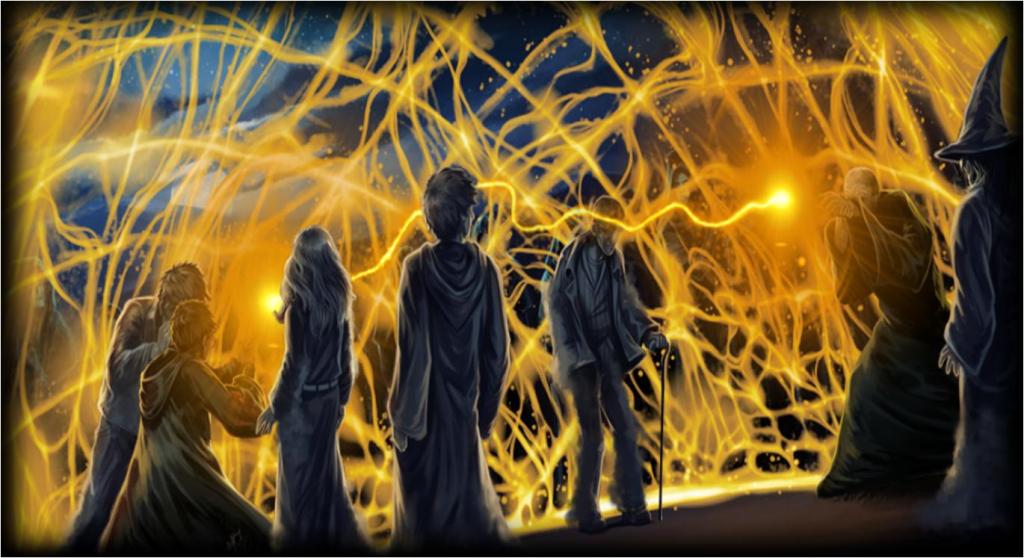
“Your father’s coming. . . .” she said quietly. “Hold on for your father… It will be all right… Hold on…”
It’s as though she doesn’t count; she, the mother, the person who sacrificed her life for her son and thus made him the only known person in wizarding Britain to survive the Avada. Only James counts; we’re waiting for him. Lily speaks quietly, even though, unlike her husband, there’s nothing to hide from Voldemort in what she says. Unlike the movies, the Potter parents do not reunite, they do not come together for Harry… only James. She sacrificed herself for Harry, but she won’t come over for him when James is there? Again, all of those paint a stark contrast to the lively girl we witness in the Prince’s Tale, and to the image of the perfect and saintly Potter family. What happened to her?
Here are some throwaway comments.
First, in the wandlore, Lily’s wand type, willow, denotes “insecurity”.
Willow is an uncommon wand wood with healing power, and I have noted that the ideal owner for a willow wand often has some (usually unwarranted) insecurity, however well they may try and hide it.
It may be suggested that the Jily relationship was one where Lily was in fact insecure and that James conquered her through her « secret » vulnerability. Or worse, that Lily became insecure. She certainly doesn’t look so in the Prince’s Tale (if anything, the insecure one seems to be James).
Second, Lily’s Patronus is a doe whereas James’ Animagus is a stag, species that actually don’t mate together. As explained in Love, not desire!, this fact indicates that James and Lily look like they match but in fact don’t. The dynamic between does and bucks / hinds and stags is also not very romantic, as the males only meet (harass) the females for reproduction while the females attend to the babies between themselves. Finally, it’s quite unhealthy to paint Lily as though she was always destined to be bred by James; as though, again, her only purpose was having him as a husband and giving him an heir.
Three, the very theme that James has “changed” out of love for Lily (which he did not), that if he sexually harassed that was because he loved her, and that Lily has succeeded in “fixing” him… This common 70-90ies trope is the prime example of relationship that’s not just toxic but also dangerous (something that many creeps would want to see re-emerge in our days). The following reeks of rape-apologia:
“And,” said Harry doggedly, determined to say everything that was on his mind now he was here, “he kept looking over at the girls by the lake, hoping they were watching him!”
“Oh, well, he always made a fool of himself whenever Lily was around,” said Sirius, shrugging. “He couldn’t stop himself showing off whenever he got near her.”
But I mean, James is already known as a sexual assaulter, so that’s no surprise.
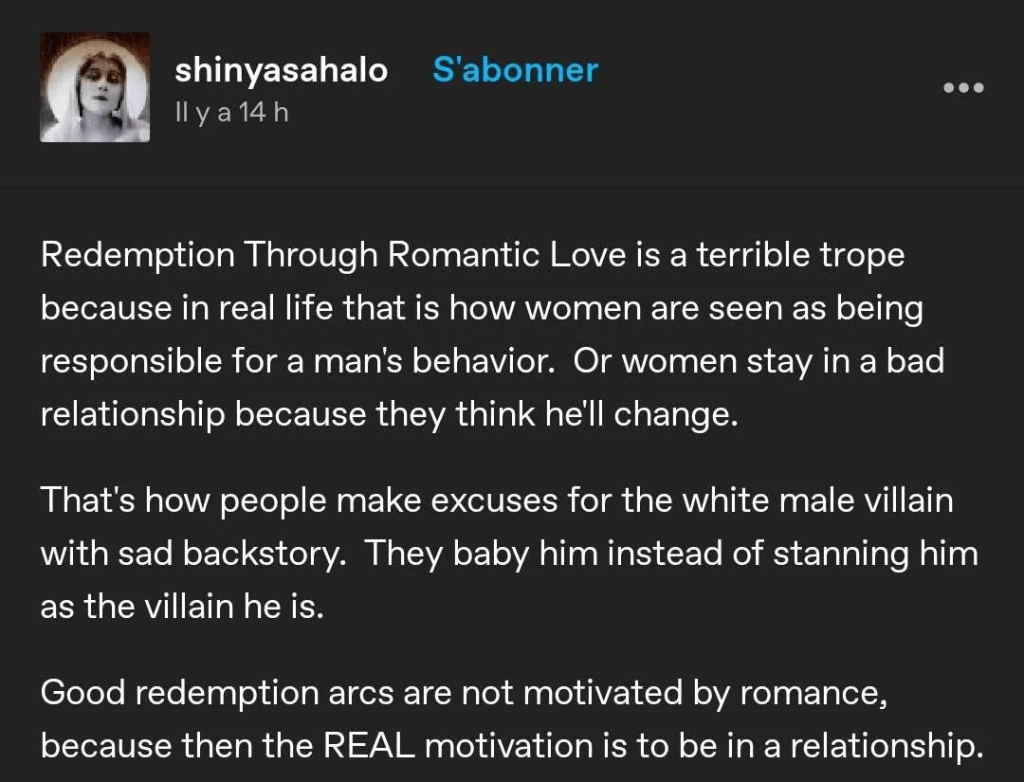
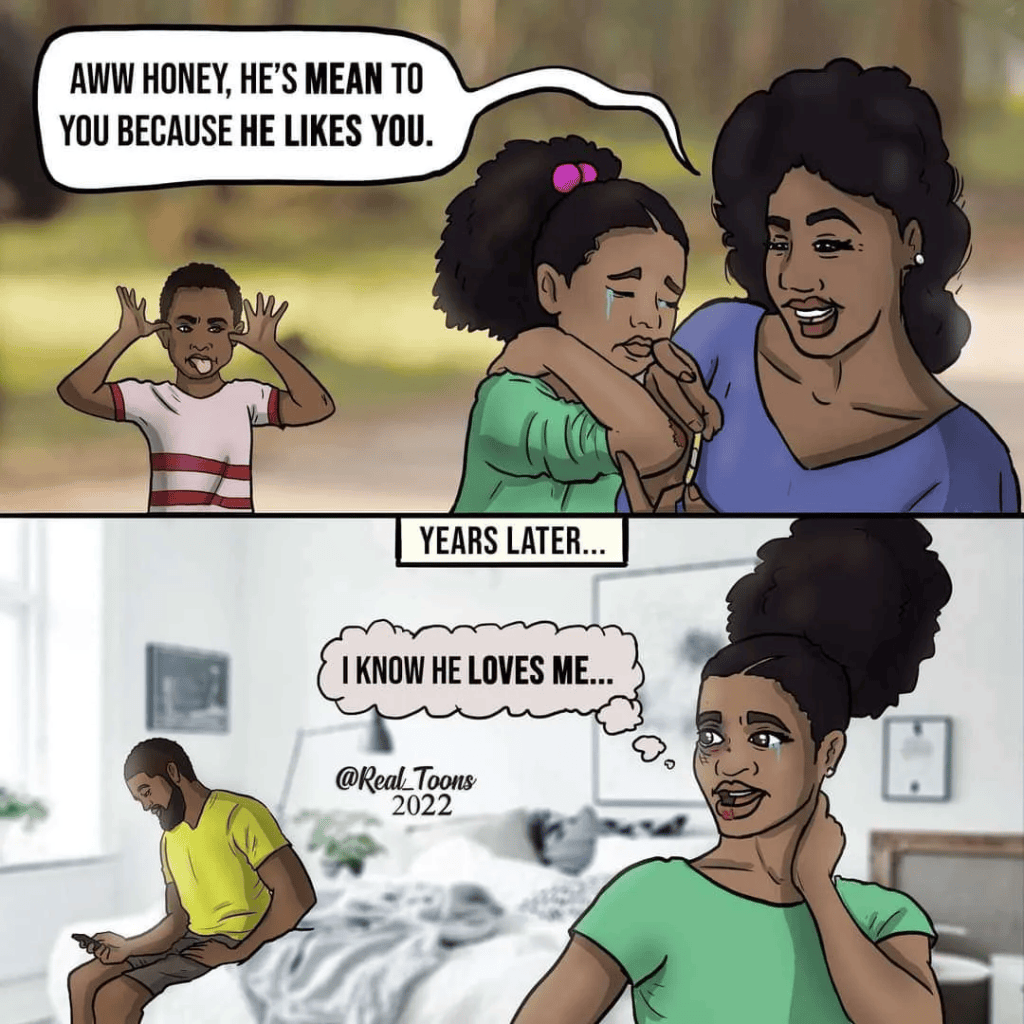
Here’s a thread that summarizes the red flags we listed (and from which I was obviously inspired; emphasis mine):
sayruq:
My definition of a healthy long lasting relationship and JKR’s are different. I hate Molly and Arthur’s relationship, Tonks and Remus are not good imo, Harry and Ginny seems to be some oddly written lust. I’m willing to bet that maybe Jily are twu luv but they’re not the healthy het couple their stans think they are. Lily hated James just as much as she was attracted to him. He asked her out in the worst places (which according to Pottermore he did frequently), he lied to her just to make himself look good, he essentially tricked her into dating him (pretended he wasn’t bullying Snape). Then he fucked up her relationship with Petunia and knowing that even anti Voldemort wizards look down on Muggle, I very very very much doubt it’s because he thought Petunia and Vernon were bigots (how would he know what oppression in the Muggle world looks like). Lily should have been the one to decide if she wanted her sister in her life and she didn’t get to, she actually ended up crying in public.
Lily gets pregnant at 19, gives birth and goes into hiding. She has no friends of her own (the ones that she did have once upon a time weren’t interested in reaching out to the Boy who Lived). Even the surviving Order members had nothing to say about her. Her whole life revolved around Harry and James, her only friends were James’ friends. Someone pointed out many years ago that her letter to Sirius sounds like it was written by a Stepford wife. So either Lily is hiding a lot of resentment or she has no personality left. To me everything about her last years are a red flag and I don’t think JKR intended it that way. Remus left a pregnant Tonks after a rushed wedding and he was called out for it. James used the invisibility cloak to leave the protection of their house, I doubt Lily got to leave. For months. That has to be psychologically damaging.
Anyway, I can’t call them a healthy relationship and imo they would break up but there’s no divorce in JKR’s world so who knows?
raptured-night:
Honestly, I’ve discussed on a few occasions how there were red flags in James and Lily’s relationship and how James as a character displayed traits that played heavily into toxic masculinity. Depending on how kind or how dark you wanted your interpretation to be, one could easily make a case that James was the “bad boy” Lily fell for. Indeed, we could go further and argue that the sheer imbalance of Rowling’s series as far as Harry learning about James the person versus Lily merely existing as a symbol is the result of her isolation. Where James continued to be a person after Lily, we see evidence of how Lily’s social connections and support network began to be whittled away until she was completely reliant upon James and his connections.
Although Snape certainly played his part in the ending of his friendship with Lily and I do not doubt that the same could be said of Petunia the very fact that James is a catalyst in both of those instances is significant. Ultimately, this young woman who was once said to be popular and well-liked while at Hogwarts manages to go from having many friends and trying to preserve her relationship with her sister to apparently only having James and his friends as her adult sources of connection. Even then, as @sayruq observes, James appears able to leave the confinement of Godric’s Hollow via his Invisibility Cloak, whereas Lily appears to fall into the tradition of the confined woman that feminist critics like Susan Gubar and Sandra Gilbert most famously wrote about in their titular Madwoman in the Attic.
This is also why I would genuinely like to see more serious critiques (particularly feminist critiques) of James and Lily that explore more than just the fanon idea of them as an “otp” power couple (who still fall into tropes that, while less scrutinized in the 90s, are more commonly regarded as problematic and anti-feminist in modern discourse, such a the “bad boy” reforming to “win” the symbolic girl of innocence and her love being framed as his prize/reward for allowing her to “tame” him) because there is much of interest there and more than a few suggestions that could point to some very dark cracks in that relationship (e.g. James’ use of deception with Lily, Lily’s isolation potentially as a result of James’ unchecked displays of toxic masculinity, etc.).
https://senlinyu.tumblr.com/post/188271207841/not-got-relateddo-you-think-james-and-lily-would
James Potter & Jorge Arantes
So, James Potter and his romance with Lily were a complete failure. My theory is that something — or someone — else polluted Rowling’s writing: her relationship with Jorge Arantes.
Who is Jorge Arantes? Why do I bring him up here? Let’s see.
According to Wikipedia’s Rowling biography:
Five months after arriving in Porto [she arrived there in November 1991, meaning this happened in April 1992], Rowling met the Portuguese television journalist Jorge Arantes in a bar and found that they shared an interest in Jane Austen. The relationship was troubled, but they married on 16 October 1992 [6 months after their encounter]. Their daughter Jessica Isabel Rowling Arantes (named after Jessica Mitford) was born on 27 July 1993 in Portugal. By this time, Rowling had finished the first three chapters of Harry Potter and the Philosopher’s Stone – almost as they were eventually published – and had drafted the rest of the novel.
Rowling experienced domestic abuse during her marriage. Arantes said in June 2020 that he had slapped her and did not regret it. Rowling described the marriage as « short and catastrophic ». She says she was not allowed to have a house key and that her husband used the growing manuscript of her first book as a hostage.
Rowling and Arantes separated on 17 November 1993 after Arantes threw her out of the house; she returned with the police to retrieve Jessica and her belongings and went into hiding for two weeks before she left Portugal. In late 1993, with a draft of Harry Potter in her suitcase, Rowling moved with her daughter to Edinburgh, Scotland, planning to stay with her sister until Christmas.
[…] Arantes arrived in Scotland in March 1994 seeking both Rowling and Jessica. On 15 March 1994, Rowling sought an action of interdict (order of restraint); the interdict was granted and Arantes returned to Portugal.
Some details by The Standard:
The pair have different accounts of the relationship but agree there had been violence. […]
Mr Arantes told the Sun in 2020 he was “not sorry” for slapping her but added, “there was not sustained abuse”. He said: “Yes. It is true I slapped her. But I didn’t abuse her.” […]
Mr Arantes was a journalist in Portugal and has worked as a television reporter. The Mirror has reported that he had an all-consuming drug habit that spiralled after Ms Rowling left him and he lost his job.
It is understood he is estranged from his daughter and was last known to be living in Paris.
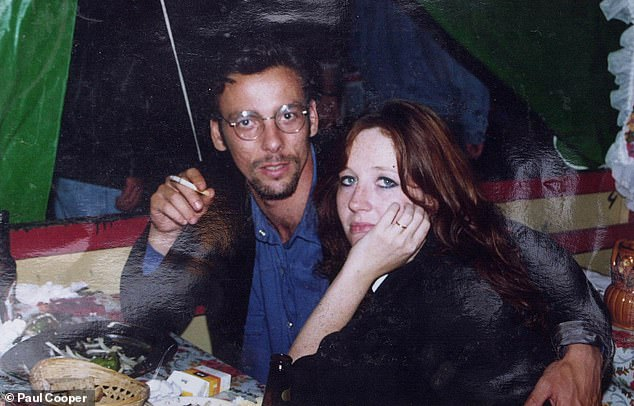
Here is Jorge Arantes with Rowling, and the reason I brought him up in this essay:

Those are basically pictures of James and Lily (and one lady that I’d argue stands as Bathilda Bagshot). I believe that whether or not it was conscious, Rowling has rewritten her failed relationship through James and Lily, but she wanted to imagine it working out even though she wrote every sign that this relationship was doomed from the start:
“Ah, Evans, don’t make me hex you,” said James earnestly. […]
She had clearly loathed James and Harry simply could not understand how they could have ended up married. Once or twice he even wondered whether James had forced her into it…
If we are to understand that James is the unwanted in-world Arantes, then it speaks a lot about him and his relationship with Lily.
Conclusion
If Rowling intended to picture James as redeemed for his school misbehavior and Jily as a desirable romance, she has failed gravely.
Indeed, the few clues we are given point to a toxic relationship, from the very trope that James becomes a better man out of desire for Lily – well, not because he realizes that he was a bad person, but because he wants a chance to date her – implying that if the relationship fails, he will resort to his old behavior, that of a predator.
James’ only acts of kindness are destined to his friends, Sirius and Lupin (taking the former into his home, becoming an Animagus for the latter), but we know those were actually selfish decisions (to live with basically a brother, to have fun with the local werewolf at said werewolf’s expense). James’ saving of Severus was not made out of selflessness but out of a necessity to protect his and his friends’ skin from Sirius’ folly (he quickly follows the Prank with telling Lily that he torments Snape just because he exists, which could be interpreted as suicide-baiting, and certainly expresses how he would love Snape dead).
Then Jily as a relationship starts on lies: James has not, in fact, changed at all, a fact strengthened by Rowling’s semi-canon prequel. Lily marries James and falls pregnant right out of school, but she apparently loses all connection outside of James’ circle… before losing herself; as most clearly portrayed through Priori Incantatem.
Rowling may be a fan of Jane Austen and her novel Pride & Prejudice, she has failed to replicate the trope between Darcy and Elizabeth. Instead, Jily seems to replicate Rowling’s relationship with Jorge Arantes, and we know how that went.
Jily is a failed romance, just like Rowling’s with Arantes has been. James has failed as a character, and Lily herself has been failed. She deserved better.


Your comment: